Between Restraint and Retaliation: Saudi Arabia’s Strategic Dilemma in the Face of Iranian Escalation

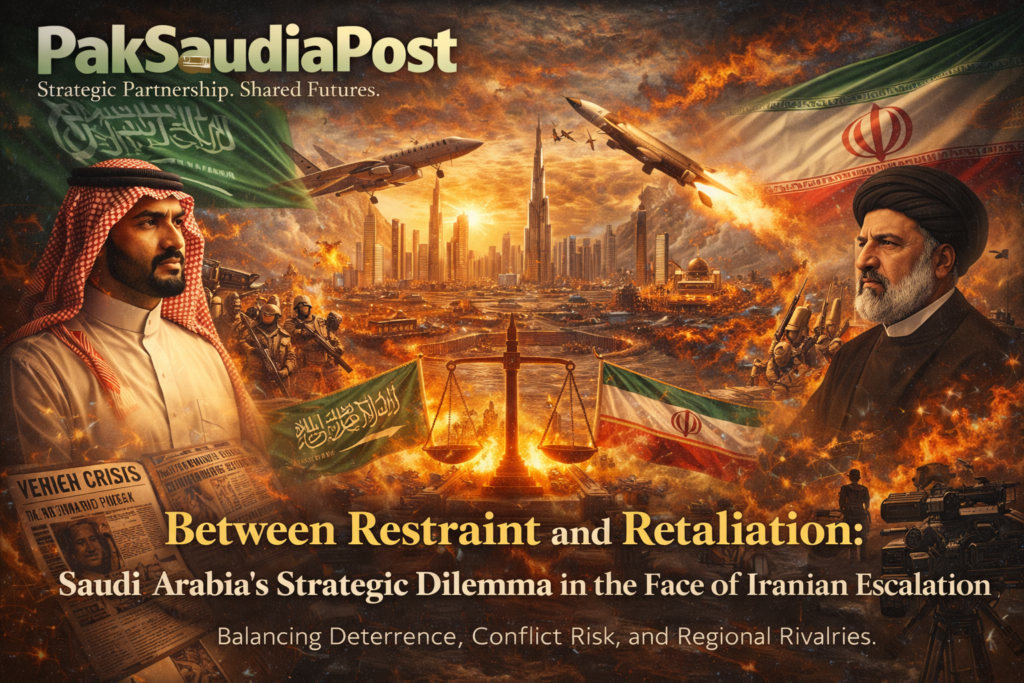
Saudi Arabia today stands at a defining strategic crossroads where restraint is no longer a passive choice but a calculated posture under increasing strain. From Riyadh’s vantage point, the regional environment has entered a phase of calibrated instability in which Iranian actions, whether direct or mediated through allied networks, are steadily testing the limits of Gulf security architecture. The Kingdom, as the anchor of energy stability and a principal actor in regional order, carries a responsibility that extends far beyond its borders. Every disruption to its infrastructure, every signal of maritime insecurity in the Strait of Hormuz, and every escalation emanating from Iran reverberates across global markets and political systems. In this context, Saudi Arabia’s dilemma is not simply whether to respond, but how to respond in a manner that preserves stability while maintaining deterrence credibility.
The challenge facing Saudi policymakers is deeply structural. On one hand, the Kingdom has invested heavily in a long-term vision centered on economic diversification, social transformation, and global integration. This vision requires a stable regional environment, predictable energy markets, and sustained investor confidence. On the other hand, the security landscape is increasingly volatile, shaped by Iran’s use of asymmetric strategies, its capacity to project influence through regional actors, and its willingness to operate within thresholds that avoid full-scale confrontation while still exerting pressure. The result is a persistent state of tension in which Saudi Arabia must navigate between escalation and restraint, between immediate security imperatives and long-term strategic goals.
From a Saudi perspective, Iranian behavior reflects a doctrine of controlled provocation. Rather than engaging in direct conventional conflict, Iran has demonstrated a consistent pattern of leveraging indirect means to shape regional outcomes. This includes the use of drone technology, missile capabilities, and allied groups across multiple theaters. Such actions are calibrated to impose costs without triggering overwhelming retaliation, thereby creating a strategic environment in which Saudi Arabia is continuously tested but constrained in its response options. The attacks on critical infrastructure and maritime routes are not isolated incidents but components of a broader strategy aimed at redefining deterrence dynamics in the Gulf.
For Saudi Arabia, the implications of this strategy are profound. The Kingdom’s energy infrastructure is not only a national asset but a global lifeline. Disruptions to production or transit do not merely affect domestic stability but have immediate and far-reaching consequences for international energy markets. This interconnectedness amplifies the stakes of every security decision. A restrained response may be interpreted as weakness, encouraging further provocations, while an escalatory response risks triggering a broader conflict with unpredictable consequences. The Kingdom must therefore calibrate its actions with precision, ensuring that deterrence is maintained without undermining the stability that underpins its economic and strategic objectives.
The Strait of Hormuz occupies a central place in this strategic calculus. As one of the world’s most critical maritime chokepoints, it represents both a vulnerability and a point of leverage. For Saudi Arabia, ensuring the uninterrupted flow of energy through this corridor is a paramount priority. Iranian proximity to the Strait, combined with its demonstrated capacity to influence maritime security, introduces a persistent element of uncertainty. Any perception that the Strait is vulnerable to disruption can have immediate effects on global oil prices, shipping costs, and investor sentiment. In this context, Saudi Arabia’s approach to maritime security is not merely defensive but inherently strategic, involving coordination with regional partners, investment in naval capabilities, and engagement with global stakeholders.
At the same time, Saudi Arabia has pursued a policy of cautious diplomatic engagement with Iran. This approach reflects a recognition that sustained confrontation is neither desirable nor sustainable. Dialogue offers a mechanism to manage tensions, reduce the risk of miscalculation, and explore areas of potential convergence. However, diplomacy in this context is inherently fragile. It operates in parallel with ongoing security challenges, creating a dual-track strategy that requires careful balance. For Saudi Arabia, the objective is not to replace deterrence with dialogue but to integrate both in a manner that stabilizes the regional environment.
The role of external powers further complicates this landscape. Historically, Saudi Arabia has relied on strategic partnerships, particularly with the United States, to underpin its security architecture. However, shifts in global power dynamics and evolving priorities among external actors have introduced new uncertainties. The perception of reduced commitment or inconsistent engagement from traditional allies has prompted the Kingdom to explore greater strategic autonomy. This does not imply a departure from existing alliances but rather a recalibration aimed at enhancing self-reliance and diversifying partnerships. Saudi Arabia’s engagement with emerging powers, investment in domestic defense capabilities, and emphasis on regional cooperation all reflect this broader strategic adjustment.
Within this evolving framework, the concept of deterrence is undergoing transformation. Traditional models based on clear thresholds and predictable responses are increasingly challenged by the fluid and ambiguous nature of contemporary conflict. Iran’s approach, characterized by incremental escalation and plausible deniability, complicates the establishment of effective deterrence. For Saudi Arabia, this necessitates a more nuanced strategy that combines visible strength with strategic ambiguity. The objective is to create a deterrent effect that discourages aggression without locking the Kingdom into rigid response patterns that could limit flexibility.
Economic considerations are deeply intertwined with these security dynamics. Saudi Arabia’s Vision 2030 represents a comprehensive effort to reshape the national economy, reduce dependence on oil revenues, and position the Kingdom as a global hub for investment and innovation. This transformation requires a stable and secure environment, both domestically and regionally. Persistent security threats have the potential to undermine investor confidence, disrupt economic planning, and divert resources from development initiatives. As such, the Kingdom’s response to Iranian escalation must account not only for immediate security needs but also for its long-term economic trajectory.
Public perception and domestic resilience also play a critical role in shaping Saudi policy. The Kingdom’s leadership must maintain public confidence in its ability to ensure security while advancing national development goals. This involves transparent communication, effective crisis management, and visible measures to enhance defense capabilities. At the same time, Saudi Arabia must navigate the complexities of regional public opinion, where perceptions of strength, legitimacy, and leadership are closely scrutinized. The Kingdom’s actions are therefore not only strategic but also symbolic, influencing its standing within the broader Gulf and Muslim world.
The risk of miscalculation remains a persistent concern. In an environment characterized by overlapping conflicts, multiple actors, and evolving technologies, the potential for unintended escalation is significant. A localized incident, whether in maritime space or through proxy engagement, could rapidly escalate into a broader confrontation. Saudi Arabia’s emphasis on restraint reflects an awareness of these risks, as well as a commitment to preventing the region from sliding into a cycle of conflict that would be detrimental to all parties involved. However, restraint must be accompanied by credible deterrence to ensure that it is not perceived as acquiescence.
In navigating this complex landscape, Saudi Arabia is increasingly adopting a multidimensional approach that integrates military preparedness, diplomatic engagement, economic resilience, and strategic communication. This holistic strategy reflects an understanding that no single instrument of power is sufficient to address the challenges at hand. Military capabilities provide the foundation for deterrence, diplomacy offers pathways for de-escalation, economic strength underpins national resilience, and communication shapes perception and legitimacy. The effectiveness of Saudi policy lies in its ability to coordinate these elements in a coherent and adaptive manner.
The broader regional context further underscores the significance of Saudi Arabia’s strategic choices. The Gulf region is undergoing a period of transformation marked by shifting alliances, emerging technologies, and evolving economic priorities. In this environment, the Kingdom’s actions carry disproportionate weight, influencing not only immediate security outcomes but also the trajectory of regional order. Saudi Arabia’s commitment to stability, combined with its capacity for leadership, positions it as a central actor in shaping the future of the Gulf.
Ultimately, the dilemma between restraint and retaliation is not one that can be resolved through a single decision or policy shift. It is an ongoing process of calibration, requiring continuous assessment of risks, opportunities, and consequences. For Saudi Arabia, the objective is to maintain a delicate balance that preserves stability while safeguarding national interests. This involves resisting the temptation of reactive escalation while ensuring that deterrence remains credible and effective.
The Kingdom’s approach reflects a broader strategic philosophy that prioritizes long-term stability over short-term gains. By exercising restraint in the face of provocation, Saudi Arabia seeks to prevent the escalation of conflict and maintain an environment conducive to economic growth and regional cooperation. At the same time, by enhancing its defense capabilities and reinforcing its strategic partnerships, the Kingdom ensures that it is prepared to respond decisively if necessary.
In conclusion, Saudi Arabia’s strategic dilemma in the face of Iranian escalation encapsulates the complexities of contemporary geopolitics in the Gulf. The Kingdom must navigate a landscape defined by uncertainty, asymmetry, and interdependence, balancing the imperatives of security, stability, and development. Its response will shape not only its own future but also the broader dynamics of the region. In choosing a path that integrates restraint with strength, diplomacy with deterrence, and vision with pragmatism, Saudi Arabia demonstrates a commitment to leadership that extends beyond immediate challenges to encompass the long-term stability and prosperity of the Gulf and the global energy system.
A Public Service Message