

CRITICAL INFRASTRUCTURE RESILIENCE AND SYSTEMIC SHOCK ABSORPTION STRATEGIES

Pakistan and Saudi Arabia are entering a phase in which the stability of state capacity is increasingly defined not by territorial control or conventional deterrence, but by the integrity of interconnected infrastructure systems that underpin modern governance. Energy transmission lines, undersea cables, satellite
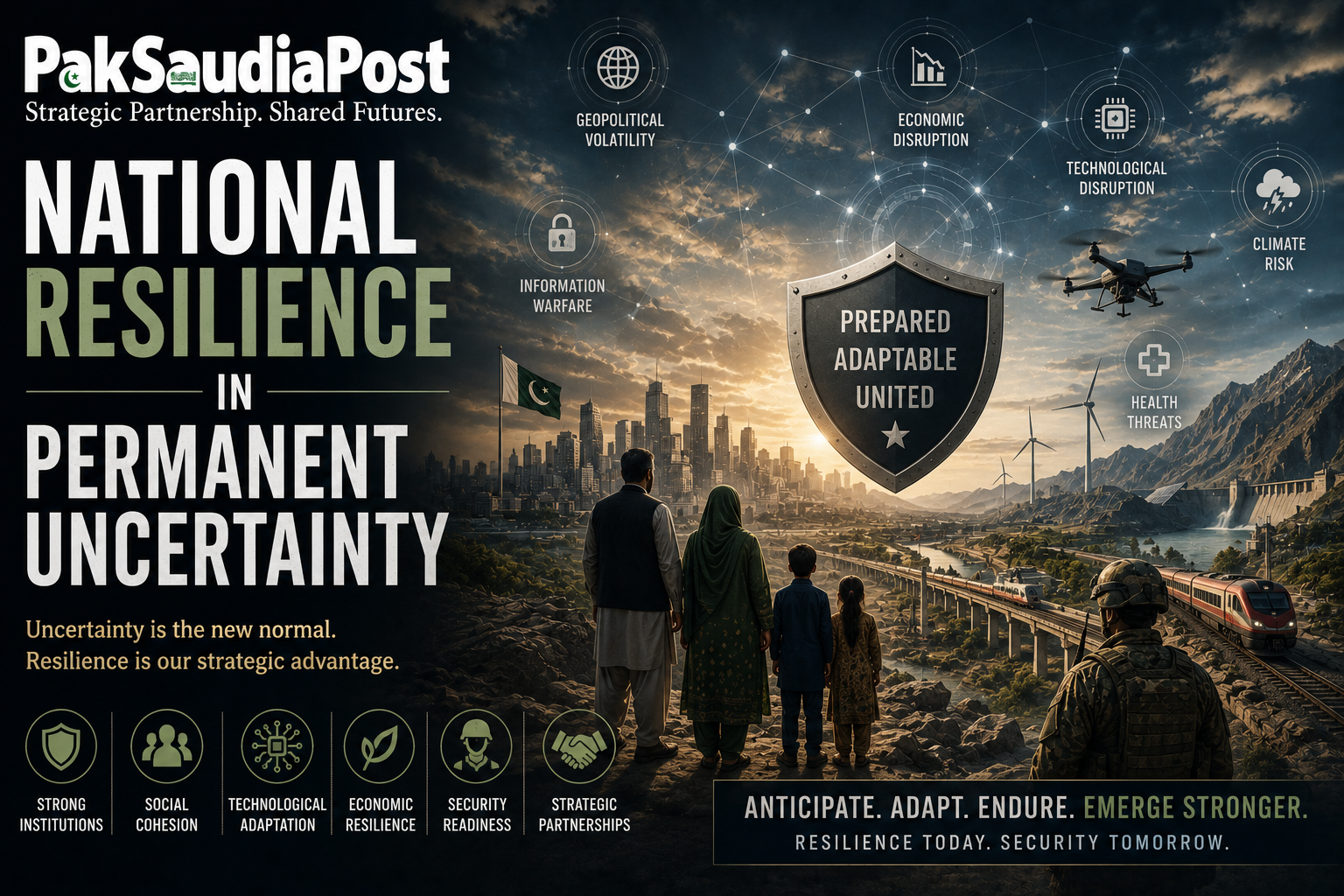
National Resilience in Permanent Uncertainty
Modern state systems are entering an operational environment in which uncertainty has ceased to be episodic and has instead become structurally continuous, altering the foundational assumptions of governance architecture, administrative predictability, and institutional legitimacy. Across multiple regions, but particularly within developing state ecosystems

Sectarian Stability Religious Diplomacy and Pakistan Saudi Statecraft Balance
In the contemporary recalibration of Muslim world geopolitics, the relationship between Pakistan and Saudi Arabia occupies a uniquely sensitive intellectual and strategic space, one that is neither reducible to conventional alliance politics nor fully explainable through doctrinal affinity alone. It is instead a

Remittances at Risk Labor Nationalization Reshapes Pakistan Saudi Migration Flows
The political economy of Pakistan’s external sector has long rested on a paradox of dependence and resilience, where structural vulnerabilities in domestic employment have been offset by the outward migration of labour to the Gulf, particularly Saudi Arabia. For decades, this arrangement functioned

Constrained Neutrality
Pakistan’s aspiration to function as a credible intermediary in regional conflicts is increasingly shaped by a structural condition that can be described as constrained neutrality, a state in which diplomatic positioning is formally autonomous yet substantively conditioned by financial dependence, security entanglements, and

Diaspora Exposure as a Strategic Pressure Lever in Pakistan–Saudi Engagement An Imperative for Policy Paradigm Shift
In the contemporary age of geopolitics the vulnerability of states is rarely confined to overt military confrontation. Rather strategic leverage has evolved into more nuanced instruments encompassing economic interdependence labor mobility financial flows and human security. Nowhere is this more evident than in

The Politics of Omission: Saudi Perspectives on Strategic Silences in Global Media Narratives
From the perspective of Saudi Arabia, understanding the dynamics of international media coverage is inseparable from the imperatives of regional security, energy stability, and strategic influence. The islands of Abu Musa and Greater Tunb, located at the entrance to the Strait of Hormuz,