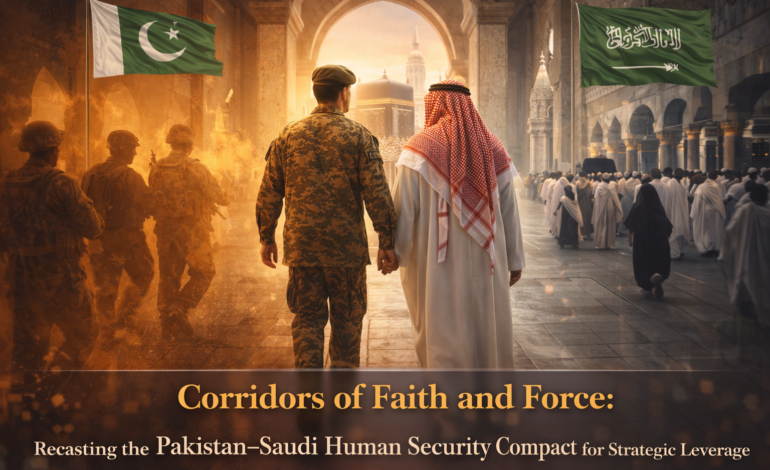
Thresholds of Alignment: Navigating Pakistan–Saudi Strategic Convergence Amid Regional Volatility

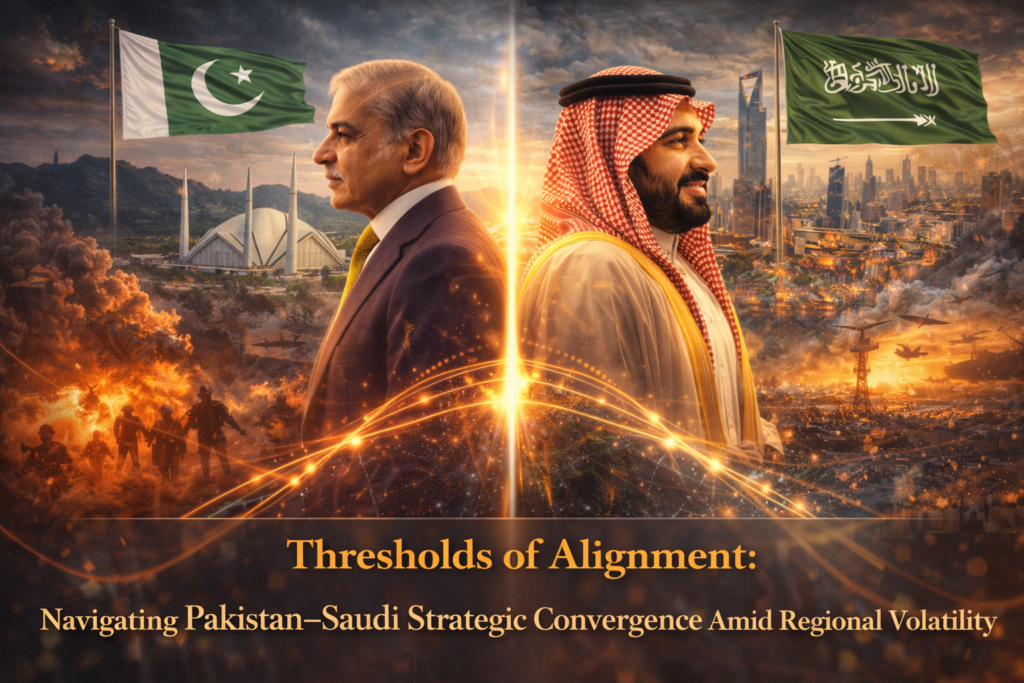
The contemporary strategic environment is increasingly characterized by rapid volatility, asymmetric threats, and fluid alliances. In this context, the bilateral nexus between Pakistan and Saudi Arabia is entering a phase where micro decisions carry macro consequences. Beyond formal treaties, economic cooperation, and military exchanges, the operational reality is defined by timing, procedural nuances, and signaling modalities. Even marginal deviations in execution or delay in articulation can generate cascading effects across economic, diplomatic, and security domains, exposing the relationship to structural stress.
The prolonged destabilization in the Gulf, amplified by the ongoing Iran conflict, has introduced new vectors of complexity. Pakistan’s strategic calculus is now constrained by competing imperatives: the need to preserve regional credibility with Saudi Arabia, the imperative to safeguard national economic resilience, and the obligation to maintain a modicum of balance in broader regional alignments. Each decision, from the timing of statements to the structuring of financial obligations and energy transactions, must be understood as a variable with disproportionate impact.
Energy provisioning exemplifies this phenomenon. Pakistan’s reliance on Saudi hydrocarbons and preferential energy agreements places it in a position of conditional leverage. Adjustments to payment schedules, contract terms, or supply volumes, while operationally minor, possess the potential to amplify economic volatility. Even marginal delays in energy settlement or the recalibration of delivery obligations could precipitate immediate consequences for foreign exchange reserves, industrial continuity, and fiscal stability. Consequently, energy management is no longer purely transactional but a strategic instrument whose precision directly affects diplomatic credibility.
Similarly, regulatory frameworks governing human mobility and labor deployment represent a latent pressure point. The Pakistani workforce in Saudi Arabia is a critical economic lever, contributing significantly to remittance inflows and by extension, to macroeconomic stability. Minor adjustments in visa regimes, employment quotas, or sectoral restrictions can trigger disproportionate economic repercussions and signal underlying friction in bilateral engagement. The effective governance of these mechanisms is therefore a matter of strategic urgency, requiring real time policy agility and institutional foresight.
Military signaling constitutes an equally sensitive vector. Pakistan’s historical cooperation with Saudi defense structures is robust yet operates under constraints of discretion and proportionality. In a region where perception often equals reality, even minimal visible alignmentsuch as joint exercises, advisory dispatches, or logistics facilitationcan be amplified by domestic and regional actors. Poorly calibrated signals risk inflaming adversarial narratives, provoking retaliatory postures, or constraining Pakistan’s future diplomatic maneuverability. The challenge lies in creating a dual-layer signaling framework that conveys commitment while maintaining operational flexibility.
Timing, in this framework, emerges as a defining strategic parameter. Public statements, bilateral communications, and formal engagements must be synchronized with the temporal expectations of Riyadh. Delay or ambiguity is no longer benign; it is interpreted as strategic hesitation, potentially eroding trust, recalibrating influence, and undermining high-stakes coordination. Pakistan’s strategic credibility in the Gulf now hinges not only on policy substance but on executional alacrity, where hours, not weeks, determine the trajectory of engagement.
Economic contingencies further exacerbate the stakes. The ongoing Iran conflict introduces volatility in global oil markets, regional trade corridors, and financial liquidity. Pakistan’s exposure to these systemic shocks is amplified by its dependence on external inflows for both energy and fiscal stability. Each minor policy misalignmentwhether in tariff regulation, remittance facilitation, or import financinghas the potential to magnify macroeconomic vulnerability. Policy precision must therefore extend beyond formal agreements to continuous operational calibration, ensuring that strategic alignment with Saudi Arabia does not create structural overexposure.
The multidimensional nature of these pressures underscores the necessity of an integrated strategic governance framework. Pakistan must establish real time decision nodes capable of synchronizing diplomatic messaging, financial management, human mobility oversight, and defense signaling. Each node must function with autonomy yet remain interoperable within a central strategic architecture. Failure to achieve such coherence risks transforming micro-operational discrepancies into systemic strategic liabilities.
Furthermore, predictive assessment is indispensable. The persistence of Iran-related hostilities implies that Pakistan’s alignment calculus cannot be static. Scenario planning, contingent operational protocols, and anticipatory signaling strategies are critical to maintaining equilibrium. Pakistan’s capacity to anticipate Saudi expectations, manage internal constraints, and calibrate external perceptions will determine whether alignment strengthens strategic partnership or generates unintended vulnerability.
In conclusion, the Pakistan–Saudi relationship in the current geopolitical moment cannot be analyzed through the lens of conventional bilateral diplomacy alone. The emerging risk matrix is defined by micro-level operational variablestiming, regulatory adjustments, financial structuring, and signaling opticsthat possess macro-level consequences. Pakistan’s challenge is to pivot from declaratory policy toward executional mastery, synchronizing strategic commitments with economic resilience and diplomatic foresight.
Failure to operationalize this precision risks eroding trust, amplifying vulnerability, and constraining Pakistan’s regional agency. Conversely, mastering these thresholds offers an unprecedented opportunity: to consolidate strategic alignment with Saudi Arabia, enhance credibility in the Gulf, and transform latent vulnerabilities into operational leverage. In an era where hours can redefine alliances, Pakistan must treat every micro decision as a determinant of macro-outcome.
A Public Service Message