

Digital Sovereignty and the Architecture of State Power

Digital sovereignty has moved from an abstract policy expression into a concrete measure of state capability. It now defines how governments store and process data, how citizens are identified across systems, how financial transactions are authenticated, and how critical decisions are increasingly mediated

Artificial Intelligence and Emerging Development Divide Risks

Across the global economy, artificial intelligence has moved beyond a frontier technology into a foundational layer of productivity, governance, and national competitiveness. Its influence is no longer confined to experimental laboratories or digital firms; it is increasingly embedded in public administration systems, financial

QUANTUM COMPUTING AND THE STRATEGIC SECRECY PARADIGM SHIFT
The accelerating maturation of quantum computing is introducing a structural rupture in the long-established architecture of strategic secrecy, where encryption, interception, and information asymmetry have historically underwritten the balance of power among states. Unlike incremental advancements in classical computation, quantum systems operate on

ARTIFICIAL INTELLIGENCE AND THE STATE ARCHITECTURE OF AUTHORITY
The accelerating incorporation of artificial intelligence into the operational core of statecraft is no longer a peripheral modernization exercise but an institutional reconfiguration of authority itself, reshaping how governments perceive, process, and act upon societal complexity. Across contemporary governance systems, algorithmic infrastructures are

Cybersecurity Deepens Pakistan Saudi Strategic Digital Defense Cooperation
The contemporary strategic environment is undergoing a profound mutation in which the traditional boundaries between war and peace, civilian infrastructure and military capability, and information and influence have become increasingly indistinguishable. Cybersecurity has emerged not merely as a technical discipline but as a
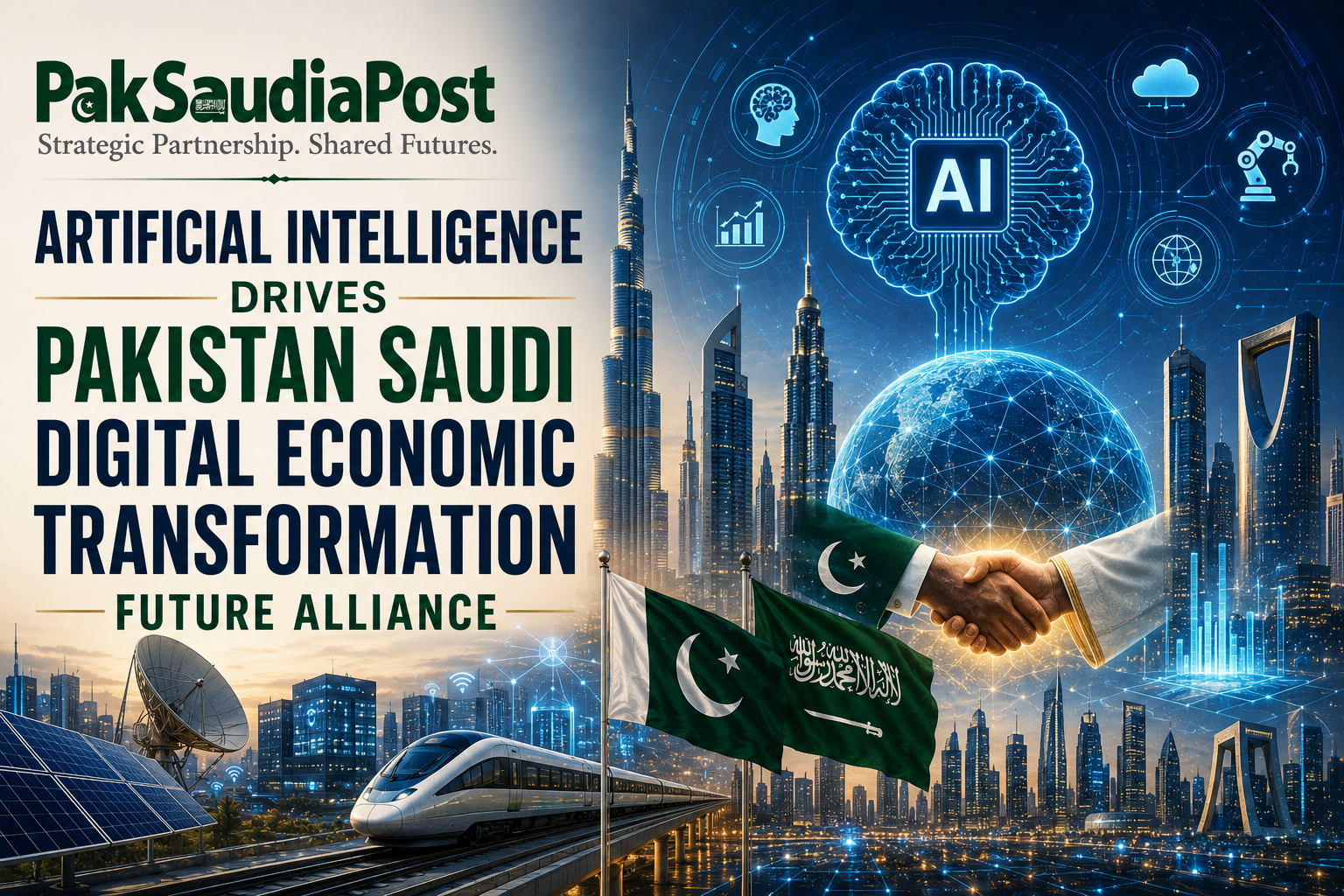
Artificial Intelligence Drives Pakistan Saudi Digital Economic Transformation Future Alliance
Artificial intelligence is no longer a distant technological abstraction reserved for advanced economies; it has become an operational grammar of state power, economic restructuring, and geopolitical reorientation. Across the Gulf region, and particularly within Saudi Arabia’s accelerating Vision 2030 framework, AI is being

AI Cybersecurity Sovereignty Pakistan Saudi Digital Axis
The accelerating convergence of artificial intelligence, cybersecurity, and data governance is reshaping the architecture of sovereignty in the twenty first century. Traditional notions of territorial control are increasingly insufficient to describe a world where critical infrastructure, financial systems, public communication networks, and even

Smart Deserts Cities Saudi Model Pakistan Urban Lessons
Urban transformation in the twenty first century is no longer a question of physical expansion alone but of informational density, algorithmic governance, and infrastructural intelligence. Cities are being reimagined as computational systems where mobility, energy, security, housing, and public services are increasingly mediated

From Oil Algorithms Saudi Tech Capital Scaling Pakistan Digital Economy
The global economy is undergoing a structural mutation in which capital is no longer defined solely by ownership of physical assets or extraction industries but increasingly by control over data flows, computational infrastructure, artificial intelligence systems, and platform ecosystems. In this emerging order,

Desert Innovation and the Transnationalisation of Vision 2030 Ecosystems Between Riyadh and Islamabad

The contemporary global political economy is undergoing a profound transformation in which innovation ecosystems are no longer geographically bounded phenomena but transnationalised structures of technological production, capital circulation, and epistemic influence. Within this shifting order, Saudi Arabia’s Vision 2030 stands as one of