

Between Universalism and Civilizational Retrenchment: Pakistan–Saudi Arabia and the Search for a Shared Metaphysical Horizon

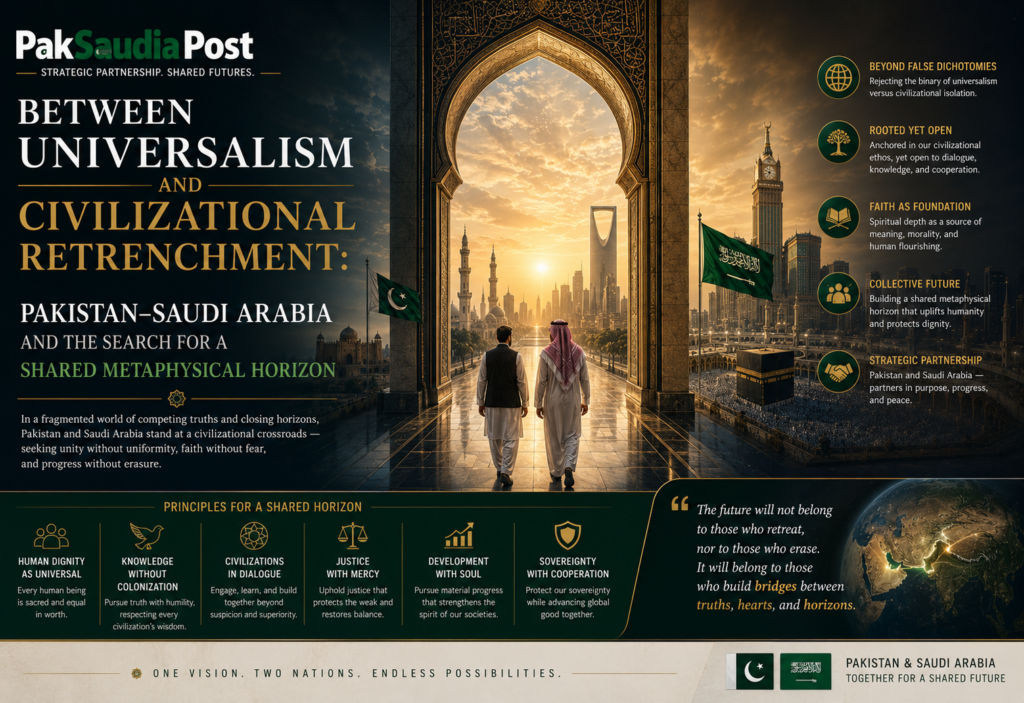
To speak of Pakistan and Saudi Arabia within the tension of universalism and civilizational retrenchment is to enter a domain where geopolitics becomes only the visible surface of a far deeper philosophical question. How does a civilization preserve its inner metaphysical coherence while participating in a world that increasingly demands universal forms of governance, ethics, economy, and meaning? And how does universalism avoid becoming a silent force of erasure, dissolving the very civilizational depths it claims to include within its moral horizon?
Pakistan and Saudi Arabia are not merely nation states connected through strategic, economic, and religious ties. They are two distinct civilizational expressions within the broader Islamic metaphysical universe. Each carries a different rhythm of memory, authority, and transformation. Saudi Arabia is undergoing a rapid and state directed reinvention, a deliberate reconfiguration of economy, society, and symbolic identity under the pressure of global modernity. Pakistan, by contrast, exists in a more fractured historical temporality where postcolonial state formation, inherited civilizational memory, and developmental instability intersect in a continuous state of negotiation. Yet both remain bound to a shared metaphysical inheritance that precedes the modern state and exceeds the categories of contemporary political analysis.
Universalism in its modern articulation often arrives through global governance systems, technological rationality, financial integration, and human rights discourse. It presents itself as neutral and universal, as though it were the natural language of progress itself. Yet beneath this apparent neutrality lies a deeper philosophical assumption, that human flourishing can be standardized, measured, and optimized across all cultural and metaphysical contexts. Utilitarian logic often supports this assumption by translating moral complexity into calculable outcomes, where well being becomes an aggregate and suffering becomes a variable in policy design.
For Pakistan and Saudi Arabia, universalism is not only an external structure imposed from outside. It is also an internal aspiration. Both states seek global legitimacy, economic modernization, technological advancement, and institutional efficiency. Saudi Arabia’s transformation agenda reflects a conscious effort to enter the grammar of global modernity not as a passive recipient but as an active architect of regional centrality. Pakistan’s developmental trajectory similarly seeks inclusion within global financial systems, digital economies, and transnational knowledge networks. Yet universalism does not arrive as a neutral instrument. It arrives as a force that reorganizes internal civilizational coherence, often subtly and gradually.
Civilizational retrenchment emerges when this universalizing pressure begins to threaten symbolic continuity. It is not merely political resistance or cultural conservatism. It is a metaphysical reflex of self preservation. In Saudi Arabia, retrenchment appears as a selective reassertion of identity within modernization, a careful recalibration of religious, cultural, and historical symbols within a rapidly transforming public sphere. In Pakistan, retrenchment often appears as an anxious reaffirmation of ideological and cultural boundaries in response to perceived external cultural pressures and internal institutional fragmentation.
Between universalism and retrenchment lies not a simple contradiction but a structural tension that defines the contemporary condition of both societies.
Utilitarianism, when applied to governance in this context, operates like a vast computational wind moving across civilizational landscapes. It asks which policies maximize welfare, stability, economic growth, and security. Yet it rarely asks what kind of human interiority is produced in the pursuit of these metrics. Infrastructure, cities, digital systems, and economic reforms can all be justified through utilitarian reasoning. However, neither Pakistan nor Saudi Arabia can be understood solely as optimization systems. They are also repositories of sacred memory, linguistic inheritance, ethical imagination, and historical consciousness.
Within Islamic metaphysical tradition, the human being is not merely an agent of preference satisfaction but a bearer of trust. This introduces a fundamental philosophical tension with utilitarian modernity. Where utilitarianism asks what produces the greatest happiness, the metaphysical tradition asks what aligns human life with truth, justice, and divine order. These questions may intersect at times, but they are not identical. A society may reduce suffering while simultaneously thinning the depth of meaning that sustains it.
Pakistan and Saudi Arabia each embody this tension in distinct ways. Saudi Arabia pursues rapid modernization at scale, expanding institutional capacity and economic diversification at unprecedented speed, while simultaneously negotiating the depth of its symbolic and religious foundations. Pakistan retains a strong civilizational and ideological self-understanding, yet struggles to translate this depth into stable institutional and developmental coherence. One risks acceleration without metaphysical anchoring, while the other risks depth without structural consolidation.
Universalism, in its operational form, tends to encourage convergence toward standardized systems. These include governance metrics, legal frameworks, technological infrastructures, and economic models. Yet civilizations do not fully converge. They translate. They reinterpret. They adapt external forms into internal grammars. The Islamic world, particularly through Pakistan and Saudi Arabia, demonstrates that universal systems always arrive through interpretation rather than pure adoption.
One may imagine this relationship through a metaphor. Universalism is like an ocean that appears uniform, while civilizations are river systems carrying distinct sediments into it. Civilizational retrenchment is not refusal of flow but insistence on remembering origin while entering larger currents. The danger arises when rivers forget they are rivers and begin to imagine themselves as only waves within the ocean.
The Pakistan Saudi relationship can therefore be read as more than strategic cooperation. It is a civilizational dialogue between two modes of negotiating modernity within a shared metaphysical horizon. Saudi Arabia increasingly expresses a state centered universal modernization embedded within Islamic legitimacy. Pakistan expresses a more plural and contested negotiation between ideological identity, postcolonial institutional fragility, and global developmental pressures. Their convergence is not only political or economic. It is philosophical, even if not always explicitly articulated.
Utilitarian governance frameworks evaluate such relations in terms of investment flows, security coordination, labor markets, and regional stability. Yet beneath these measurable categories lies a deeper question. Can two civilizations undergoing different intensities of transformation sustain a shared metaphysical coherence without collapsing into homogenization or fragmentation?
Universalism assumes coherence through standardization. Civilizational thought suggests coherence through resonance. Standardization reduces difference, while resonance harmonizes difference without erasing it. Pakistan and Saudi Arabia, in their strongest potential alignment, represent not the merging of identities but the synchronization of distinct civilizational frequencies.
Modernity complicates this possibility through acceleration. Technological change, global communication, and financial interdependence compress time itself. Civilizational memory, once extended over centuries, is now required to respond within policy cycles. In such a compressed temporality, utilitarian logic becomes dominant because it produces immediate feedback through measurable outcomes. Metaphysical meaning, by contrast, unfolds slowly, often invisibly, like geological formation beneath visible structures.
Both Pakistan and Saudi Arabia therefore face a shared philosophical dilemma. How can they remain civilizational meaningful in a world that rewards only what is immediately measurable? This is not a conflict between tradition and modernity in a simplistic sense. It is a deeper tension between depth and abstraction.
Civilizational retrenchment should not be interpreted as rejection of modernity. It is an attempt to preserve meaning from dissolution within pure functionality. In Saudi Arabia, this takes the form of carefully curated transformation within Islamic symbolic continuity. In Pakistan, it appears as repeated attempts to anchor national identity within ideological and historical narratives that resist complete absorption into global categories.
Universalism continues to expand as the dominant grammar of global order. It operates through development indices, human rights frameworks, climate governance, digital regulation, and financial architecture. It is not inherently hostile to civilizational meaning, but it is structurally indifferent to it unless meaning is translated into its own operational language.
The philosophical challenge for Pakistan and Saudi Arabia is therefore not rejection of universalism but its metabolization. Metabolization is different from absorption. Absorption erases distinction, while metabolization transforms external input into internal coherence without losing identity.
Utilitarianism, if reinterpreted with philosophical sensitivity, may serve as a transitional instrument rather than an ultimate horizon. It can reduce suffering and improve material conditions, yet it cannot define ultimate meaning. Meaning remains a civilizational and metaphysical task, not a computational outcome.
At a deeper level, both Pakistan and Saudi Arabia are engaged in a recalibration of time itself. Saudi Arabia accelerates toward a future oriented modernity while attempting to preserve sacred continuity. Pakistan oscillates between inherited past, unstable present, and aspirational future. Universalism pulls both toward synchronization with global temporal rhythms, while civilizational retrenchment pulls them toward continuity with sacred and historical time.
These temporal tensions are not anomalies. They are the condition of contemporary civilization.
Civilizations do not survive by eliminating tension. They survive by transforming tension into form. The Pakistan Saudi philosophical relationship within universalism and utilitarianism is therefore not a problem to be solved but a condition to be inhabited. Both must continue to ask whether human flourishing is merely the optimization of life conditions or the alignment of life with meaning that exceeds calculation.
If the modern world is a system of visible structures, then civilizations are its invisible foundations. Universalism constructs the visible architecture, while civilizational memory sustains the underlying ground. Without the first, order collapses. Without the second, meaning evaporates.
Within this unfolding horizon, Pakistan and Saudi Arabia are not peripheral actors. They are co participants in a deeper civilizational question. Whether it is possible to enter universality without losing particularity, and whether it is possible to preserve particularity without denying universality. The answer remains open, not because it is unknown, but because it is still being formed within the lived movement of history itself.
A Public Service Message


