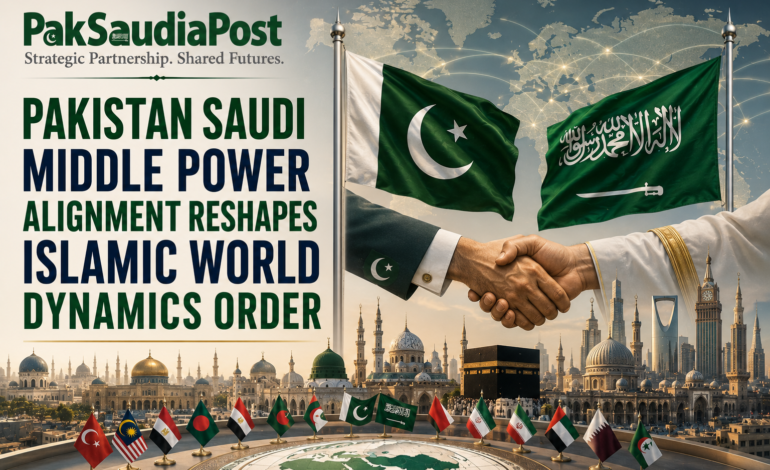
Pakistan Saudi Middle Power Alignment Reshapes Islamic World Dynamics Order

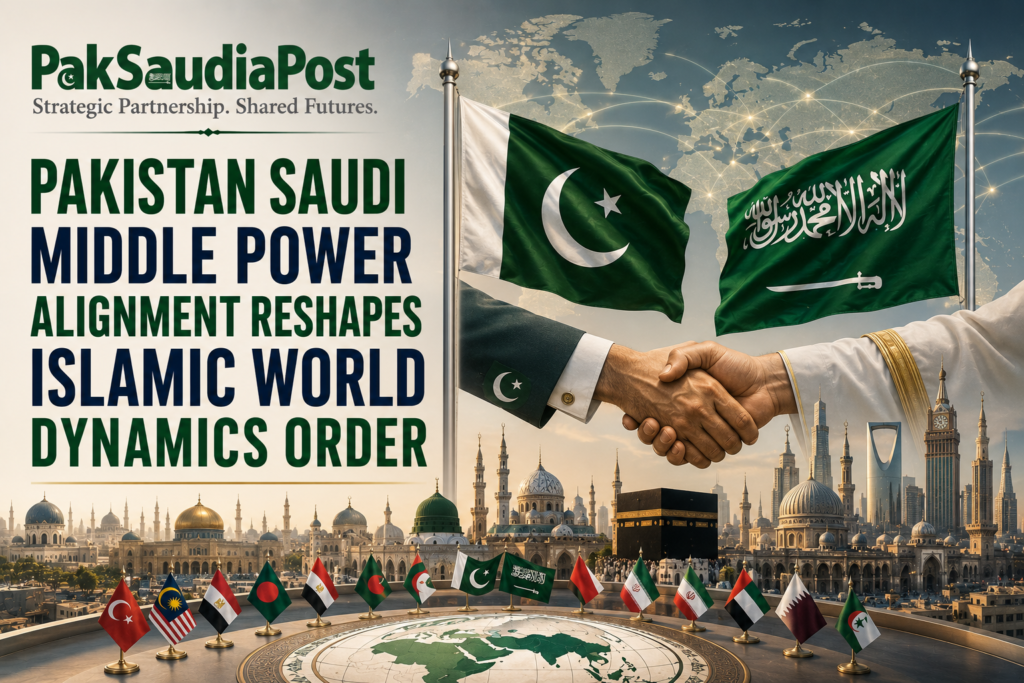
In the evolving geometry of global power, where traditional hierarchies are dissolving into fluid constellations of influence, the relationship between Pakistan and Saudi Arabia is increasingly being reinterpreted not merely as a bilateral partnership but as a potential axis of middle power coordination within the Islamic world. This conceptual shift is neither accidental nor rhetorical. It emerges from structural pressures in global politics, where great power rivalry, economic fragmentation, and regional instability have created a vacuum in which mid-tier states are compelled to assume responsibilities once monopolized by superpowers.
Within this emerging context, Pakistan and Saudi Arabia are gradually repositioning themselves as co-anchors of stability, each bringing distinct but complementary forms of leverage. Saudi Arabia, endowed with vast financial capital, religious centrality, and growing diplomatic assertiveness under its economic transformation agenda, is seeking to diversify its strategic dependencies beyond traditional Western security guarantees. Pakistan, with its demographic weight, nuclear capability, geographic centrality, and deep entanglement in South Asian and Middle Eastern security architectures, offers a different form of strategic utility grounded in operational depth rather than financial abundance.
The convergence of these two trajectories suggests the possibility of an informal but increasingly structured middle power alignment. Such an alignment would not resemble a formal alliance system in the classical sense, nor would it replicate Cold War style bloc politics. Instead, it would function as a distributed network of coordinated diplomatic, economic, and normative interventions designed to manage instability across overlapping regions of interest, including the Gulf, the Levant, and South Asia.
At the core of this emerging architecture lies the principle of strategic neutrality, not as passive non alignment, but as active calibrated engagement. Both states, despite their differing external relationships, have demonstrated an increasing willingness to avoid rigid ideological entrapments in favor of pragmatic issue based cooperation. This is particularly evident in their approach to regional conflicts, where both have often favored de escalation, mediation, and humanitarian engagement over direct military entanglement.
Yet the deeper significance of this alignment lies not only in external behavior but in internal reconfiguration. In Pakistan, the evolving relationship with Saudi Arabia intersects directly with questions of national identity, economic survival, and civil military equilibrium. Saudi financial support, labor migration networks, and investment flows are not merely economic variables; they are embedded within the domestic political economy of legitimacy. They influence how ruling elites construct narratives of stability, how religious institutions interpret international alignment, and how the broader public perceives Pakistan’s place within the Islamic world.
This produces a complex duality. On one hand, Saudi engagement reinforces Pakistan’s Islamic identity narrative, providing symbolic and material validation of its civilizational positioning. On the other hand, it raises persistent concerns about asymmetry, dependency, and strategic autonomy. These tensions are not static; they evolve in response to shifting global conditions, particularly as Pakistan seeks diversified partnerships with China, Gulf states, and emerging Eurasian economic frameworks.
Saudi Arabia, in parallel, is undergoing its own transformation. The diversification agenda associated with its long term economic restructuring has necessitated a recalibration of foreign policy instruments. Investment driven diplomacy, sovereign wealth expansion, and regional mediation efforts are increasingly replacing older security centric paradigms. In this context, Pakistan represents not only a labor and security partner but also a strategic node in broader Islamic world connectivity, linking the Gulf to Central and South Asia.
The idea of middle power diplomacy, therefore, must be understood not as a static category but as a dynamic performance of influence. It is characterized by selective engagement in global governance issues, targeted mediation in regional conflicts, and the capacity to shape agenda setting within multilateral forums. Pakistan and Saudi Arabia, when viewed through this lens, are not aspiring to global dominance but to regional stabilization authority.
However, this aspiration is constrained by structural asymmetries. Economic disparities between the two states remain significant, and their strategic priorities do not always converge. Pakistan’s security concerns are deeply entangled with South Asian rivalries, particularly its enduring competition with India, while Saudi Arabia’s strategic horizon is increasingly shaped by Gulf security dynamics, Iran relations, and global energy transitions. These divergences necessitate a carefully calibrated framework of cooperation that avoids overextension while maximizing functional overlap.
A central pillar of this framework is economic interdependence. Remittance flows from Pakistani labor in Saudi Arabia constitute a critical stabilizer of Pakistan’s external accounts, while Saudi investment potential offers long term opportunities for infrastructure development, energy security, and industrial modernization. Yet this interdependence is not without friction. It generates structural dependencies that must be managed through institutional diversification and domestic economic reform within Pakistan.
Another pillar is defense and security cooperation. While not formalized into an alliance structure, existing patterns of training, advisory exchange, and limited defense collaboration suggest a latent framework of security convergence. This is particularly relevant in the context of counterterrorism, maritime security, and regional crisis response. Nevertheless, both states have been cautious to avoid entanglement in each other’s regional conflicts, reflecting a shared preference for strategic flexibility over rigid alignment.
Diplomatic coordination represents a third pillar. Pakistan and Saudi Arabia have increasingly engaged in parallel diplomatic efforts within Islamic multilateral institutions, humanitarian initiatives, and regional conflict mediation processes. This includes efforts to stabilize conflict zones, facilitate prisoner exchanges, and support humanitarian relief operations. Such activities, while often understated, contribute to a gradual accumulation of diplomatic capital that reinforces their middle power identity.
Yet perhaps the most transformative dimension of this evolving relationship lies in its domestic political implications. In Pakistan, the narrative of Saudi partnership is deeply embedded within religious sentiment, historical memory, and socio economic aspiration. It is frequently invoked in political discourse as a symbol of Islamic solidarity and economic lifeline. However, this narrative is also contested within segments of civil society and policy circles that emphasize strategic autonomy and diversified foreign relations.
This tension reflects a broader epistemic struggle over Pakistan’s identity in the international system. Is it primarily an Islamic world anchor state, a South Asian security actor, or an emerging Eurasian economic participant? The Saudi dimension does not resolve this question but rather complicates it, adding another layer of strategic positioning that must be managed through careful policy calibration.
Media ecosystems further amplify these dynamics. Digital platforms, transnational news flows, and religious discourse networks play a significant role in shaping public perception of Pakistan Saudi relations. Positive narratives often emphasize solidarity, economic opportunity, and shared religious identity, while critical narratives highlight dependency, asymmetry, and strategic overreliance. This duality underscores the importance of narrative governance as an integral component of foreign policy.
From a policy perspective, the evolution of Pakistan Saudi middle power coordination requires institutionalization beyond ad hoc engagement. This includes the development of structured dialogue mechanisms, joint economic planning frameworks, and coordinated crisis response protocols. It also requires investment in epistemic infrastructure, including think tanks, academic exchange programs, and policy research networks capable of sustaining long term strategic thinking.
Equally important is the need for internal economic reform within Pakistan to reduce vulnerability to external shocks and dependency cycles. Without domestic structural strengthening, external partnerships risk reinforcing asymmetrical dependencies rather than enabling balanced cooperation. Saudi investment, while significant, must therefore be integrated into a broader framework of industrial diversification, human capital development, and technological upgrading.
For Saudi Arabia, the challenge lies in balancing global investment ambitions with regional strategic commitments. Its engagement with Pakistan must be situated within a broader recalibration of its foreign policy architecture, which seeks to diversify partnerships while maintaining stability in its immediate neighborhood. Pakistan offers both opportunity and complexity in this regard, requiring sustained diplomatic attention and institutional continuity.
The broader geopolitical environment will ultimately determine the trajectory of this emerging alignment. As global power becomes increasingly fragmented, with competing economic blocs and shifting security architectures, middle powers are likely to assume greater responsibility in managing regional order. Pakistan and Saudi Arabia, if able to institutionalize their cooperation effectively, may emerge as significant contributors to stability within the Islamic world.
However, this outcome is not predetermined. It depends on the ability of both states to navigate internal constraints, manage asymmetries, and resist the temptation of short term transactionalism. Middle power status is not declared; it is constructed through sustained institutional practice, diplomatic credibility, and strategic consistency.
In conclusion, the evolving Pakistan Saudi relationship represents more than bilateral cooperation. It reflects a broader transformation in the architecture of Islamic world politics, where middle powers are increasingly called upon to fill governance gaps left by retreating or overextended great powers. Whether this potential is realized will depend on the capacity of both states to translate convergence into durable institutional frameworks, and to align domestic political economies with external strategic ambitions. The stakes are not merely diplomatic; they are structural, shaping the contours of regional order in a fragmented global era.
A Public Service Message