Pakistan Saudi Institutional Architecture Rebuilds Long Term Strategic Depth

The evolution of Pakistan and Saudi Arabia’s relationship has increasingly moved beyond ceremonial diplomacy and episodic financial cooperation toward a more structurally embedded institutional imagination. What is now emerging, though still uneven and partially articulated, is a recognition in both capitals that sustainable partnership cannot remain hostage to transactional cycles of labor export, oil diplomacy, or crisis driven financial bailouts. Instead, the logic is gradually shifting toward institutional depth, where long term coordination in education, defense production, energy systems, and technological innovation becomes the defining grammar of bilateral engagement.
This transformation is taking place against a broader global backdrop where institutional resilience has replaced ad hoc alliances as the central currency of strategic credibility. States that once relied on personality driven diplomacy or crisis based engagement are now compelled to construct durable mechanisms that outlive political transitions, economic shocks, and regional volatility. In this context, Pakistan and Saudi Arabia are confronted with a shared imperative: to convert historically rooted affinity into future oriented structural integration.
At the heart of this emerging framework is the recognition that episodic diplomacy has reached its limits. While financial assistance, labor mobility, and symbolic solidarity have long defined the relationship, they have also exposed its fragility. Each crisis, whether economic in Pakistan or geopolitical in the Gulf, has triggered reactive engagement rather than preemptive coordination. The absence of institutional continuity has meant that policy resets are frequent, often dependent on shifting leadership priorities rather than embedded strategic design.
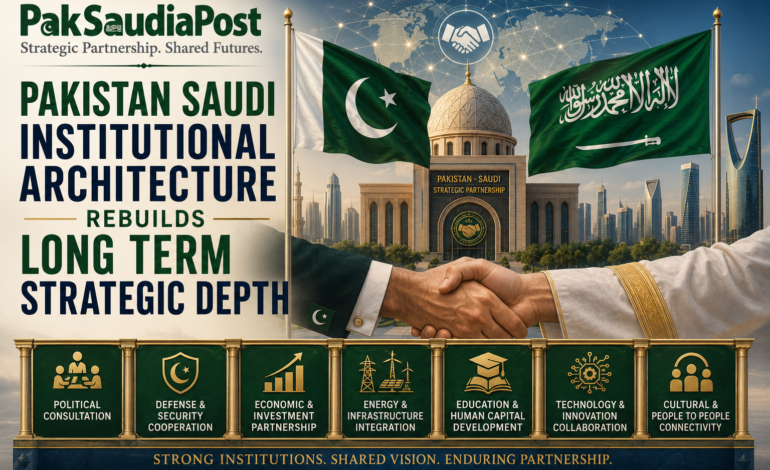
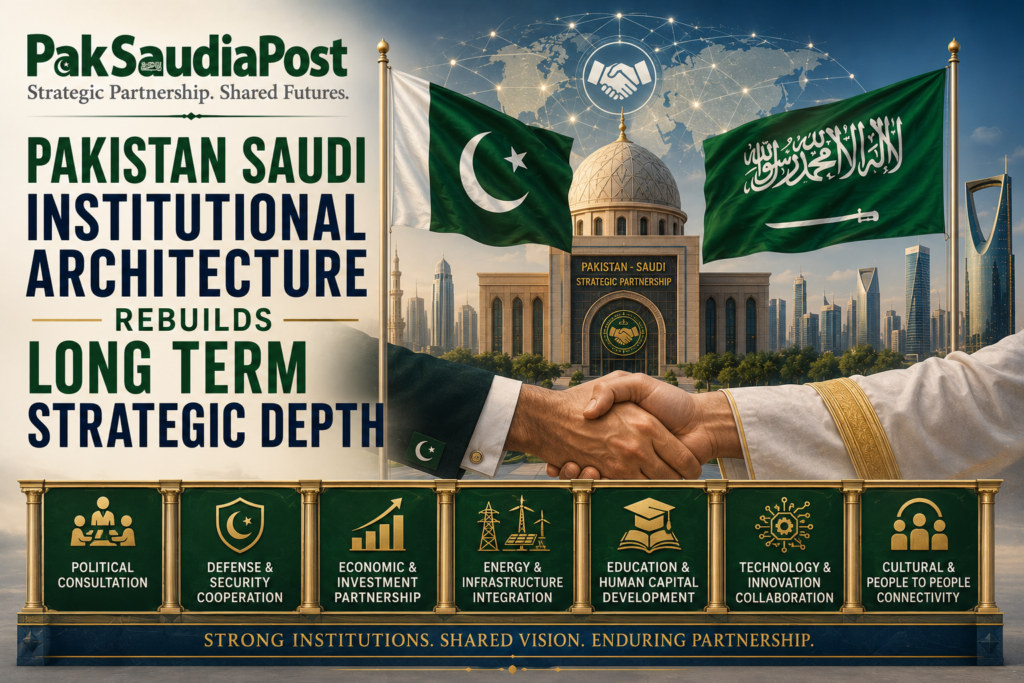
To overcome this structural limitation, a multi layered institutional roadmap is gradually becoming necessary. In the domain of education, the potential lies not merely in scholarships or student exchanges but in the creation of joint knowledge production ecosystems. Shared universities, research consortia, and policy think tanks could serve as intellectual bridges, generating a new class of professionals socialized into both systems simultaneously. This would reduce epistemic distance and create a cohort capable of translating bilateral priorities into technical and policy implementation.
In defense production, the logic of cooperation is evolving beyond training programs and procurement toward co development frameworks. Both states possess asymmetrical but complementary capabilities. Saudi Arabia brings financial capacity and an ambition to localize defense manufacturing under its broader economic transformation agenda. Pakistan brings operational experience, human capital in defense engineering, and an established military industrial base. A coordinated approach could enable joint production clusters, technology transfer agreements, and maintenance ecosystems that reduce external dependency while increasing strategic autonomy.
Energy security represents another critical axis of institutional convergence. Saudi Arabia’s central role in global energy markets and Pakistan’s chronic energy vulnerabilities create a natural space for long term coordination. However, the future of this relationship cannot be limited to oil supply agreements alone. It must expand into renewable energy collaboration, grid modernization, and investment in transitional energy systems. The logic of energy diplomacy is shifting globally, and both states must adapt to a world where hydrocarbons coexist with decarbonization imperatives.
Technological innovation adds an additional layer of complexity and opportunity. Both Pakistan and Saudi Arabia are navigating the challenges of digital transformation, artificial intelligence integration, and knowledge economy development. Yet neither possesses sufficient domestic capacity to achieve technological leapfrogging in isolation. Joint innovation hubs, digital infrastructure partnerships, and startup ecosystem linkages could provide a pathway toward shared technological modernization. Such cooperation would not only enhance economic competitiveness but also reduce the risk of technological marginalization in a rapidly evolving global order.
However, institutional architecture is not merely a technical exercise. It is deeply embedded in political economy dynamics. In Pakistan, institutional cooperation with Saudi Arabia is often filtered through the lens of fiscal necessity. External inflows are frequently interpreted as stabilizing instruments for balance of payments pressures, rather than as components of long term structural transformation. This creates a bias toward short term liquidity rather than long term productivity enhancement.
In Saudi Arabia, institutional engagement with Pakistan is increasingly shaped by diversification strategy. As the kingdom seeks to reposition itself within global investment and innovation networks, Pakistan is viewed both as a labor reservoir and as a potential emerging market for infrastructure and service sector expansion. However, the challenge lies in converting this perception into structured institutional commitments rather than fragmented investment episodes.
A key obstacle to institutional deepening is the persistence of asymmetry. The relationship is not between equals in economic terms, which creates inherent imbalances in agenda setting and implementation capacity. Without careful calibration, institutional frameworks risk reproducing dependency structures rather than overcoming them. This requires deliberate design mechanisms that ensure reciprocity, balanced representation, and mutual accountability in joint initiatives.
Another critical dimension is the role of bureaucratic inertia. Both states operate through complex administrative systems that often lack coordination across ministries and agencies. Institutional cooperation therefore requires not only political will but also administrative harmonization. Without synchronized bureaucratic frameworks, even well designed agreements risk stagnation at the implementation stage.
Beyond state structures, institutional cooperation must also engage non state actors. Private sector participation, academic institutions, religious organizations, and civil society networks all play a role in shaping the depth and durability of bilateral engagement. In particular, the private sector is increasingly central to investment flows, technological adoption, and labor market integration. Without its active inclusion, institutional frameworks risk remaining state centric and underutilized.
The transformation of labor mobility from a purely remittance driven model to a skill development and knowledge transfer system is particularly significant. Pakistani labor in Saudi Arabia has historically been viewed through the lens of remittance dependency. However, a more forward looking approach would treat labor mobility as a channel for skill accumulation, professional certification, and return migration based knowledge diffusion. This would require coordinated regulatory frameworks, skill recognition systems, and labor rights harmonization.
In parallel, cultural and religious dimensions continue to shape institutional perceptions. The symbolic significance of Saudi Arabia within Pakistan’s religious imagination adds an intangible layer of legitimacy to the relationship. However, reliance on symbolic capital alone is insufficient for institutional sustainability. It must be complemented by tangible economic and technological outcomes that reinforce credibility.
From a policy standpoint, the central challenge is to design an institutional ecosystem that is resilient, adaptive, and forward looking. This includes establishing permanent bilateral secretariats, joint strategic planning units, and integrated monitoring mechanisms capable of tracking implementation across sectors. It also requires embedding foresight capabilities into institutional design, allowing both states to anticipate global shifts rather than merely reacting to them.
The success of such an architecture depends on its ability to evolve beyond bilateralism into a networked regional framework. Both Pakistan and Saudi Arabia operate within overlapping regional systems, including the Gulf Cooperation environment, South Asian security architecture, and broader Islamic world institutions. Institutional cooperation must therefore be scalable, allowing for multilateral expansion when necessary.
Ultimately, the institutionalization of Pakistan Saudi relations represents a transition from affinity based diplomacy to system based cooperation. It signals a maturation of bilateral engagement from symbolic alignment to operational integration. Whether this transition succeeds will depend on the ability of both states to sustain political commitment, align bureaucratic systems, and invest in long term capacity building.
In an increasingly fragmented global order, where institutional weakness is often the source of geopolitical instability, the construction of durable bilateral frameworks is not merely an option but a strategic necessity. For Pakistan and Saudi Arabia, the challenge is not the absence of opportunity but the difficulty of translating opportunity into structure. The outcome of this process will significantly influence not only their bilateral trajectory but also the broader architecture of stability within the Islamic world.
A Public Service Message