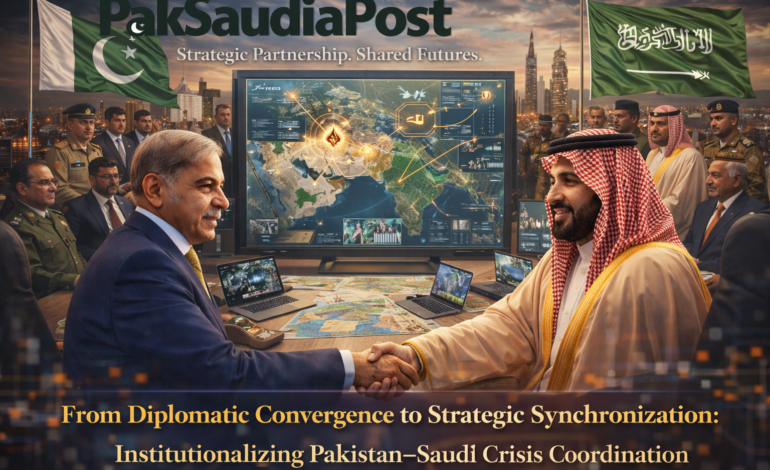
From Diplomatic Convergence to Strategic Synchronization: Institutionalizing Pakistan–Saudi Crisis Coordination

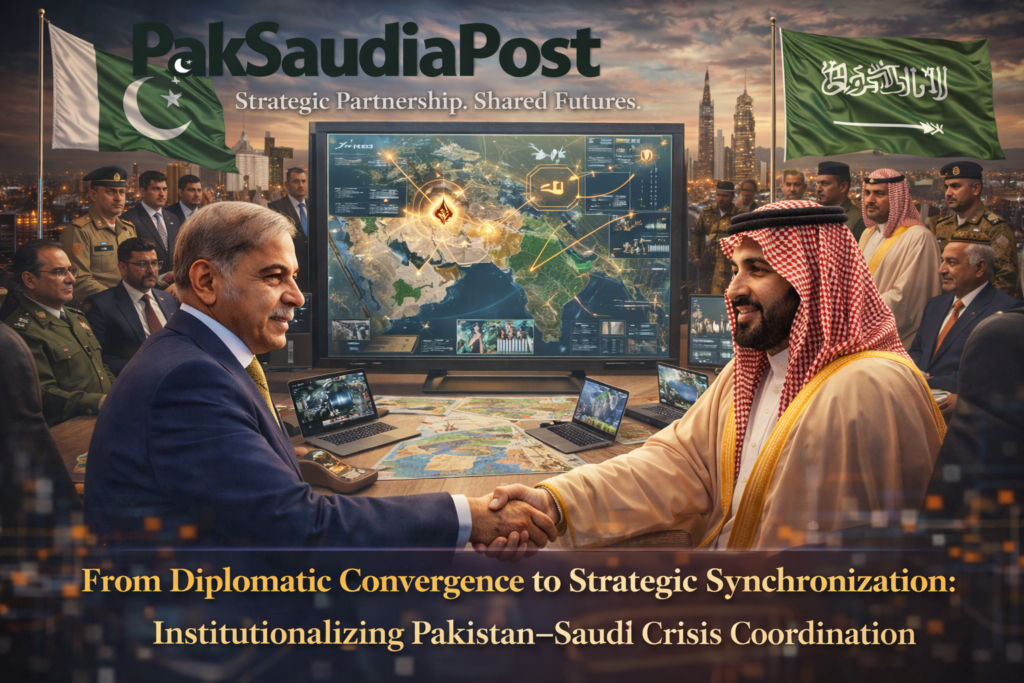
The contemporary geopolitical environment is no longer defined by predictable alliances or linear conflicts. It is shaped by overlapping crises, fluid alignments, and rapid escalation cycles that demand not only diplomatic agility but institutional preparedness. Within this evolving order, the recent engagement between Ishaq Dar and Faisal bin Farhan Al Saud reflects more than routine diplomatic exchange. It signals the emergence of a deeper convergence in strategic outlook between Pakistan and Saudi Arabia, one that must now be transformed into a structured and institutionalized coordination framework capable of responding to regional volatility with precision and coherence.
Pakistan and Saudi Arabia have historically maintained a relationship rooted in shared identity, religious affinity, and political alignment. Yet the demands of the present era require a transition from symbolic solidarity to operational synchronization. The increasing complexity of crises in the Gulf and the wider Middle East, including proxy conflicts, energy disruptions, and shifting power centers, necessitates a mechanism that allows both states to align not only their positions but also their responses in real time. The absence of such a mechanism risks reducing even the strongest bilateral ties to reactive diplomacy, limiting their ability to shape outcomes in a rapidly transforming strategic landscape.
The concept of a Pakistan Saudi Strategic Coordination Mechanism represents a policy innovation designed to bridge this gap. It envisions a permanent institutional platform that integrates diplomatic, security, and intelligence channels into a unified system for crisis assessment and response. Such a mechanism would move beyond episodic consultations and create a continuous feedback loop between Islamabad and Riyadh, ensuring that both capitals remain synchronized in their interpretation of events and their policy choices.
At its core, this framework would function through structured engagement across multiple tiers. At the highest level, it would institutionalize regular strategic dialogues between foreign ministers, supported by dedicated working groups focusing on regional security, economic stability, and multilateral diplomacy. At the operational level, it would establish secure communication channels between relevant ministries and agencies, enabling rapid information exchange during periods of heightened tension. At the analytical level, it would facilitate joint assessments of emerging threats, drawing on the expertise of policy planners, intelligence analysts, and academic institutions from both countries.
The importance of such a mechanism becomes evident when examined against the backdrop of recent regional developments. The Middle East is experiencing a phase of recalibration, characterized by both de escalation efforts and latent tensions. While diplomatic engagements have sought to reduce friction, underlying structural rivalries continue to pose risks of sudden escalation. In this environment, the ability to coordinate responses swiftly and effectively can determine whether a crisis is contained or amplified.
For Pakistan, the institutionalization of crisis coordination with Saudi Arabia offers an opportunity to reposition itself within the regional order. Traditionally perceived as a peripheral actor in Middle Eastern geopolitics, Pakistan possesses unique attributes that can enhance its relevance. Its strategic location, its military capabilities, and its historical ties with Gulf states provide a foundation upon which a more proactive role can be built. By aligning closely with Saudi Arabia through a structured mechanism, Pakistan can transition from a reactive participant to a contributory stabilizer in regional affairs.
For Saudi Arabia, the benefits are equally significant. As a central actor in the Middle East, Riyadh faces the challenge of managing multiple fronts simultaneously, ranging from regional security concerns to economic transformation under Vision 2030. A reliable partner that can provide diplomatic support, strategic depth, and operational coordination enhances Saudi Arabia’s ability to navigate these challenges. Pakistan, with its capacity for both military cooperation and diplomatic engagement, emerges as a natural candidate for this role.
The operationalization of the Pakistan Saudi Strategic Coordination Mechanism requires the definition of clear variables and metrics to assess its effectiveness. One critical variable is the frequency and quality of high level interactions. Regular and structured engagements between leaderships ensure continuity and build trust, reducing the likelihood of misalignment during crises. Another variable is the degree of policy convergence in multilateral forums such as the Organization of Islamic Cooperation, where coordinated positions can amplify the influence of both countries on issues of collective concern.
A third variable is the responsiveness of the mechanism during crises. This can be measured through the speed of information exchange, the alignment of public statements, and the coherence of policy actions. A successful mechanism would enable both countries to issue joint or complementary statements, coordinate diplomatic outreach, and align their positions in international forums within a compressed time frame. Such responsiveness not only enhances effectiveness but also signals unity, deterring potential adversaries and reassuring partners.
The impact pathways of this policy innovation extend across multiple dimensions. In the diplomatic domain, it strengthens the credibility of Pakistan and Saudi Arabia as coordinated actors capable of influencing regional dynamics. This credibility is particularly important in an era where fragmented responses often undermine the effectiveness of international interventions. By presenting a unified front, both countries can enhance their bargaining power and shape the discourse on key issues.
In the strategic domain, the mechanism fosters deeper trust and interdependence. Trust is not merely a function of shared interests but of demonstrated reliability. When two states consistently align their responses and support each other during crises, they build a reservoir of trust that can be leveraged in other areas of cooperation, including defense and economic partnerships. This trust reduces uncertainty and creates a stable foundation for long term collaboration.
In the regional domain, the implications are even more profound. The Middle East and South Asia are interconnected through energy flows, migration patterns, and security dynamics. Instability in one region often reverberates in the other. By coordinating their approaches, Pakistan and Saudi Arabia can contribute to a more stable regional environment, mitigating the spillover effects of conflicts and enhancing resilience against external shocks.
The predictive dimension of this policy is particularly compelling. If effectively implemented, the Pakistan Saudi Strategic Coordination Mechanism could elevate Pakistan’s status within the broader geopolitical hierarchy. It could transform Pakistan into a Tier two diplomatic anchor state, a country that, while not a primary power in the Middle East, plays a critical supporting role in maintaining stability and facilitating dialogue. This transformation would have implications beyond the region, enhancing Pakistan’s global standing and opening new avenues for engagement with other powers.
However, the realization of this vision is not without challenges. Institutional inertia, bureaucratic fragmentation, and differences in policy priorities can impede the development of a cohesive mechanism. To overcome these challenges, both countries must demonstrate political will and commit to a process of continuous refinement. This includes investing in institutional capacity, fostering a culture of collaboration, and ensuring that the mechanism remains adaptable to changing circumstances.
Another challenge lies in managing external perceptions. The deepening of Pakistan Saudi coordination may be viewed with caution by other regional actors, particularly those with competing interests. It is therefore essential that the mechanism is framed not as an exclusive alliance but as a platform for promoting stability and dialogue. By emphasizing its role in conflict prevention and crisis management, both countries can mitigate concerns and position the mechanism as a constructive contribution to regional peace.
The role of leadership is also critical in driving this initiative forward. The engagement between Ishaq Dar and Faisal bin Farhan Al Saud provides a starting point, but sustained commitment at the highest levels is necessary to translate vision into reality. Leadership must not only endorse the mechanism but actively participate in its evolution, ensuring that it remains aligned with national priorities and responsive to emerging challenges.
The integration of technology offers an additional dimension to this framework. In an era of digital diplomacy, the use of secure communication platforms, data analytics, and real time monitoring systems can enhance the effectiveness of coordination. By leveraging technological tools, both countries can improve situational awareness, streamline decision making, and reduce the lag between information and action. This technological integration transforms the mechanism from a traditional diplomatic platform into a modern, agile system capable of operating in a fast paced environment.
Furthermore, the inclusion of non state actors, such as think tanks, academic institutions, and policy research organizations, can enrich the analytical capacity of the mechanism. These actors provide diverse perspectives and innovative solutions, complementing the insights generated within government structures. By creating channels for their participation, the mechanism can benefit from a broader knowledge base and enhance its ability to anticipate and respond to complex challenges.
The economic dimension, while not the primary focus of this policy, cannot be ignored. Stability and predictability are essential for economic growth, and a robust crisis coordination mechanism contributes to both. By reducing the likelihood of disruptions and enhancing confidence, it creates a conducive environment for investment and trade. This, in turn, reinforces the broader objective of deepening Pakistan Saudi relations across multiple sectors.
In conclusion, the transition from diplomatic convergence to strategic synchronization represents a necessary evolution in Pakistan Saudi relations. The establishment of a Pakistan Saudi Strategic Coordination Mechanism offers a pathway to achieve this transition, transforming a historically strong relationship into a dynamic and operational partnership. It aligns with the demands of a complex and unpredictable geopolitical environment, providing both countries with the tools to navigate crises effectively and contribute to regional stability.
The engagement between Ishaq Dar and Faisal bin Farhan Al Saud should therefore be viewed not as an isolated event but as the beginning of a strategic trajectory. By institutionalizing coordination, defining clear operational parameters, and committing to continuous adaptation, Pakistan and Saudi Arabia can redefine their partnership and enhance their collective influence in the regional and global arenas. This is not merely a policy option but a strategic imperative, one that will shape the future of their bilateral relations and their role in an increasingly interconnected world.
A Public Service Message