
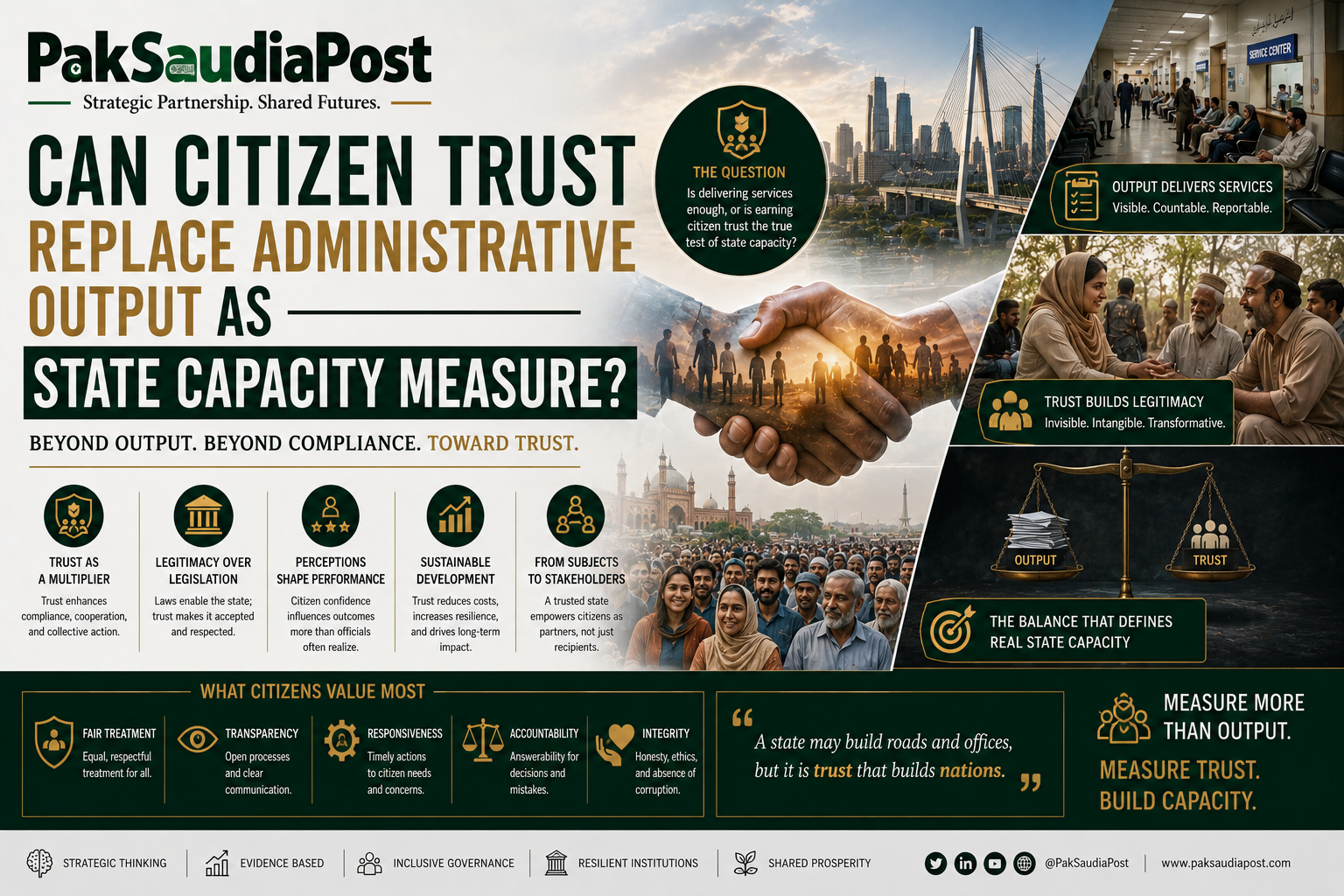
Can Citizen Trust Replace Administrative Output as State Capacity Measure

The conventional grammar of governance assessment has long rested on quantifiable administrative outputs. Budgets executed, infrastructure completed, regulations issued, and services delivered have formed the core metrics through which state capacity is traditionally evaluated. Yet this input-output logic is increasingly misaligned with how

Governance Fatigue and Administrative Legitimacy in Developing States Today
The contemporary condition of governance in many developing states is increasingly defined not by institutional absence but by a slow, cumulative erosion of administrative credibility that operates beneath the surface of formal continuity. Governments continue to function, ministries continue to issue directives, and

Pakistan Saudi Institutional Architecture Rebuilds Long Term Strategic Depth
The evolution of Pakistan and Saudi Arabia’s relationship has increasingly moved beyond ceremonial diplomacy and episodic financial cooperation toward a more structurally embedded institutional imagination. What is now emerging, though still uneven and partially articulated, is a recognition in both capitals that sustainable

Pakistan Saudi Economic Statecraft Structural Convergence and Sovereign Capital Credibility Transformation 2026 to 2031
The emerging architecture of Pakistan–Saudi economic relations is undergoing a structural transition that cannot be adequately interpreted through traditional categories of aid dependence, episodic investment diplomacy, or symbolic geopolitical alignment. The deeper reality is that both states are now operating within a transformed

Water Scarcity Heat Stress Climate Security Pakistan Saudi Emergency
The accelerating convergence of water scarcity and heat stress across South Asia and the Arabian Peninsula is no longer a distant environmental concern but an active structural condition reshaping state capacity, economic planning, and regional diplomacy. In both Pakistan and Saudi Arabia, climate

Energy Security Compact
The question of energy security has emerged as the most structurally consequential dimension of Pakistan Saudi relations, not merely because it involves hydrocarbons and fiscal arrangements, but because it sits at the intersection of sovereignty, dependency, and geopolitical positioning. The proposed Energy Security
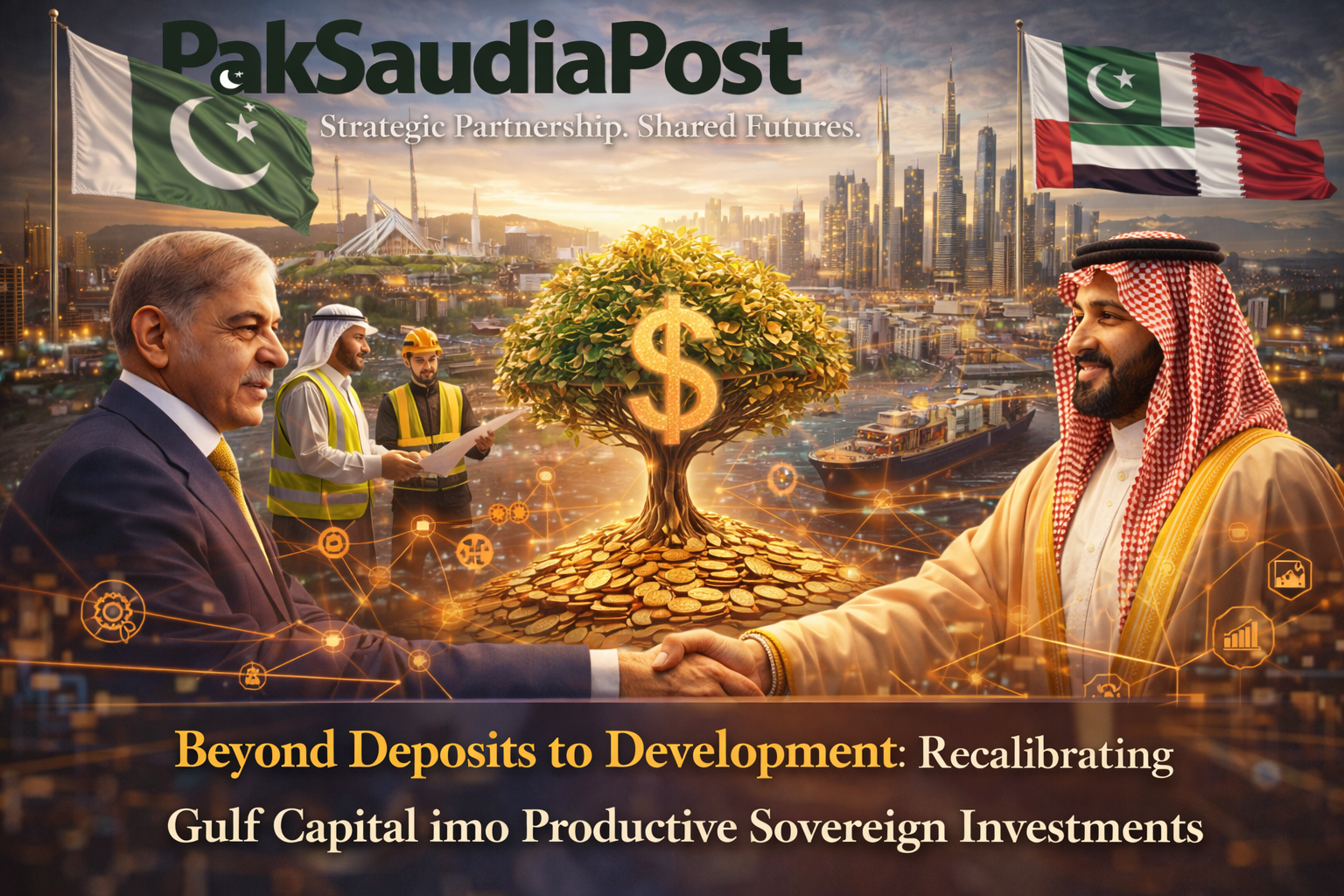
Beyond Deposits to Development: Recalibrating Gulf Capital into Productive Sovereign Investments
The structural fragility of Pakistan’s external financing model has long been masked by episodic inflows of bilateral support, often extended in moments of acute fiscal stress and withdrawn once temporary stability is restored. The recent decision to repay high cost deposits to the