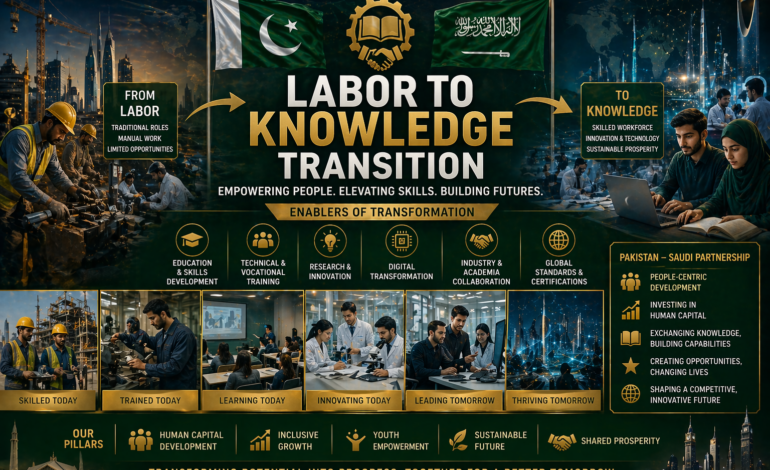
Labor to Knowledge Transition

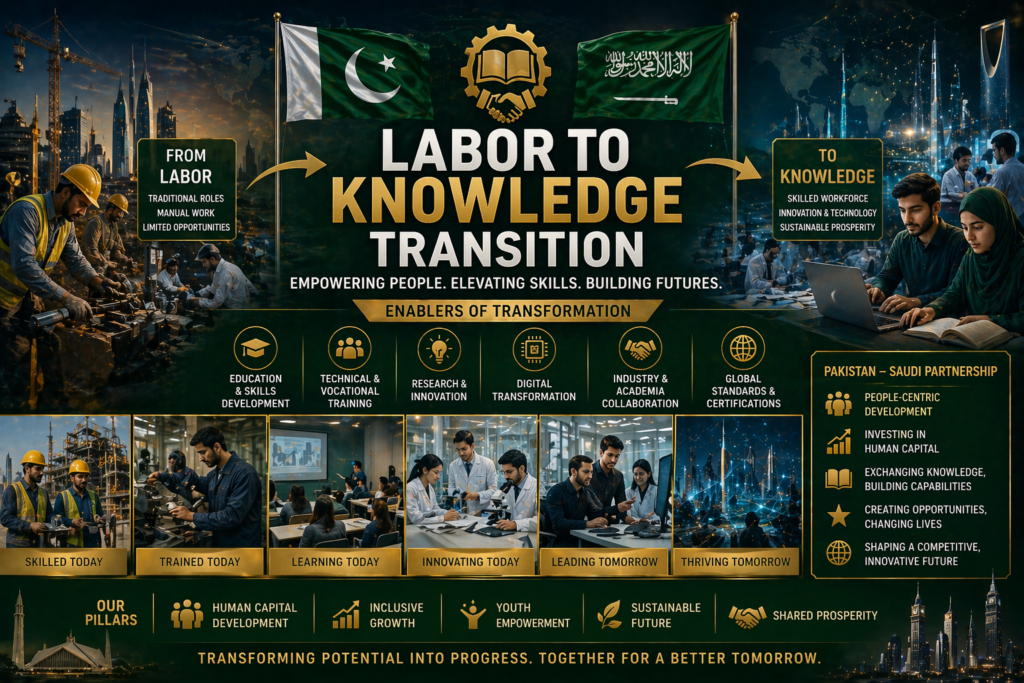
The structure of Pakistan Saudi labor relations has historically been one of the most durable yet least theorised pillars of their bilateral engagement, functioning simultaneously as an economic stabiliser for Pakistan and a demographic supplement for Saudi Arabia. For decades, Pakistani labor migration to the Kingdom has been organised around low skill and semi-skilled categories, producing a remittance dependent macroeconomic buffer for Pakistan while sustaining critical segments of Saudi infrastructure, construction, domestic services, and maintenance sectors. Yet this model is now encountering a structural inflection point shaped by Saudi Arabia’s Vision 2030 transformation agenda, domestic labor nationalisation policies, and the global shift toward knowledge intensive economies. The emerging policy challenge is no longer simply about regulating labor flows, but about transforming the very epistemic hierarchy of labor exchange itself, moving from a remittance-based survival model to a knowledge-based mobility system.
From the perspective of dependency theory, the existing labor regime reflects a classic asymmetry in global labor value chains. Pakistan exports human labor in its most commodified form, absorbing the risks of unemployment, underemployment, and skill stagnation domestically, while importing back financial inflows in the form of remittances that sustain consumption driven economic stability. This circular dependency generates a paradox in which labor becomes both a source of national survival and a mechanism of structural stagnation. The remittance economy, while vital for foreign exchange reserves, reduces incentives for domestic industrial absorption and skill upgrading, effectively locking a significant portion of the workforce into externally dependent labor trajectories. Saudi Arabia, in this configuration, functions as a labor importing core economy that selectively absorbs human capital without necessarily facilitating its upward mobility.
However, the Saudi Arabian labor market is undergoing a profound structural transformation. Vision 2030 has introduced a systematic policy of Saudisation, aimed at increasing domestic employment participation across both public and private sectors. This policy shift is not merely demographic but epistemic, as it prioritises high skill, technologically advanced, and knowledge intensive labor segments. As a result, the traditional absorption capacity for low skill foreign labor is gradually contracting, creating a transitional pressure on migrant sending countries such as Pakistan. At the same time, Saudi Arabia is expanding its demand for specialised expertise in fields such as artificial intelligence, financial technology, renewable energy engineering, tourism management, logistics optimisation, and advanced healthcare systems. This dual movement of labor contraction at the low end and expansion at the high end creates a structural opening for what can be described as a labor to knowledge transition architecture.
Complex interdependence theory provides a more dynamic framework to understand this shift. Labor migration is no longer a unidirectional flow of human capital from a sending to a receiving country, but a multidimensional system involving education networks, certification regimes, institutional partnerships, and circular mobility patterns. In this emerging configuration, Pakistani workers are not merely migrants but potential participants in transnational knowledge ecosystems. The relationship between Pakistan and Saudi Arabia therefore evolves from a simple labor export model into a complex network of skill production, validation, deployment, and reintegration. This shift increases mutual sensitivity, as disruptions in one domain, such as educational certification or labor regulation, can have cascading effects across economic and diplomatic spheres.
The proposed labor to knowledge transition requires a fundamental reengineering of Pakistan’s human capital strategy. The first axis of transformation involves the stratification of skill exports. Instead of treating labor as a homogeneous category, Pakistan must develop a tiered system of human capital deployment that distinguishes between low skill, medium skill, and high skill labor streams. This requires institutional reform in technical and vocational education systems, alignment of curricula with global labor market demands, and the establishment of internationally recognised certification standards. Without such restructuring, Pakistan risks perpetuating a low value equilibrium in global labor markets, even as demand for high skill labor increases elsewhere.
The second axis involves the creation of a bilateral credential recognition framework between Pakistan and Saudi Arabia. One of the persistent inefficiencies in the current labor system is the non-recognition or partial recognition of Pakistani qualifications in Saudi labor markets, which leads to skill underutilisation and occupational downgrading. Engineers, technicians, and healthcare professionals often find themselves placed in positions below their qualification levels due to regulatory and certification mismatches. A formalised equivalency system would reduce this structural inefficiency and allow for more optimal allocation of human capital across sectors.
The third axis is the development of a Pakistan Saudi knowledge corridor, which would institutionalise educational and professional mobility between the two countries. This corridor would integrate universities, technical institutes, research centers, and corporate training platforms into a shared ecosystem of knowledge production and dissemination. Such an arrangement would represent a significant departure from traditional labor export models, as it would embed migration within a continuous cycle of learning, certification, employment, and reintegration. In this configuration, migration becomes not a permanent economic displacement but a dynamic knowledge exchange process.
The fourth axis involves the transformation of remittance flows into investment channels. Currently, remittances function primarily as consumption stabilisers within Pakistan’s domestic economy, financing household expenditures, real estate investment, and informal savings mechanisms. However, a portion of these flows could be redirected into structured diaspora investment funds that support joint ventures in technology, infrastructure, and renewable energy sectors between Pakistan and Saudi Arabia. This would convert labor migration from a purely consumptive economic mechanism into a productive investment engine, aligning individual financial flows with macroeconomic development objectives.
Saudi Arabia’s internal labor market dynamics also play a critical role in shaping this transition. The Kingdom’s simultaneous pursuit of localisation and diversification creates a structural demand for high skill foreign expertise, even as it reduces reliance on low skill labor. This paradox generates both opportunity and tension. On one hand, it opens pathways for Pakistani professionals to integrate into high value sectors within the Saudi economy. On the other hand, it intensifies competition for limited high skill positions, requiring Pakistan to significantly upgrade its educational and training systems to remain competitive.
Neo structural economic theory underscores the importance of internal institutional capacity in determining the success of such transitions. External demand for skilled labor is insufficient unless matched by domestic capability to produce and certify such skills. In Pakistan’s case, persistent challenges in educational quality, research infrastructure, and vocational training limit the scalability of high skill labor exports. Without addressing these structural constraints, the labor to knowledge transition risks remaining aspirational rather than operational.
From Saudi Arabia’s perspective, the transition aligns with its broader objective of building a diversified knowledge economy. The import of high skill labor is not merely a short-term necessity but a strategic component of its economic transformation agenda. However, this also raises questions about long term dependency on foreign expertise in critical sectors. The ideal outcome would therefore be a gradual process of knowledge transfer and localisation, where foreign expertise contributes to domestic capacity building rather than permanent substitution.
Ultimately, the labor to knowledge transition represents a fundamental redefinition of Pakistan Saudi human capital relations. It challenges the historical equilibrium of low skill labor export and remittance dependence, replacing it with a more complex and potentially more equitable system of knowledge exchange. However, this transformation is neither automatic nor guaranteed. It requires deliberate institutional coordination, sustained policy commitment, and structural reforms on both sides. Without these, the transition may remain partial, fragmented, and vulnerable to the inertia of existing labor regimes.
The deeper implication of this shift is that labor itself is no longer merely an economic input but a strategic asset embedded within global knowledge systems. Pakistan’s ability to navigate this transition will determine whether it remains locked in a low skill dependency cycle or emerges as a meaningful participant in the global knowledge economy. Saudi Arabia’s role will be equally decisive, as its willingness to institutionalise knowledge transfer and skill integration will shape the depth and durability of this evolving partnership.
A Public Service Message