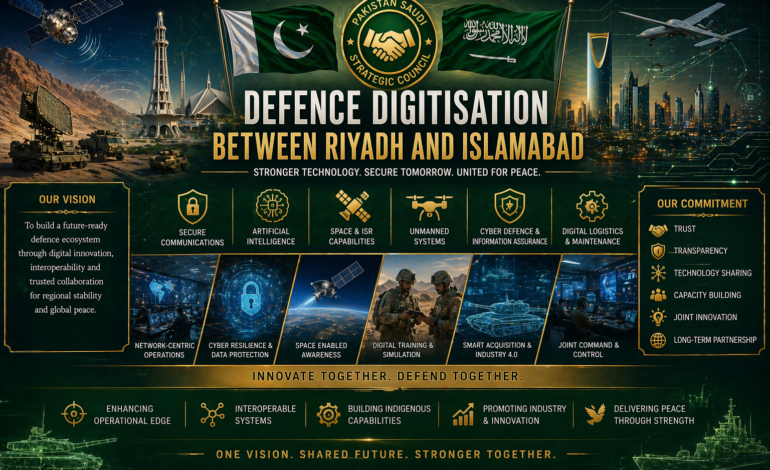
Defence Digitisation Between Riyadh and Islamabad

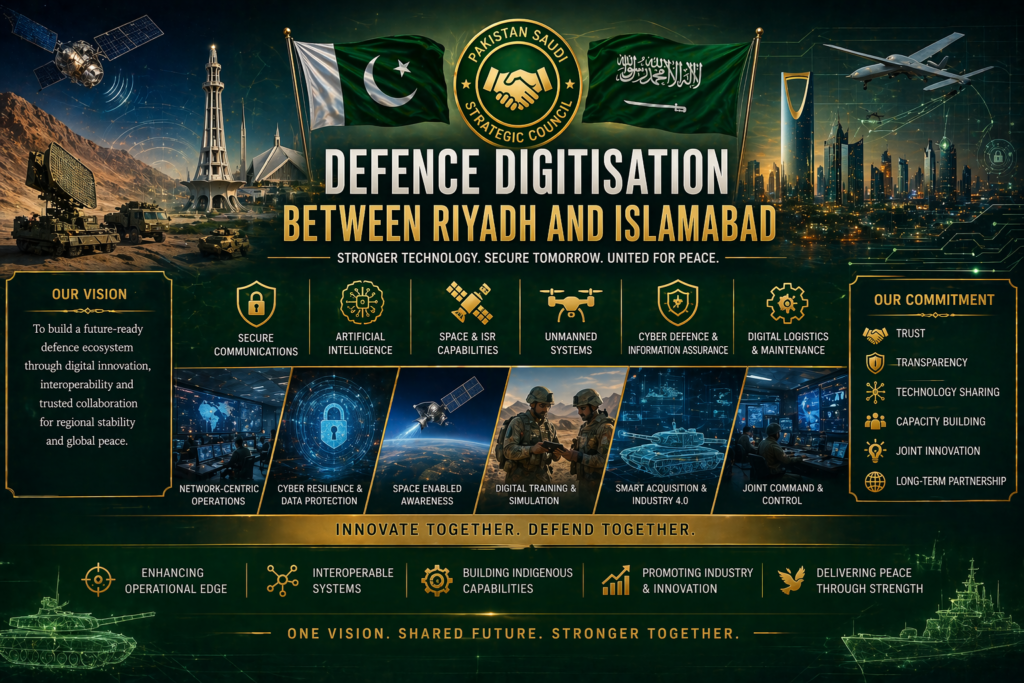
The accelerating convergence of Saudi Arabia and Pakistan in the domain of defencedigitisation is increasingly shaped by a global security environment in which warfare is no longer defined by conventional force projection alone but by algorithmic speed, networked sensing, and multi domain integration of land, air, cyber and space based systems. The recent intensification of drone and missile related incidents across the Gulf security theatre has underscored a structural shift in strategic vulnerability, particularly for energy infrastructure and critical urban nodes, compelling Riyadh to reassess the adequacy of its existing deterrence configuration. Within this evolving landscape, Pakistan emerges not merely as a recipient of defence cooperation but as a parallel innovation node shaped by decades of exposure to asymmetric conflict, electronic warfare adaptation and resource constrained technological improvisation.
From a theoretical standpoint, this emerging alignment can be interpreted through dependency theory, complex interdependence, and neo structuralism, each of which reveals distinct yet overlapping dimensions of the relationship. Dependency theory suggests that defence relations between technologically asymmetrical states often risk reproducing structural hierarchies in which capital rich actors dominate systems of production and knowledge extraction, while labour or innovation intensive partners remain confined to subordinate roles. In the Saudi Pakistan context, this risk is present insofar as Saudi Arabia possesses capital surplus and procurement capacity, while Pakistan contributes tactical design experience and manpower intensive defence expertise. However, this dependency is not fixed and may be transformed if knowledge transfer becomes bidirectional rather than extractive.
Complex interdependence offers a more fluid interpretive lens. It suggests that in contemporary international systems, military, economic, and technological linkages are so deeply embedded that no single domain can be isolated from another. The Saudi Pakistan defence relationship increasingly reflects this condition, as drone interception capabilities, cyber security systems, satellite based surveillance, and artificial intelligence driven threat analysis converge into a unified ecosystem of security production. In such a system, the distinction between supplier and recipient becomes blurred, replaced by mutual vulnerability and mutual reliance. Saudi Arabia depends on external technical expertise and adaptive operational doctrines, while Pakistan depends on financial inflows, infrastructure access and integration into advanced defence supply chains.
Neo structuralism adds a further layer of analysis by emphasising the role of state led industrial policy and strategic economic planning in shaping technological trajectories. Both Saudi Arabia and Pakistan operate within this framework, albeit with differing capacities. Saudi Arabia’s Vision 2030 represents a high intensity neo structural transformation project aimed at decoupling national economic identity from hydrocarbon dependency through investment in artificial intelligence, defence manufacturing and digital infrastructure. Pakistan, while lacking comparable fiscal depth, has pursued a fragmented but increasingly relevant neo structural adaptation in the form of indigenous drone development, cyber capability expansion and selective localisation of defence production. The convergence of these two trajectories suggests the possibility of a hybridised neo structural bloc in which state directed technological development becomes a shared strategic objective.
At the operational level, the most immediate area of convergence lies in unmanned aerial systems and integrated air defence architectures. Drone warfare has fundamentally altered the cost structure of military engagement, allowing relatively low cost platforms to impose disproportionate strategic pressure on high value infrastructure. Saudi Arabia’s experience of drone and missile incursions targeting energy installations has exposed the limitations of conventional interception systems when confronted with swarm based or multi vector attacks. Pakistan’s operational experience in asymmetric border environments provides valuable insights into distributed detection networks, rapid response protocols and layered defence redundancy.
However, technological integration is not merely a matter of hardware compatibility. It requires deep institutional alignment in command structures, data sharing protocols and threat interpretation frameworks. Artificial intelligence based interception systems rely on continuous data streams, algorithmic learning models and real time decision architectures. Without harmonised data governance, such systems risk producing fragmented or contradictory threat assessments. Therefore, the challenge is not only technical but epistemological, involving the question of how threats are defined, classified and prioritised across sovereign boundaries.
Cyber coordination represents an equally critical frontier. The digitisation of military infrastructure has expanded the attack surface of states beyond physical borders into distributed networks of vulnerability. Energy grids, radar systems, logistics chains and communication platforms are increasingly interlinked with civilian digital ecosystems, making them susceptible to hybrid forms of warfare that combine misinformation, system disruption and kinetic escalation. A Saudi Pakistan cyber coordination framework would therefore need to function not merely as an intelligence sharing mechanism but as a joint epistemic system for interpreting digital threats in real time.
Yet, structural asymmetries remain central to the durability of this partnership. Saudi Arabia’s defencemodernisation is characterised by procurement intensity, rapid infrastructure deployment and reliance on external technological ecosystems, while Pakistan’s system is shaped by adaptive innovation under fiscal constraint. This divergence produces both complementarity and tension. Complementarity arises from the potential fusion of capital and innovation. Tension emerges when decision making authority, technological ownership and data sovereignty become unevenly distributed.
From a dependency theory perspective, the critical risk is that Pakistan’s role may be confined to lower tier production and tactical adaptation without access to core algorithmic architecture or system level intellectual property. Such an outcome would reinforce hierarchical integration rather than genuine technological partnership. Conversely, if Saudi Arabia facilitates co ownership of research, joint development of artificial intelligence models and shared control over defence platforms, the relationship could evolve into a more symmetrical structure.
Complex interdependence suggests that such symmetry is not only desirable but increasingly necessary. In a security environment defined by rapid escalation cycles, no state can maintain isolated technological superiority. The diffusion of drone technology, electronic warfare tools and cyber offensive capabilities means that deterrence is only sustainable through networked resilience. This creates incentives for deeper integration between Riyadh and Islamabad, particularly in the creation of joint early warning systems, shared satellite feeds and interoperable command and control infrastructures.
Neo structuralism further implies that the state remains the primary architect of technological transformation. Private sector actors, while important, operate within policy ecosystems defined by strategic state objectives. In this context, both Saudi Arabia and Pakistan must invest in institutional frameworks that transcend episodic cooperation. A permanent joint defence technology council, supported by long term funding mechanisms and integrated research institutions, would be necessary to ensure continuity and coherence in technological development.
Ultimately, defencedigitisation between Riyadh and Islamabad is not simply a matter of upgrading military capability. It represents a deeper transformation in the nature of sovereignty itself, where security is produced through data flows, algorithmic prediction and networked infrastructures rather than territorial control alone. The success of this partnership will depend on whether both states can move beyond transactional cooperation towards a structurally integrated model of technological co production that balances asymmetry with shared strategic intent.
A Public Service Message