Why Strategic Announcements Outpace Institutional Delivery Systems Across Developing States

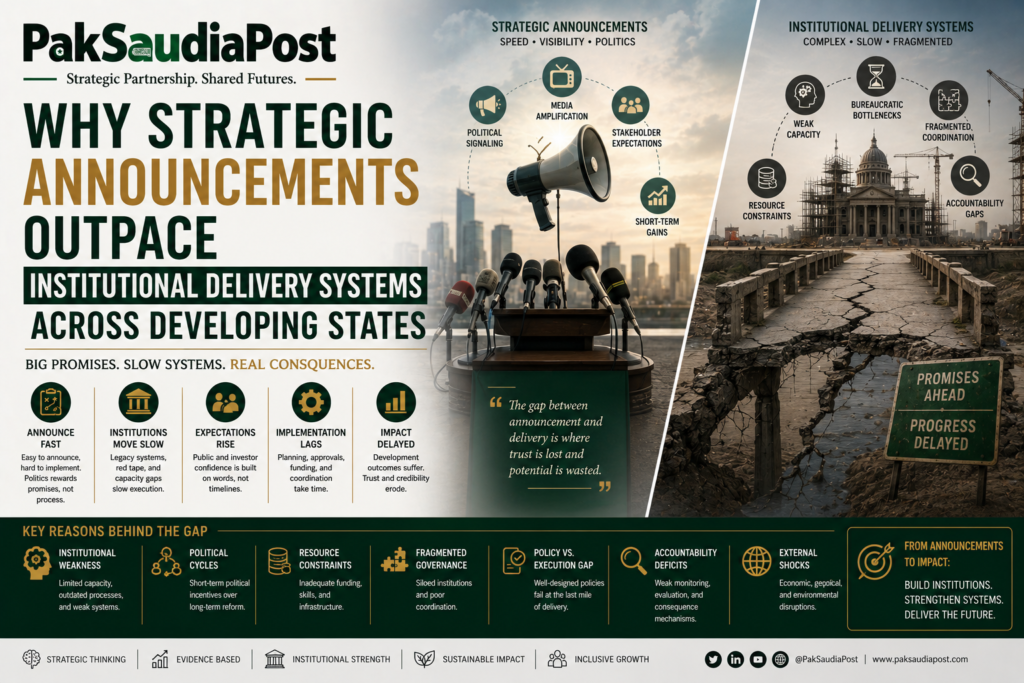
In many developing states, the contemporary policy environment is defined by a recurring paradox. Governments announce ambitious transformation agendas with precision, frequency, and visible diplomatic amplification, yet the administrative machinery tasked with converting these announcements into measurable outcomes advances at a markedly slower pace. The result is a widening credibility gap between strategic articulation and operational delivery. This gap is not merely technical; it is structural, embedded in the architecture of public administration, incentive systems, and coordination logic that govern state behaviour.
In both Pakistan and Saudi Arabia, this tension is particularly visible, albeit for different historical and institutional reasons. In one case, long-standing bureaucratic fragmentation and fiscal constraints shape implementation capacity. In the other, rapid modernization agendas intersect with legacy administrative cultures and evolving governance reforms. Yet the underlying issue converges on a shared challenge: the absence of fully integrated delivery systems capable of translating high-level intent into synchronized execution across ministries, agencies, and subnational structures.
The proliferation of strategic announcements is not accidental. Modern states operate in an environment where signalling intent has become an instrument of economic confidence, diplomatic positioning, and domestic legitimacy. Investment forums, bilateral memoranda, national visions, and sectoral roadmaps serve multiple audiences simultaneously. However, this expansion of strategic communication has not been matched by equivalent investment in execution systems. As a result, policy formulation has become increasingly sophisticated while implementation systems remain unevenly modernized.
One structural limitation lies in the fragmentation of administrative authority. In many developing governance systems, ministries operate as semi-autonomous silos with overlapping mandates and limited interoperability. Coordination mechanisms exist, but they are often procedural rather than functional. Inter-ministerial committees may convene regularly, yet they lack binding enforcement capacity over timelines, resource allocation, and performance accountability. This produces a system in which policy coherence is asserted at the top but diluted during implementation.
Another constraint is the misalignment between planning cycles and budgetary execution. Strategic documents are often designed on multi-year horizons, while fiscal processes remain annualized and rigid. This creates discontinuities where long-term objectives are repeatedly recalibrated to fit short-term financial constraints. In such environments, even well-designed initiatives lose momentum as they move from planning desks to expenditure frameworks.
Human capital limitations further compound the problem. Public administration systems in many developing states continue to rely on generalist bureaucratic cadres trained for procedural governance rather than outcome-based delivery. The absence of specialised project management expertise within core ministries leads to inefficiencies in procurement, contracting, monitoring, and evaluation. Where technical capacity does exist, it is often concentrated in isolated agencies rather than distributed across the system.
A more subtle but equally significant constraint is the incentive structure embedded within governance institutions. Administrative success is frequently measured through compliance indicators rather than outcome indicators. Officials are rewarded for procedural correctness, documentation completeness, and budget absorption rather than measurable improvements in service delivery or economic impact. This creates a culture of risk aversion, where innovation is discouraged and implementation becomes a process of procedural shielding rather than performance optimization.
Digital governance reforms have begun to address some of these gaps, particularly in areas such as public financial management and service digitisation. Saudi Arabia’s digital transformation agenda, for instance, has introduced integrated service platforms and data-driven monitoring tools. Pakistan has similarly expanded e-governance initiatives across taxation, identity management, and service delivery sectors. However, digitisation alone does not resolve structural fragmentation unless it is accompanied by institutional redesign that aligns data flows with decision-making authority.
The absence of unified delivery architectures is perhaps the most critical limitation. In advanced governance systems, delivery units are often established to sit at the centre of government, directly tracking priority reforms across sectors. These units integrate real-time data monitoring, interagency coordination, and performance escalation mechanisms. In many developing states, however, such structures either do not exist or lack the authority to enforce corrective action. As a result, monitoring becomes descriptive rather than interventionist.
Pakistan and Saudi Arabia, despite their differences in administrative scale and institutional maturity, both face the need to evolve toward more integrated performance governance models. In Pakistan, fragmented federal-provincial coordination often slows execution of national initiatives, particularly in infrastructure, health, and education sectors. In Saudi Arabia, rapid diversification programmes require continuous alignment between central planning entities and executing ministries to ensure coherence across mega-projects and sectoral reforms.
The issue is not the absence of strategic vision. On the contrary, both states have articulated highly structured long-term frameworks that define economic diversification, human capital development, and institutional modernization. The challenge lies in execution fidelity, where the translation of vision into action is mediated by multiple layers of administrative interpretation, each introducing delay and dilution.
A critical reform pathway involves the establishment of unified national delivery frameworks that consolidate strategic planning, execution monitoring, and performance accountability under a single governance architecture. Such frameworks would not replace existing ministries but would overlay them with coordination mechanisms capable of enforcing timelines, resolving interagency conflicts, and escalating stalled initiatives to higher decision-making levels.
These delivery systems require several core components. First, real-time performance dashboards integrated across ministries to provide continuous visibility into project status. Second, empowered delivery units staffed with technical experts in project management, data analytics, and sectoral policy. Third, legally binding performance agreements between central authorities and implementing agencies. Fourth, escalation protocols that allow unresolved bottlenecks to be addressed at cabinet or equivalent executive levels within defined timeframes.
Equally important is the reform of incentive structures within public administration. Performance-based evaluation systems must gradually replace input-based assessments. This requires redefining bureaucratic success not in terms of activity volume but in terms of measurable outcomes such as service reliability, project completion rates, and citizen satisfaction indices. Without this shift, even the most advanced delivery architecture will struggle to overcome entrenched behavioural patterns.
Institutional coordination must also extend beyond government itself. Private sector contractors, development partners, and civil society actors increasingly play operational roles in policy implementation. However, their integration into delivery systems remains uneven. A more coherent governance model would treat these actors as part of a managed ecosystem rather than external participants, with clearly defined accountability linkages and reporting obligations.
Fiscal governance reform is another critical dimension. Medium-term expenditure frameworks must be strengthened to ensure alignment between strategic priorities and resource allocation. Capital budgeting processes should be restructured to reduce delays in fund release and improve predictability of financing for multi-year projects. Without fiscal coherence, delivery systems will remain constrained by periodic liquidity disruptions.
In both Pakistan and Saudi Arabia, political leadership has demonstrated a strong preference for visible reform announcements, particularly in sectors linked to economic transformation and global competitiveness. However, sustaining credibility increasingly depends on the less visible domain of administrative execution. In this context, institutional strength is defined not by the number of initiatives launched, but by the proportion of initiatives successfully completed within defined parameters of time, cost, and quality.
The broader implication is that governance in developing states is entering a phase where execution capacity becomes the primary determinant of state performance. Strategic articulation will remain important, but it will no longer be sufficient as a standalone indicator of reform seriousness. Investors, international partners, and domestic constituencies are increasingly evaluating states based on delivery reliability rather than policy ambition.
For Pakistan and Saudi Arabia, the convergence of reform agendas presents an opportunity to re-engineer governance systems around shared principles of performance accountability and institutional integration. While their administrative contexts differ, both can benefit from adopting hybrid delivery models that combine centralised strategic oversight with decentralised execution flexibility, supported by robust digital monitoring infrastructure.
Ultimately, the persistent gap between announcement and delivery is not a failure of intent but a reflection of outdated institutional design. Bridging this gap requires a shift from governance as communication to governance as execution engineering. The states that succeed in making this transition will not only improve domestic outcomes but will also enhance their credibility in an international system increasingly attentive to implementation performance rather than declaratory ambition.
A Public Service Message