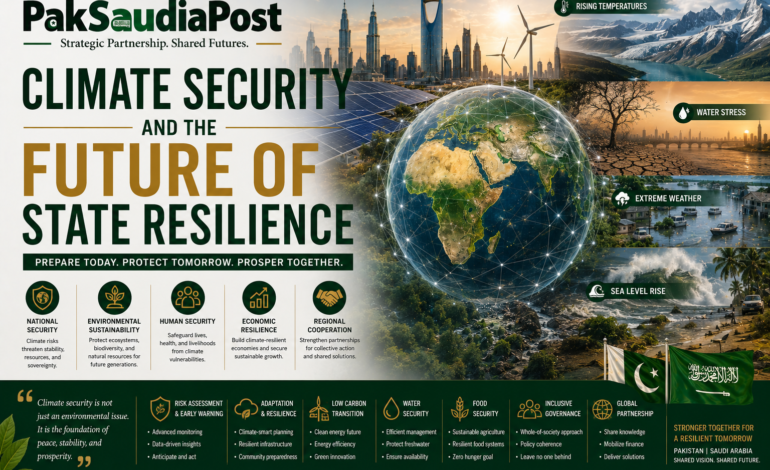
CLIMATE SECURITY AND THE FUTURE OF STATE RESILIENCE

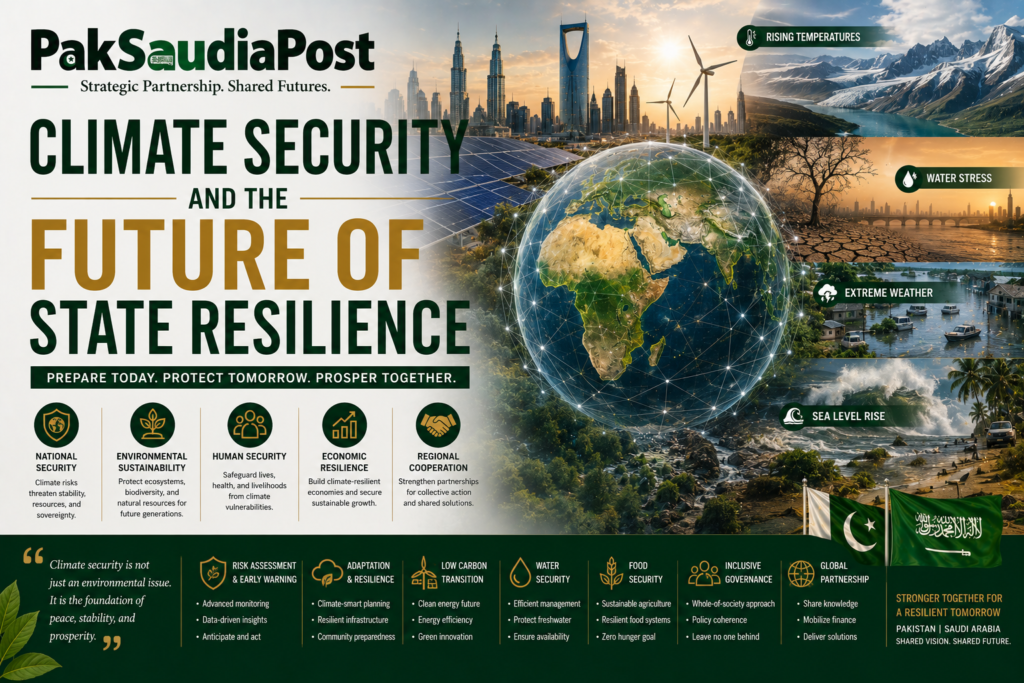
Pakistan and Saudi Arabia are entering a period in which climate dynamics are no longer peripheral environmental stressors but central determinants of state stability, fiscal endurance, and long term governance capacity. The acceleration of heat intensity, water volatility, land degradation, and atmospheric unpredictability is reshaping both countries’ development trajectories in ways that conventional planning instruments were not designed to manage.
In Pakistan, climate stress has shifted from episodic disaster management to continuous structural pressure. Flood events of unprecedented scale, glacial melt acceleration in the northern regions, and irregular monsoon cycles have created a condition in which agricultural output, rural livelihoods, and urban infrastructure are simultaneously exposed to systemic instability. In Saudi Arabia, rising temperatures, groundwater depletion, and the ecological cost of large scale urban expansion are converging to challenge the sustainability of long term economic diversification strategies.
The defining feature of this transformation is not simply intensity but synchronization. Climate shocks are no longer isolated across geography or sector. They increasingly occur in overlapping cycles that amplify one another. Heatwaves coincide with energy demand spikes. Flooding intersects with transport disruption. Water scarcity compounds agricultural stress while simultaneously increasing import dependency. The result is a tightening constraint on fiscal space and administrative flexibility.
Despite these shifts, institutional architectures in both countries remain largely calibrated to historical climate baselines. Environmental governance is still treated as a sectoral responsibility rather than a cross cutting determinant of national planning. Ministries of climate or environment operate alongside, rather than within, the core economic and security decision making frameworks. This separation has created a structural lag between risk reality and policy response.
A more integrated approach would require climate risk to be embedded directly into macroeconomic modeling. Budget planning processes in both Pakistan and Saudi Arabia must incorporate long range climate projection scenarios as binding constraints on infrastructure development, energy investment, and agricultural policy. Without such integration, capital allocation risks reinforcing vulnerability rather than reducing it.
Water emerges as the most immediate point of convergence in both states’ climate exposure profiles. Pakistan’s river dependent irrigation system is increasingly vulnerable to glacial variability and erratic precipitation patterns. Seasonal predictability, once a foundation of agricultural planning, is weakening. In Saudi Arabia, reliance on energy intensive desalination and limited groundwater reserves introduces long term sustainability questions that intersect directly with energy pricing and industrial expansion.
Water governance must therefore shift from supply expansion to demand transformation. This implies large scale investment in irrigation efficiency technologies, crop pattern restructuring, and leakage reduction systems in urban water networks. It also implies political sensitivity, as water use patterns are deeply embedded in rural economies and urban consumption habits. The challenge is not technical alone but institutional and behavioral.
Agriculture, particularly in Pakistan, represents a critical vulnerability node. Crop yields are increasingly exposed to heat stress during key growth phases. Shifts in rainfall timing disrupt planting cycles. Soil degradation reduces resilience to climatic variability. In Saudi Arabia, domestic agriculture has already undergone contraction in water intensive sectors, yet food security remains tied to import stability, which itself is exposed to global supply chain disruptions.
A climate resilient agricultural model would require diversification away from water intensive crops, expansion of climate tolerant seed varieties, and integration of predictive meteorological analytics into planting decisions. This is not merely a technological upgrade but a restructuring of rural economic incentives.
Urban systems represent another axis of vulnerability. Rapid urbanization in both countries has proceeded with limited incorporation of climate adaptive design. Heat island effects in dense urban zones are intensifying energy demand for cooling, creating feedback loops between climate stress and energy consumption. Flood drainage systems in several Pakistani cities are under capacity during peak rainfall events, while Saudi urban megaprojects face rising cooling and infrastructure stress under extreme heat conditions.
Urban resilience requires rethinking the physical logic of city design. Building materials, spatial planning, transport systems, and energy distribution must be aligned with projected climate realities rather than historical averages. Passive cooling architecture, expanded urban green corridors, and decentralized energy systems are no longer optional design enhancements but structural necessities.
Public health systems are increasingly positioned at the intersection of climate and governance stress. Heat related mortality, vector borne diseases, and air quality degradation are becoming more frequent and less predictable. These pressures strain hospital capacity and emergency response systems, particularly in densely populated urban regions.
An integrated climate health surveillance system linking meteorological data with epidemiological monitoring would allow earlier detection of climate induced health risks. Such systems require cross institutional coordination between health ministries, meteorological departments, and disaster response agencies.
Energy systems represent both a contributor to and a potential mitigator of climate vulnerability. In Saudi Arabia, energy transition strategies are already underway, with significant investment in solar infrastructure and diversification efforts. Pakistan’s energy landscape remains more constrained, with reliance on imported fuels and structural inefficiencies in distribution.
However, in both contexts, climate resilience requires not only energy transition but energy system flexibility. Grid modernization, distributed generation, and storage capacity become essential for absorbing climate related demand fluctuations. Extreme temperatures place stress on transmission infrastructure, increasing the need for adaptive engineering standards.
Financial systems must also adapt to climate risk exposure. Credit allocation mechanisms that fail to account for climate vulnerability risk mispricing assets and reinforcing exposure. Climate risk disclosure frameworks for banks, insurance companies, and investment funds should become mandatory. This would allow capital markets to gradually adjust toward resilience aligned investment portfolios.
Insurance systems in particular require structural reform. Current models often underprice long tail climate risk, leaving governments to absorb post disaster fiscal burdens. A recalibrated insurance architecture would distribute risk more efficiently between public and private sectors while incentivizing resilient construction and land use.
At the governance level, climate adaptation cannot remain fragmented across ministries. High level climate security councils integrated into executive decision making structures would allow coordinated policy responses across energy, water, agriculture, finance, and urban development sectors. These bodies must be empowered not merely as advisory institutions but as coordination hubs with implementation authority.
Technological collaboration between Pakistan and Saudi Arabia offers an underutilized pathway for resilience building. Joint investment in solar energy research, desalination efficiency technologies, and climate data analytics could produce shared benefits. Both countries possess complementary advantages: Saudi Arabia’s capital and infrastructure capacity, and Pakistan’s demographic scale and agricultural exposure providing a diverse testing ground for adaptation strategies.
Migration dynamics represent a longer horizon but increasingly relevant dimension of climate security. Rural to urban migration in Pakistan is likely to accelerate as agricultural viability declines in certain regions. In Saudi Arabia, labor market adjustments linked to climate sensitive sectors may reshape workforce distribution. Without anticipatory planning, these shifts risk placing additional strain on urban infrastructure and social services.
Education and workforce planning must therefore incorporate climate literacy and adaptation skills. Technical training programs focused on renewable energy systems, water management technologies, and climate resilient construction methods will become essential components of labor market evolution.
Institutionally, the adequacy of current frameworks is increasingly limited. Most existing structures were designed for incremental environmental variation rather than systemic climate transformation. This creates a mismatch between risk velocity and governance responsiveness. Reform must therefore move beyond procedural adjustment toward structural redesign.
The core principle guiding this redesign should be integration. Climate intelligence must be embedded into every layer of policy formation, from national budgets to infrastructure design standards. Fragmentation of responsibility must be replaced by coordinated systems thinking.
In strategic terms, climate security is no longer a subset of environmental policy but a determinant of national continuity. It influences fiscal stability, social cohesion, infrastructure integrity, and external economic positioning. For Pakistan and Saudi Arabia, the ability to internalize climate risk into state planning will define their capacity to sustain development trajectories under conditions of increasing environmental volatility.
The challenge is not simply to adapt to climate change but to redesign the architecture of governance in anticipation of its compounding effects. States that succeed in this transition will not only mitigate risk but also create new forms of economic and technological capability. Those that delay structural reform will face escalating costs of reactive management.
The trajectory ahead is therefore defined by a narrow window of institutional opportunity. Climate resilience is not a distant objective but an immediate requirement for maintaining functional state capacity in an era of environmental acceleration.
A Public Service Message