Digital Narratives Reshape Pakistan Saudi Public Diplomacy And Perception Ecosystem

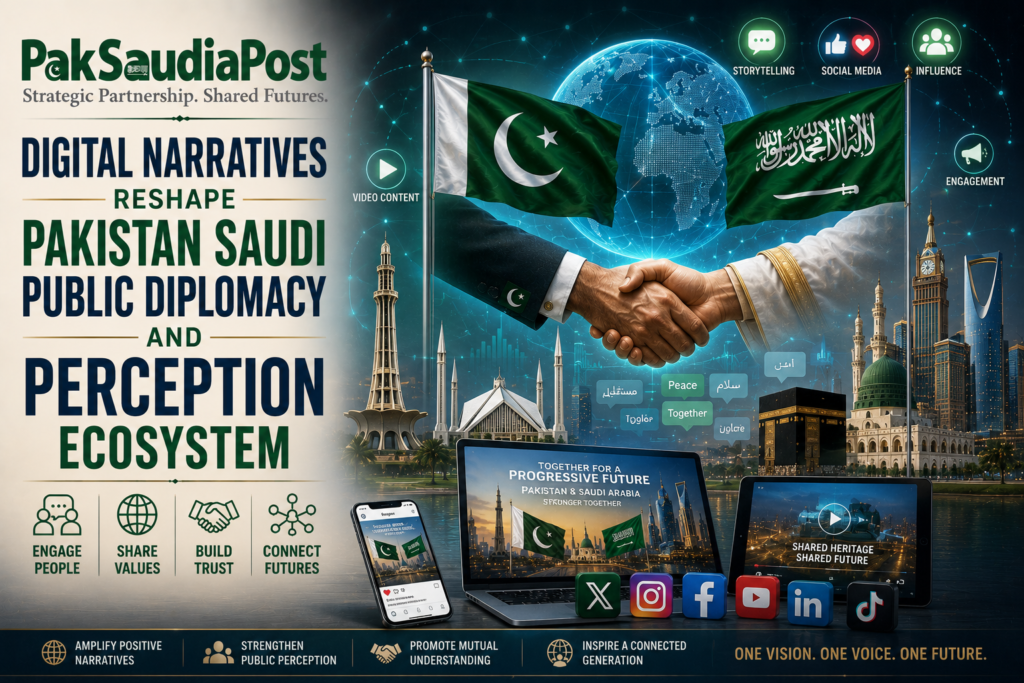
In the early twenty first century, the architecture of diplomacy has undergone a quiet but decisive mutation. The formal rituals of statecraft, once confined to embassies, press briefings, and ministerial communiqués, now unfold within a far more volatile and decentralized arena, the digital information ecosystem. Within this emerging order, Pakistan–Saudi relations are increasingly mediated not only by strategic agreements or economic exchanges but by the circulation of narratives across algorithmically governed platforms, influencer networks, religious discourse communities, and transnational media flows. The result is a form of public diplomacy that is no longer linear or hierarchical but rhizomatic, constantly reassembled through perception, repetition, and emotional resonance.
At the core of this transformation lies a shift from message control to narrative competition. State institutions in both Pakistan and Saudi Arabia continue to articulate official positions, yet these positions are rapidly reinterpreted, refracted, and sometimes distorted as they enter the digital commons. The Saudi state’s modernization discourse associated with Vision 2030, framed around diversification, tourism, and post oil identity reconstruction, circulates globally with a degree of coherence. Pakistan’s diplomatic messaging, by contrast, often appears more fragmented, shaped by institutional discontinuities and competing domestic narratives. In digital spaces, these asymmetries are not merely technical; they become perceptual realities that influence how international and domestic audiences understand the relationship.
The rise of influencers and platform based intermediaries has further complicated this communicative order. Religious commentators, lifestyle vloggers, diaspora content creators, and short form video producers have become inadvertent diplomatic actors. Their content, often produced without explicit political intent, nonetheless constructs powerful interpretive frames. A pilgrimage vlog from Makkah filmed by a Pakistani influencer, for instance, does not simply document spiritual experience; it subtly reinforces narratives of proximity, sacred geography, and emotional belonging between the two societies. Similarly, Saudi lifestyle content showcasing modernization projects in Riyadh or NEOM contributes to an evolving image of Saudi Arabia as a technologically ambitious and reform oriented state, an image that indirectly reshapes perceptions within Pakistani digital audiences.
Religious discourse remains one of the most potent narrative infrastructures within this ecosystem. Sermons, online lectures, and short religious clips circulate widely across Urdu and Arabic digital spheres, reinforcing shared symbolic references and emotional registers. Yet even religious narratives are no longer insulated from geopolitical interpretation. The framing of Islamic solidarity, custodianship of holy sites, and historical ties between the two states is increasingly embedded within broader conversations about migration, economic opportunity, and regional alignment. In this sense, religion operates not as a static ideological anchor but as a dynamic communicative medium through which political meaning is continuously negotiated.
Platform algorithms introduce another layer of complexity. Visibility is no longer determined solely by institutional authority but by engagement metrics, recommendation systems, and viral dynamics. This has profound implications for Pakistan–Saudi narratives. Content that evokes emotional intensity, whether admiration, nostalgia, or controversy, tends to outperform more nuanced diplomatic communication. As a result, simplified or polarised representations of bilateral relations often achieve greater reach than carefully calibrated state messaging. The algorithmic economy thus privileges affect over accuracy, immediacy over depth, and resonance over resolution.
Transnational media further amplifies these dynamics by filtering bilateral relations through competing geopolitical lenses. Western media outlets frequently interpret Pakistan–Saudi relations through the prism of security alignment, counterterrorism cooperation, and energy interdependence. Arab media tends to emphasize fraternal solidarity and developmental partnership within the broader Gulf transformation agenda. Chinese media situates the relationship within connectivity corridors and infrastructural integration frameworks. Pakistani media oscillates between strategic optimism and economic concern. These overlapping narratives do not cancel each other out; instead, they coexist in a state of interpretive pluralism that shapes global perception in fragmented ways.
Within this fragmented environment, public diplomacy becomes an exercise in narrative orchestration rather than message dissemination. States are compelled to engage not only with foreign ministries and international organizations but also with digital communities whose interpretive authority often exceeds that of traditional institutions. The challenge is no longer simply to communicate policy but to sustain narrative coherence across heterogeneous and rapidly shifting informational terrains.
For Pakistan, this presents both vulnerability and opportunity. The vulnerability lies in its relatively diffuse digital communication infrastructure, which struggles to maintain consistent narrative continuity across platforms and languages. The opportunity lies in its highly active diaspora networks and youthful digital population, which possess significant capacity for organic narrative production. If strategically harnessed, these networks could function as distributed nodes of public diplomacy, capable of projecting more nuanced and multidimensional representations of Pakistan–Saudi relations.
Saudi Arabia, by contrast, benefits from a more centralized and resource intensive media ecosystem. Its global communication strategy is increasingly sophisticated, integrating state branding, entertainment industries, sports diplomacy, and technological futurism into a coherent narrative of transformation. However, even this system is not immune to the unpredictability of digital circulation. Once released into global platforms, narratives acquire a degree of autonomy that can complicate even the most carefully constructed messaging strategies.
The interaction between these two narrative systems produces a complex communicative field in which perception is continuously negotiated. In this field, Pakistan–Saudi relations are not fixed objects but evolving constructs shaped by repetition, amplification, and reinterpretation. The relationship is simultaneously strategic, emotional, religious, and economic, and each of these dimensions is differently emphasized depending on the platform, audience, and moment of circulation.
This condition demands a rethinking of public diplomacy itself. Traditional models based on one way communication and institutional messaging are increasingly inadequate. Instead, what is required is a model of narrative agility, one that recognizes the fluidity of digital ecosystems and the multiplicity of interpretive communities. Such a model would prioritize engagement over proclamation, listening over broadcasting, and adaptation over rigidity.
Policy makers must therefore invest in what can be described as narrative infrastructure. This includes multilingual content production units capable of operating across Urdu, Arabic, and English digital spheres, analytical teams trained in platform dynamics and algorithmic behavior, and partnerships with credible digital creators who can serve as informal diplomatic intermediaries. Equally important is the development of rapid response communication mechanisms capable of addressing misinformation and narrative distortion without resorting to heavy handed censorship or reactive messaging.
At a deeper level, both Pakistan and Saudi Arabia must recognize that digital narratives are not merely external representations but internal forces that shape political expectations, identity formations, and policy legitimacy. In this sense, public diplomacy is no longer an auxiliary function of foreign policy but an integral component of statecraft itself.
The future of Pakistan–Saudi relations will therefore depend not only on strategic alignment or economic cooperation but on the capacity of both states to navigate the informational turbulence of the digital age. Success will require a delicate balance between narrative control and narrative openness, between institutional authority and participatory communication, and between strategic messaging and organic expression.
In an environment where perception travels faster than policy, and where narratives often precede diplomatic clarification, the ability to shape meaning becomes as critical as the ability to shape outcomes. Pakistan and Saudi Arabia are thus entering an era in which diplomacy is no longer conducted solely between states but within networks of attention, emotion, and algorithmic visibility.
The challenge ahead is not simply to communicate more effectively, but to understand that communication itself has become the primary terrain of geopolitics.
A Public Service Message