

Competing Media Frames Shape Pakistan Saudi Geopolitical Perceptions

The representation of Pakistan–Saudi relations in global media ecosystems is no longer a peripheral interpretive exercise; it has become a central arena in which geopolitical meaning is actively constructed, contested, and strategically deployed. In an increasingly multipolar information order, where narratives travel faster

Digital Narratives Reshape Pakistan Saudi Public Diplomacy And Perception Ecosystem

In the early twenty first century, the architecture of diplomacy has undergone a quiet but decisive mutation. The formal rituals of statecraft, once confined to embassies, press briefings, and ministerial communiqués, now unfold within a far more volatile and decentralized arena, the digital

Image Management and Soft Power in Saudi Arabia–Pakistan Strategic Communication
The contemporary strategic relationship between Saudi Arabia and Pakistan is increasingly shaped not only by material cooperation in the domains of energy, finance, and security, but also by an expanding architecture of image management and soft power projection. In an era where international
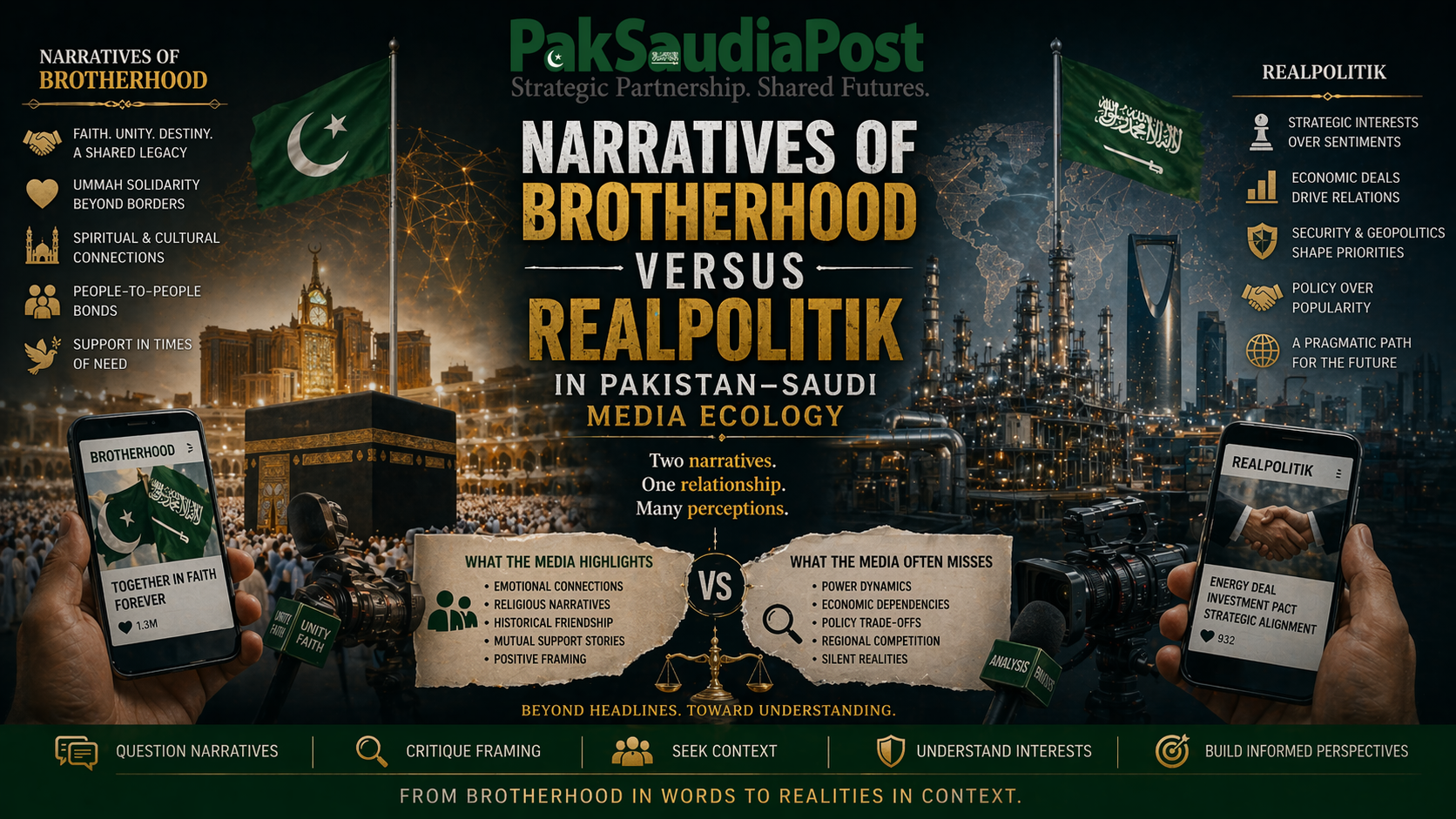
Narratives of Brotherhood Versus Realpolitik in Pakistan–Saudi Media Ecology
The media ecology surrounding Pakistan–Saudi relations is shaped by a persistent tension between emotional narration and strategic calculation, where the language of “brotherhood” operates as both a cultural idiom and a political technology. Across Pakistani and Arab media landscapes, particularly in state-aligned newspapers,
Resonance and Authority: Prominence in Digital Discourse as a Vector of Bilateral Influence
In the contemporary strategic landscape, social media has transformed the way nations construct authority, legitimacy, and influence. Pakistan and Saudi Arabia have increasingly relied on digital prominence to project diplomatic discourse, shape public perception, and reinforce strategic alignment. Prominence is not merely visibility;

Echoes of Influence: Frequency and Framing in the Architecture of Bilateral Legitimacy
In contemporary diplomacy, media has evolved from a passive observer to an active architect of legitimacy, trust, and strategic alignment. Pakistan and Saudi Arabia exemplify this transformation, using sustained and strategically framed coverage to shape public perception, reinforce bilateral credibility, and enable both