

Competing Media Frames Shape Pakistan Saudi Geopolitical Perceptions

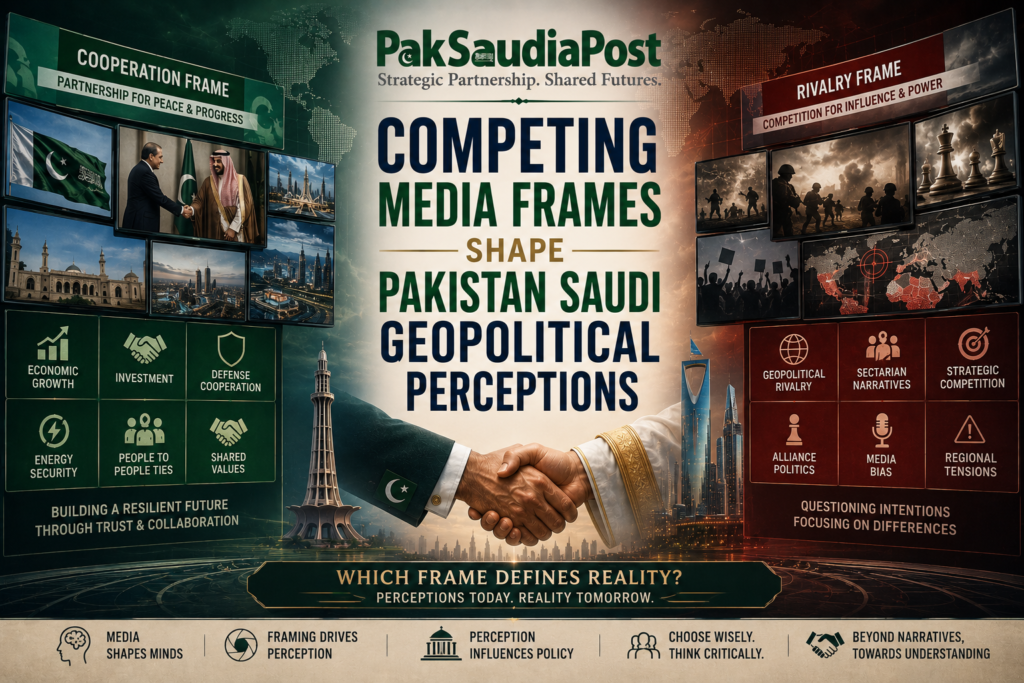
The representation of Pakistan–Saudi relations in global media ecosystems is no longer a peripheral interpretive exercise; it has become a central arena in which geopolitical meaning is actively constructed, contested, and strategically deployed. In an increasingly multipolar information order, where narratives travel faster than diplomatic cables and perception often precedes policy, the framing of bilateral relations is itself a form of power. Pakistan and Saudi Arabia, historically bound by strategic cooperation, religious affinity, and economic interdependence, now find their relationship interpreted through divergent media lenses shaped by regional interests, ideological predispositions, and institutional priorities.
Western media systems tend to situate Pakistan–Saudi relations within a functionalist geopolitical grammar. The relationship is frequently framed through the prism of security cooperation, energy dependency, and counterterrorism alignment. Within this interpretive structure, Pakistan is often depicted as a security export state, providing manpower and strategic depth, while Saudi Arabia is positioned as a hydrocarbon anchored power leveraging financial influence for regional stability. This framing, while analytically coherent within Western policy discourse, tends to compress the relationship into transactional categories, underrepresenting its civilizational, religious, and sociocultural dimensions. The result is a reductionist narrative architecture that privileges strategic utility over historical continuity.
Arab media ecosystems, by contrast, construct a more emotionally resonant and identity infused narrative. Within Gulf oriented media, Pakistan is often represented as a long standing fraternal partner within the Islamic world, bound by shared religious symbolism and mutual developmental aspirations. Saudi Arabia’s media discourse, particularly in outlets aligned with state modernization agendas, increasingly integrates Pakistan into broader narratives of South Asian connectivity, labour mobility, and Islamic economic integration. This framing is less securitized and more relational, emphasizing continuity, solidarity, and socio economic interdependence. However, it also reflects an implicit hierarchy in which Saudi Arabia occupies a central modernizing role, while Pakistan is positioned as a supportive demographic and labour contributor within Gulf transformation strategies.
Chinese media introduces a distinctly structural and infrastructural framing. Within this narrative universe, Pakistan–Saudi relations are not primarily bilateral but are interpreted as nodes within a wider Eurasian connectivity matrix. Pakistan is frequently situated as a corridor state within Belt and Road architecture, while Saudi Arabia is framed as an energy and capital hub potentially intersecting with transregional supply chain realignments. This perspective emphasizes material flows, infrastructural integration, and long term geoeconomic convergence, often downplaying ideological or identity based dimensions in favor of systemic connectivity logic.
Pakistani media narratives occupy a more internally fragmented interpretive space. On one hand, there is a strong tradition of symbolic diplomacy that elevates the relationship to a level of quasi sacred fraternity, emphasizing religious solidarity, historical cooperation, and emotional proximity. On the other hand, economic commentary and investigative journalism often highlight structural asymmetries, trade imbalances, and labour dependency concerns. This duality produces a cognitive dissonance in public perception, where idealized diplomatic narratives coexist with pragmatic economic anxieties. The absence of a unified interpretive framework contributes to a fluctuating national discourse that oscillates between aspiration and critique.
These divergent media framings are not merely descriptive variations; they actively shape geopolitical cognition. In Western policy circles, Pakistan–Saudi relations are often interpreted through risk management and strategic balancing lenses. In Gulf narratives, the relationship is embedded within a broader vision of Islamic modernization and regional leadership consolidation. In Chinese discourse, it becomes part of an infrastructural futurism anchored in connectivity and economic integration. In Pakistani domestic media, it remains a contested symbol of national identity, economic necessity, and religious affiliation.
The interaction of these frames produces what can be described as a fragmented global perception ecology. There is no singular narrative of Pakistan–Saudi relations; instead, there are overlapping and sometimes contradictory interpretive regimes that coexist without resolution. This fragmentation has important implications for diplomacy. It means that policy actions are not interpreted uniformly across audiences, and that the same bilateral development can generate multiple, sometimes conflicting, meanings across different media environments.
In such a context, media framing becomes a strategic domain in its own right. States are no longer merely subjects of representation; they are active participants in framing contests. Saudi Arabia’s investment in global media outreach, cultural diplomacy, and strategic communication reflects an awareness of this reality. Its narratives of modernization, diversification, and global integration are carefully curated to resonate across Western, Asian, and Islamic audiences simultaneously. Pakistan, by contrast, faces structural constraints in projecting a consistent external narrative, often relying on reactive communication rather than proactive framing strategies.
A critical dimension of this framing contest lies in the role of ideological assumptions embedded within media systems. Western narratives are shaped by liberal institutional expectations and strategic realism, often privileging state capacity, governance metrics, and security cooperation. Arab narratives are influenced by civilizational identity frameworks and post oil economic transformation agendas. Chinese narratives are embedded within state centric developmentalism and infrastructural determinism. Pakistani narratives are shaped by post colonial identity formation, economic vulnerability, and aspirational geopolitical positioning. These underlying epistemic structures determine not only what is reported, but how it is interpreted.
Digital media further intensifies these framing divergences. Algorithmic amplification systems privilege emotionally resonant and simplified narratives, often reinforcing pre existing biases rather than encouraging interpretive complexity. As a result, nuanced diplomatic realities are frequently overshadowed by headline driven simplifications. A minor policy disagreement may be amplified into perceived strategic divergence, while long term structural cooperation may receive comparatively limited attention. This algorithmic distortion contributes to a volatile perception environment in which narratives are continuously unstable.
For policymakers, the implications are profound. First, media framing must be understood as an extension of geopolitical strategy rather than a secondary communication function. Second, states must develop sophisticated narrative literacy capabilities, enabling them to anticipate how different media systems will interpret policy actions. Third, diplomatic engagement must increasingly include media stakeholders as indirect participants in international relations, including editors, platform architects, and influential commentators.
In the case of Pakistan–Saudi relations, strategic communication must move beyond symbolic affirmation toward analytical coherence. This requires not only promoting positive narratives but also addressing structural ambiguities that generate interpretive divergence. Economic asymmetries, labour dynamics, and investment flows must be contextualized within transparent frameworks that reduce space for speculative framing. Similarly, shared initiatives must be communicated in ways that resonate across multiple media cultures without losing conceptual precision.
Ultimately, the contest of media framing is not a peripheral phenomenon but a constitutive element of contemporary geopolitics. Pakistan–Saudi relations are not only conducted through treaties and investments but also through interpretive struggles over meaning. In this environment, power is exercised not only through material capabilities but through narrative influence, framing authority, and perceptual coherence.
The future stability and strategic clarity of the relationship will therefore depend on the ability of both states to engage effectively within this fragmented media ecology. This requires not uniform messaging, but adaptive framing strategies capable of operating across divergent informational regimes. In a world where perception is increasingly plural, contested, and instantaneous, geopolitical success will depend as much on interpretive mastery as on diplomatic negotiation.
A Public Service Message


