Institutionalizing Pakistan Saudi Relations Through Permanent Strategic Coordination Desk

Pakistan’s economic and strategic relationship with Saudi Arabia has entered a phase where informal diplomacy, episodic engagement, and personality driven negotiations are no longer sufficient to sustain the scale and complexity of emerging financial, energy, and investment linkages. The evolution of global sovereign capital flows, particularly under Saudi Arabia’s economic transformation agenda, demands a fundamentally different architecture of engagement, one that is institutional, continuous, and insulated from political discontinuity. The central policy argument is that Pakistan requires a permanent Saudi Strategic Desk embedded across its federal governance structure, not as a symbolic coordination unit but as a functional state capacity mechanism designed to manage high value bilateral economic statecraft.
The existing model of Pakistan Saudi engagement is characterized by fragmentation across multiple layers of governance. The Ministry of Foreign Affairs manages diplomatic signalling, the Ministry of Finance handles fiscal negotiations, the Ministry of Energy oversees energy cooperation, the Board of Investment attempts to facilitate foreign direct investment, and the military establishment plays a parallel and often decisive role in strategic and economic coordination. While each of these institutions plays a legitimate role, their lack of integration produces a structural deficit in policy coherence. For Saudi Arabia, which increasingly operates through centralized sovereign wealth decision making frameworks, this fragmented architecture presents a transaction cost problem that directly affects investment confidence.
In contemporary sovereign investment logic, particularly within Gulf capital ecosystems, the primary requirement is not merely political alignment but institutional predictability. Saudi Arabia’s Public Investment Fund and related sovereign entities are increasingly guided by frameworks that prioritize execution certainty, legal enforceability, and governance coherence over diplomatic assurances. In this context, Pakistan’s current engagement model, which relies heavily on high level political visits and ad hoc agreements, fails to meet the operational standards required for long horizon capital deployment. This gap between political intent and institutional execution is now a defining constraint in Pakistan Saudi economic relations.
A central feature of Pakistan’s bilateral management deficit is the absence of a unified command structure for Saudi related economic engagement. Investment proposals, energy deals, infrastructure commitments, and labor agreements are processed through multiple uncoordinated channels, often resulting in delays, duplication, or inconsistent policy signaling. This creates an environment where even strategically important initiatives suffer from administrative inertia. From a sovereign investor perspective, this lack of coordination signals weak state capacity, which increases perceived risk premiums and reduces appetite for large scale commitments.
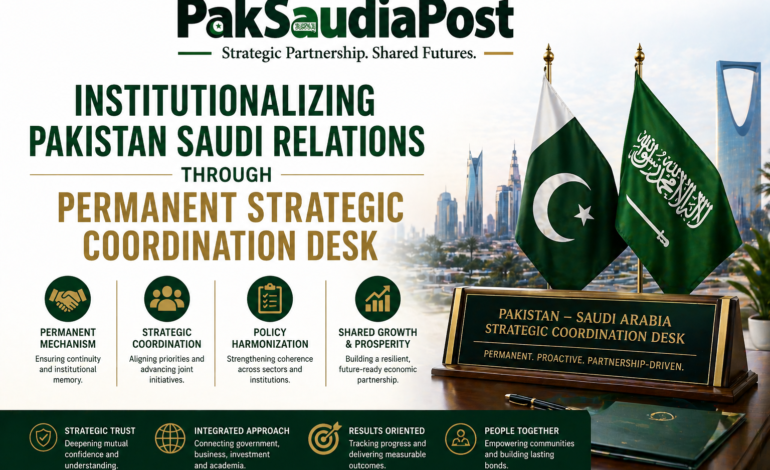
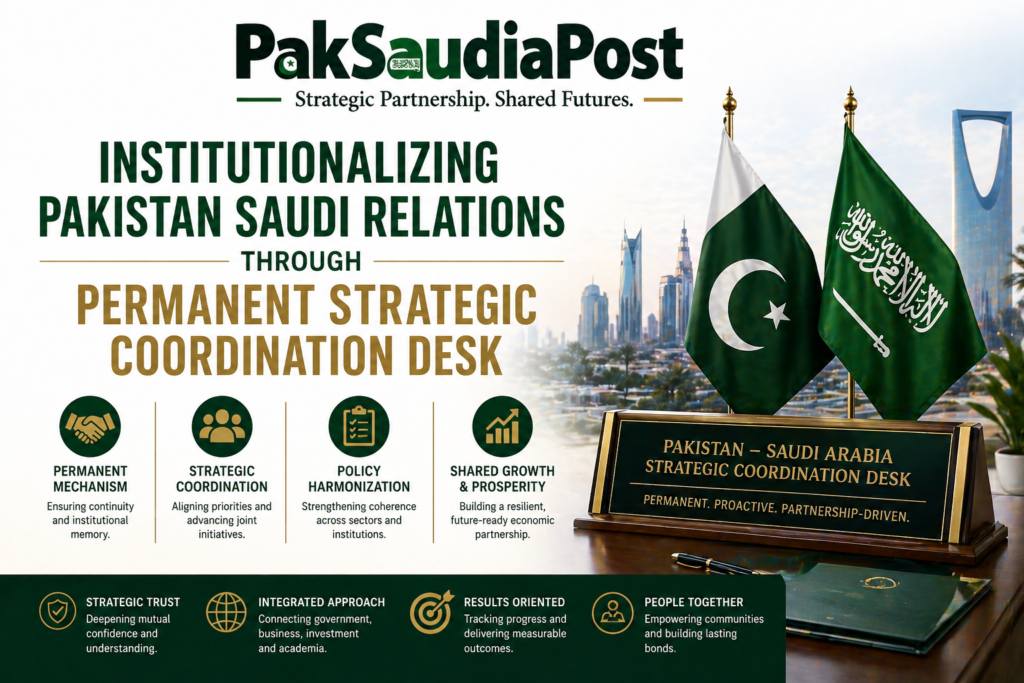
The concept of a permanent Saudi Strategic Desk is therefore not an administrative refinement but a structural necessity. Such a mechanism would function as a centralized coordination hub responsible for aligning all Saudi related engagements across Pakistan’s federal institutions. It would integrate diplomatic, financial, defense related, and investment focused interactions into a single coherent framework. This would not eliminate institutional diversity but would synchronize it under a unified strategic direction. The purpose is to ensure that Pakistan speaks with one economic and strategic voice when engaging with Saudi sovereign capital structures.
One of the most critical deficiencies in the current system is the absence of institutional memory continuity. Pakistan’s governance structure is highly vulnerable to political transitions, with policy priorities frequently shifting between administrations. This results in repeated cycles of negotiation reset, where agreements reached under one political configuration are reinterpreted or delayed under another. For long horizon investors such as Saudi Arabia, this creates a perception of contractual fragility. The absence of durable institutional memory means that strategic commitments lack continuity, undermining confidence in long term implementation.
In contrast, Saudi Arabia’s investment governance model is increasingly characterized by continuity, centralization, and strategic discipline. Vision 2030 has institutionalized a long term planning framework that is insulated from short term political fluctuations. Investment decisions are embedded within a unified strategic logic that prioritizes national transformation objectives over cyclical political considerations. When Saudi sovereign capital engages externally, it expects counterpart institutions to exhibit comparable levels of coherence and continuity. Pakistan’s current fragmented model falls short of this expectation.
Another structural challenge lies in the separation between civilian and military economic diplomacy channels in Pakistan. While both actors play significant roles in external engagement, their lack of formalized coordination creates parallel negotiation structures that are not always aligned. This duality may produce short term tactical flexibility but undermines long term strategic credibility. For Saudi investors, the presence of multiple uncoordinated negotiation channels increases uncertainty regarding decision authority and implementation responsibility. A unified Saudi Strategic Desk would help integrate these parallel channels into a structured coordination mechanism, reducing ambiguity and improving accountability.
The issue of announcement driven diplomacy has become particularly relevant in shaping external perceptions of Pakistan’s investment environment. Over time, repeated cycles of high level announcements without corresponding implementation have generated a narrative within Gulf financial and advisory circles that Pakistan suffers from an execution gap. This narrative is not merely rhetorical but has tangible effects on investment psychology. Sovereign capital institutions increasingly discount commitments from jurisdictions where announcement frequency is high but implementation consistency is low. The result is a credibility discount that raises the effective cost of capital for Pakistan.
Media discourse analysis indicates that this perception is becoming increasingly entrenched. Financial commentary in regional ecosystems often highlights a pattern of ambitious investment announcements followed by delayed execution timelines or partial realization. This creates a reputational feedback loop in which future announcements are evaluated with increased skepticism. In sovereign investment logic, perception lag can be as influential as structural reality. Once a country is categorized as an announcement heavy but execution weak environment, reversing that perception requires institutional rather than rhetorical change.
The establishment of a Saudi Strategic Desk would directly address this perception challenge by introducing a mechanism of accountability and continuity. By centralizing all Saudi related initiatives within a single institutional framework, Pakistan would be able to track commitments, monitor execution progress, and ensure policy consistency across administrative transitions. This would transform bilateral engagement from a series of disconnected agreements into a managed portfolio of deliverable outcomes.
From a structural governance perspective, the Strategic Desk would need to operate at the highest level of state authority, potentially linked directly to the Prime Minister’s Office or a designated inter-ministerial council. Its mandate would include coordination of all Saudi related investment projects, oversight of energy cooperation frameworks, facilitation of labor mobility agreements, and integration of defense related economic cooperation where applicable. It would also function as the primary interface with Saudi sovereign entities, ensuring that communication channels remain consistent, authoritative, and streamlined.
A key feature of such an institution would be its ability to generate policy continuity across electoral cycles. By embedding Saudi related engagement within a permanent institutional structure, Pakistan would reduce the vulnerability of bilateral relations to political turnover. This is particularly important in the context of long term infrastructure and energy investments, which require multi decade stability in regulatory and contractual frameworks. Institutional continuity would therefore become a strategic asset rather than a bureaucratic preference.
The macroeconomic implications of establishing such a desk are significant. Improved coordination and execution efficiency would increase Pakistan’s attractiveness for Saudi sovereign capital, potentially leading to higher volumes of long term investment in infrastructure, energy, logistics, and industrial sectors. More importantly, it would enhance Pakistan’s credibility in global capital markets by signaling a shift toward institutional maturity. This could have secondary effects in terms of improved credit ratings, reduced risk premiums, and increased foreign direct investment inflows from non Saudi sources as well.
However, the success of such an initiative would depend on its ability to overcome entrenched bureaucratic resistance. Pakistan’s administrative structure is characterized by institutional silos that often resist centralization efforts. Ministries may perceive a unified coordination mechanism as an encroachment on their authority. Overcoming this resistance would require high level political consensus and clear delineation of roles within the Strategic Desk framework. Without such clarity, the institution risks becoming symbolic rather than functional.
Another potential challenge lies in ensuring that the Strategic Desk does not become another layer of bureaucracy but instead functions as a genuine coordination and execution platform. This would require embedding performance metrics, accountability mechanisms, and real time monitoring systems into its operational design. The success of the institution would ultimately depend not on its formal establishment but on its ability to improve execution outcomes and reduce coordination friction.
From a geopolitical perspective, institutionalizing Pakistan Saudi relations through a permanent coordination architecture would also enhance strategic stability in the broader region. As Saudi Arabia diversifies its investment partnerships globally, having a reliable and institutionally coherent partner in South Asia would strengthen bilateral resilience. For Pakistan, it would provide a stable anchor within an increasingly volatile external financing environment.
In conclusion, the case for a permanent Saudi Strategic Desk is rooted not in administrative efficiency alone but in structural necessity. Pakistan’s current bilateral engagement model is misaligned with the requirements of modern sovereign capital systems, which demand institutional coherence, execution reliability, and policy continuity. Without addressing these gaps, Pakistan risks remaining trapped in a cycle of announcement driven diplomacy that fails to translate into sustained economic transformation. The establishment of a centralized coordination architecture represents a critical step toward aligning Pakistan’s state capacity with the evolving expectations of Saudi Arabia’s sovereign investment framework and the broader global capital environment.
A Public Service Message