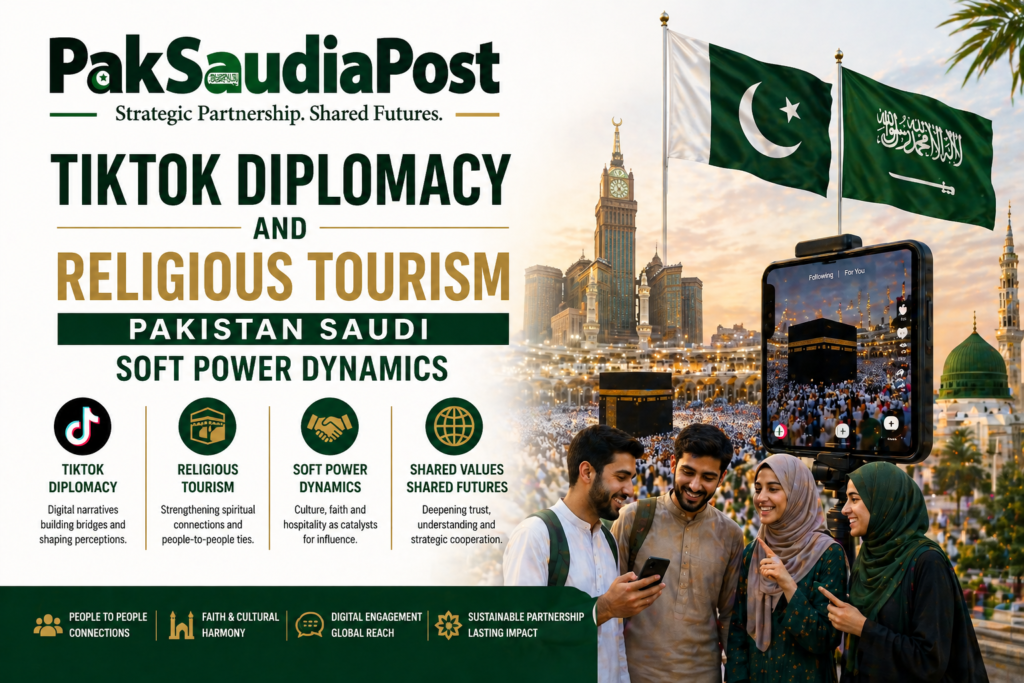
TikTok Diplomacy and Religious Tourism Pakistan Saudi Soft Power Dynamics

The evolving relationship between Pakistan and Saudi Arabia is increasingly being mediated through channels that were structurally irrelevant a decade ago. What once operated through state-to-state diplomacy, oil financing arrangements, labor export regimes, and pilgrimage administration is now being refracted through algorithmic platforms, short video ecosystems, and influencer driven religious travel economies. This shift is not cosmetic. It reflects a deeper redistribution of narrative authority away from ministries and state broadcasters toward decentralized digital actors embedded in attention driven platforms. In this environment, soft power is no longer projected exclusively by states. It is co-produced by pilgrims, content creators, tourism intermediaries, and platform recommendation systems whose incentives are not aligned with diplomatic coherence but with engagement maximization.
The most visible manifestation of this transformation is the rise of what can be described as TikTok mediated pilgrimage culture. Pakistani pilgrims traveling to Saudi Arabia for Hajj and Umrah increasingly document their journeys in short form video formats. These clips are not merely personal records. They function as micro diplomatic artifacts that circulate globally within Urdu speaking digital publics and increasingly within Arabic and transnational Muslim audiences. The content typically emphasizes emotional immediacy, spatial accessibility, hospitality experiences, and infrastructural aesthetics of sacred cities. Makkah and Madinah are not only religious sites in this framing. They become curated visual environments where state capacity, service delivery, and spiritual affect are blended into consumable narrative units.
Saudi Arabia, whether intentionally or not, is increasingly inserted into this ecosystem as a hybrid actor. On one level it remains the custodian of the holy sites, managing highly regulated flows of pilgrims through quota systems, visa regimes, and logistical infrastructure. On another level it is becoming an object of experiential evaluation by ordinary users whose assessments are shaped by hotel standards, transportation efficiency, crowd management, and digital connectivity. The evaluative criteria of pilgrimage are subtly expanding beyond theological fulfilment toward service economy benchmarking. This does not replace religious meaning but overlays it with consumer style metrics that are globally recognizable.
This shift has implications for the political economy of religious tourism. The traditional model of pilgrimage diplomacy was hierarchical and state mediated. Governments negotiated quotas, airlines structured routes, and licensed operators organized packages. Information asymmetry was high, and narrative control largely rested with official channels. The emergence of TikTok diplomacy disrupts this architecture by flattening information hierarchies. A single viral video from a Pakistani pilgrim can now shape perceptions of Saudi logistical performance more rapidly than formal diplomatic communication. This creates a parallel feedback loop in which micro experiences are aggregated into macro reputational signals.
However, this is not a stable soft power gain for either side. The same digital infrastructure that amplifies positive narratives also accelerates the visibility of friction points. Complaints regarding cost structures, visa delays, accommodation variability, and crowd density circulate with equal velocity. The algorithm does not distinguish between devotional content and logistical critique. It optimizes for engagement intensity. As a result, the perception space surrounding Saudi pilgrimage infrastructure is increasingly volatile, composed of simultaneous reverence and grievance. This hybridity complicates any linear interpretation of soft power accumulation.
Within Pakistan, these digital flows are reshaping youth perceptions of Saudi Arabia in ways that are less ideologically coherent than in previous decades. Earlier narratives were anchored in religious solidarity and labor migration dependency. The current narrative environment is fragmented. Younger audiences encounter Saudi Arabia through multiple registers simultaneously, including religious aspiration, employment opportunity, lifestyle aspiration, and digital travel content. These registers do not converge into a unified perception. They coexist in tension, producing what can be described as layered ambivalence rather than stable admiration or critique.
The role of influencers is structurally significant in this configuration. They function as informal intermediaries between state managed religious infrastructure and mass digital audiences. Their content is often monetized through sponsorships, travel partnerships, and platform monetization systems. This introduces a commercial logic into what was historically a non-commercial religious domain. The pilgrimage experience becomes partially reframed as content production opportunity. This does not necessarily diminish religious sincerity, but it introduces parallel incentive structures that shape what is recorded, emphasized, and omitted.
Saudi Arabia’s position within this ecosystem is complex. The state is simultaneously expanding its capacity in religious tourism infrastructure under broader modernization agendas while also managing the reputational exposure generated by uncontrolled digital documentation. Vision oriented reforms in transport, hospitality, and crowd management are increasingly subject to real time public evaluation. This creates a feedback sensitive environment where policy execution is continuously audited by distributed observers. The gap between planned improvements and perceived experience becomes a central variable in digital discourse.
Pakistan’s position is equally constrained but in different ways. As a major source of pilgrims and religious tourists, it does not control the destination infrastructure but heavily participates in shaping narrative flows. However, its ability to systematically influence perception outcomes is limited by the decentralization of content production. State media and official religious institutions no longer monopolize narrative framing. Instead, they coexist with a vast informal network of travelers whose perspectives are heterogeneous and often uncoordinated. This reduces the coherence of any national level communication strategy regarding pilgrimage diplomacy.
The dominant narrative constructs circulating in this space reinforce certain structural asymmetries. One persistent frame is the depiction of Pakistan as a recurrent recipient of external financial and logistical support, extended into the symbolic domain of pilgrimage assistance and facilitation. Another is the portrayal of Saudi Arabia as a strategic stabilizer whose role extends beyond religious custodianship into broader economic and infrastructural provision. These frames are not necessarily inaccurate, but they are increasingly filtered through transactional interpretation logic rather than affective solidarity.
A particularly important dynamic is the emergence of what observers describe as the announcement versus execution gap. In the context of pilgrimage infrastructure and bilateral cooperation, formal announcements of reforms or enhancements are rapidly disseminated through digital media, while their implementation timelines are subject to delays, partial completion, or uneven execution. This creates a persistent discrepancy between expectation formation and lived experience. In algorithmic environments, this discrepancy is not forgotten. It accumulates as a comparative dataset, shaping long term reputational evaluation.
At a deeper level, TikTok diplomacy is altering the semiotics of religious geography. Sacred spaces are no longer perceived solely through doctrinal or historical lenses. They are increasingly interpreted through infrastructural and aesthetic markers. Cleanliness, crowd flow, digital accessibility, and visual architecture become part of the evaluative grammar. This does not secularize pilgrimage but expands its perceptual dimensions. The sacred is now mediated through the logistics of access and the aesthetics of service delivery.
This transformation also introduces new forms of vulnerability. Because perception is increasingly datafied through short form content, it becomes more sensitive to episodic disruptions. A single overcrowding incident, transportation delay, or service failure can disproportionately influence aggregated perception due to its visual reproducibility. Conversely, systemic improvements may remain underrepresented if they are less visually dramatic. This asymmetry between visual salience and structural reality is a defining feature of platform mediated diplomacy.
From a policy perspective, both Pakistan and Saudi Arabia are operating in a partially unrecognized informational environment. Traditional diplomatic tools are insufficient to manage perception dynamics that are generated through decentralized content ecosystems. Regulatory control is limited, and narrative ownership is distributed. In such a system, the key variable is not message control but experience design. The quality of logistical systems, transparency of service delivery, and consistency of implementation become the primary determinants of reputational stability.
Scenario analysis suggests three broad trajectories. In a baseline scenario, TikTok mediated pilgrimage content continues to expand without significant institutional coordination, resulting in a mixed but stable perception environment characterized by simultaneous admiration and critique. In an optimistic scenario, improved service delivery and coordinated digital engagement strategies reduce the announcement execution gap, leading to more coherent positive perception cycles. In a stress scenario, repeated visibility of infrastructural frictions combined with algorithmic amplification of negative experiences produces episodic reputational shocks that complicate bilateral narrative stability.
In all scenarios, the structural reality remains the same. Religious tourism between Pakistan and Saudi Arabia is no longer a purely administrative or spiritual domain. It has become an integrated digital economy of attention, emotion, and infrastructure evaluation. TikTok diplomacy does not replace formal relations, but it increasingly conditions how those relations are perceived, interpreted, and evaluated in real time.
A Public Service Message