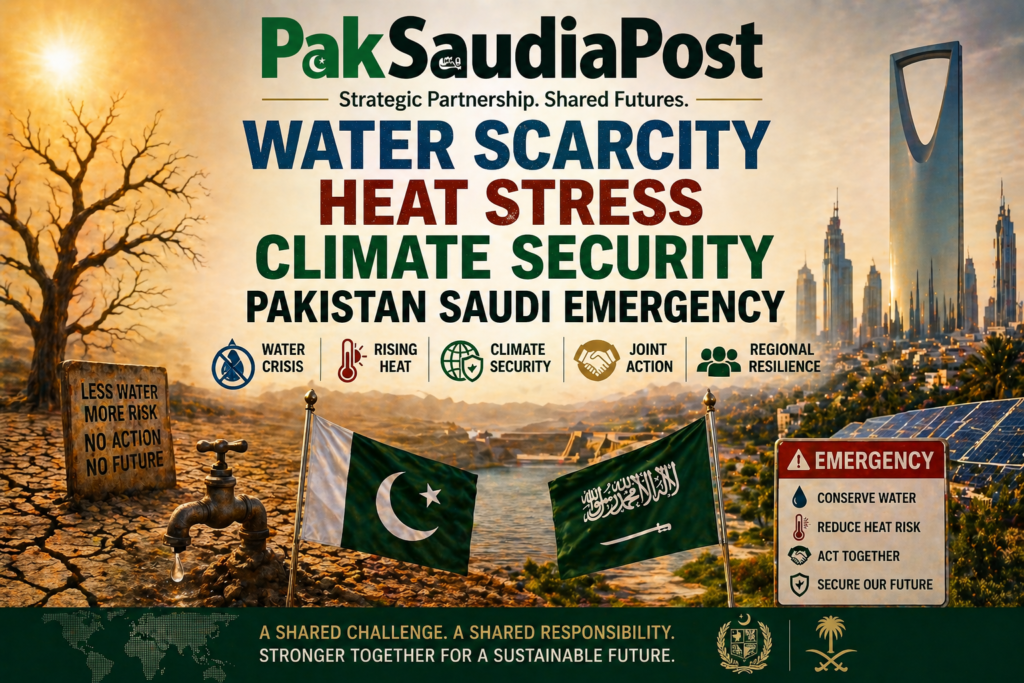
Water Scarcity Heat Stress Climate Security Pakistan Saudi Emergency

The accelerating convergence of water scarcity and heat stress across South Asia and the Arabian Peninsula is no longer a distant environmental concern but an active structural condition reshaping state capacity, economic planning, and regional diplomacy. In both Pakistan and Saudi Arabia, climate stress has moved beyond the domain of environmental policy into the core of national security thinking, albeit through different pathways and narrative constructions. What is emerging is a shared but asymmetrically experienced climate emergency, where ecological stressors are increasingly indistinguishable from economic vulnerability and geopolitical recalibration.
In Pakistan, the climate crisis is experienced through a compounding set of pressures: glacial melt in the Hindu Kush Himalayan system, erratic monsoon cycles, prolonged heatwaves in urban centres, and declining agricultural water availability in the Indus basin. These are not isolated phenomena but interconnected stress points within a hydrological system that has historically underwritten the country’s agrarian economy. The Indus river system, which supports the majority of agricultural output and rural livelihoods, is increasingly subject to seasonal volatility and upstream variability, raising long term concerns about water governance, interprovincial distribution, and food security stability.
In Saudi Arabia, the climate challenge is structurally different but no less severe. The Kingdom exists in one of the most water scarce geographies on earth, where renewable freshwater resources are minimal and dependence on energy intensive desalination has become a defining feature of state infrastructure. Heat stress in the Arabian Peninsula is intensifying, with rising average temperatures and increased frequency of extreme heat events placing pressure on urban infrastructure, labour systems, and energy demand cycles. The climate is not only harsh but becoming more operationally demanding for a state that is simultaneously pursuing economic diversification under Vision 2030.
Despite these differences, both countries are increasingly bound within a shared climate-security horizon. Water scarcity and heat stress are no longer purely environmental variables; they are now embedded in economic planning, migration patterns, energy consumption models, and even diplomatic positioning. The climate emergency is therefore not converging in uniformity but in parallel vulnerability, where distinct ecological systems generate comparable governance pressures.
A key dimension of this emerging reality is the shifting role of water as a strategic resource. In Pakistan, water governance has historically been managed through a combination of colonial infrastructure legacies and federal-provincial allocation frameworks. However, climate change is destabilising these historical arrangements by introducing variability that exceeds institutional design capacity. Flood events alternating with drought conditions have created a cycle of hydraulic unpredictability, challenging the planning assumptions of irrigation systems and urban water supply networks. The 2022 catastrophic floods, which submerged large parts of the country, remain a critical reference point in understanding how climate volatility can rapidly escalate into macroeconomic disruption.
In Saudi Arabia, water scarcity has been addressed through technological substitution rather than hydrological abundance. Desalination plants, among the largest in the world, supply a significant proportion of potable water. Yet this model is energy intensive and closely tied to hydrocarbon infrastructure, creating an interdependence between water security and energy systems. As global energy transitions accelerate, the long term sustainability of this model becomes a strategic question. The Kingdom is increasingly investing in advanced desalination technologies, water recycling systems, and smart consumption frameworks to mitigate this dependency, but structural vulnerability remains inherent.
Heat stress operates as a second layer of convergence. In Pakistan, urban heat islands in cities such as Karachi, Lahore, and Multan are intensifying due to rapid urbanisation, inadequate green infrastructure, and energy constrained cooling systems. Heatwaves have become more frequent and more lethal, disproportionately affecting low income populations and outdoor labour sectors. Agricultural productivity is also being affected through shifts in growing seasons and crop stress conditions. The heat crisis is therefore not only an environmental phenomenon but a labour and productivity challenge.
In Saudi Arabia, heat stress is increasingly shaping urban planning, labour policy, and infrastructure design. Mega projects and urban expansions are being engineered with climate resilience in mind, including shaded architecture, cooling corridors, and energy efficient building systems. However, the extreme baseline temperature environment means that adaptation costs are structurally high. Outdoor labour, much of which has historically relied on expatriate workers from countries like Pakistan, is particularly exposed to heat related risks, linking climate stress directly to migration and labour governance systems.
This intersection between climate stress and labour mobility introduces a critical dimension to Pakistan–Saudi relations. Pakistani labour migration to Saudi Arabia has long been a key channel of remittance inflow and socio economic interdependence. However, rising heat stress in the Gulf may increasingly affect labour demand patterns, working conditions, and sectoral distribution of migrant workers. Climate change is thus indirectly influencing migration governance, not through political borders but through physiological limits of human labour under extreme environmental conditions.
Media narratives in both countries are beginning to reflect, albeit unevenly, this climate-security linkage. In Pakistan, climate discourse is often framed through the lens of vulnerability and disaster response, with strong emphasis on humanitarian impact, international aid, and infrastructure recovery. The narrative is reactive, episodic, and crisis oriented, shaped by flood events, heatwave mortality spikes, and agricultural disruption cycles. Climate change is frequently externalised as a global injustice problem, reinforcing a discourse of climatic victimhood within international forums.
In Saudi Arabia, media and official narratives frame climate change through a technocratic and innovation driven lens. The emphasis is on adaptation capacity, technological leadership in desalination, renewable energy transition projects, and smart city development. Climate stress is acknowledged but reframed as an opportunity for infrastructural modernisation and global leadership in environmental engineering. This creates a narrative asymmetry between the two countries, where one frames climate as vulnerability and the other as managed transformation.
Despite these differences, both narratives converge on a shared recognition: climate stress is now a strategic issue. It affects food systems, water availability, urban planning, labour productivity, and long term economic sustainability. This recognition is gradually pushing climate policy into the realm of high politics, where it intersects with national security, foreign policy, and economic planning.
At the structural level, the climate crisis is also reshaping energy systems in both countries, which has indirect implications for water and heat governance. Pakistan’s energy shortages exacerbate cooling constraints during heatwaves, while Saudi Arabia’s energy abundance enables large scale desalination but ties water security to fossil fuel dynamics. The global transition toward renewable energy introduces both risks and opportunities for these models, potentially altering the cost structures of climate adaptation.
Another emerging dimension is the role of urbanisation. Both countries are experiencing rapid urban expansion, albeit with different trajectories. In Pakistan, urbanisation is often unplanned or informally structured, leading to infrastructure deficits that amplify climate vulnerability. In Saudi Arabia, urbanisation is state planned and capital intensive, allowing for integrated climate adaptation design. However, both models face challenges in scaling resilience to extreme climate scenarios.
Agricultural systems remain a critical point of divergence and vulnerability. Pakistan’s economy remains heavily dependent on climate sensitive agriculture, making it highly exposed to hydrological variability. Shifts in rainfall patterns, river flows, and temperature extremes directly affect food security and rural livelihoods. Saudi Arabia, by contrast, has reduced domestic agricultural dependence through imports and controlled farming initiatives, but remains vulnerable to global food price volatility, which is itself increasingly climate influenced.
The emerging question is whether climate stress will evolve into a central axis of Pakistan–Saudi bilateral cooperation. Historically, the relationship has been structured around labour migration, energy trade, and security cooperation. However, climate change introduces a new domain of potential engagement: water technology transfer, desalination innovation, climate resilient agriculture, and urban heat mitigation systems. These areas could become future vectors of cooperation, particularly as both countries confront escalating adaptation costs.
Yet institutional coordination remains limited. There is no comprehensive bilateral climate framework between Pakistan and Saudi Arabia that integrates water management, heat resilience, and environmental planning into a unified strategic dialogue. This represents a governance gap at a time when climate stress is becoming structurally binding. Without institutionalisation, cooperation remains fragmented and reactive rather than strategic and anticipatory.
From a geopolitical perspective, climate stress is also reshaping regional alignments. Water scarcity in South Asia has implications for upstream downstream relations, while heat stress in the Gulf affects labour importing economies across Asia. Climate vulnerability is therefore creating new forms of interdependence that are not fully captured by traditional diplomatic frameworks. Pakistan and Saudi Arabia are both positioned within this emerging climate interdependence network, albeit from different structural positions.
The long-term risk is that climate stress may outpace institutional adaptation capacity. In such a scenario, water scarcity and heat stress could become drivers of economic instability, migration pressure, and geopolitical tension. Alternatively, if managed through coordinated policy frameworks, they could become catalysts for technological cooperation and strategic alignment.
What is increasingly clear is that climate change is no longer an environmental backdrop to international relations between Pakistan and Saudi Arabia. It is becoming an active structural force shaping the conditions under which economic, social, and political systems operate. The emergency is not only ecological; it is institutional, economic, and narrative.
In this sense, water scarcity and heat stress are not merely challenges to be managed but signals of a deeper transformation in the architecture of regional interdependence. The question is no longer whether climate change will affect Pakistan and Saudi Arabia, but how it will reorganise the terms of their engagement with each other and with the broader global system.
A Public Service Message