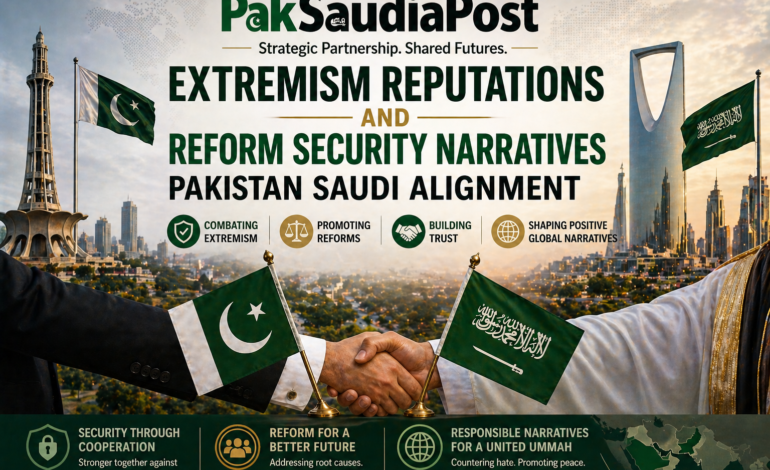
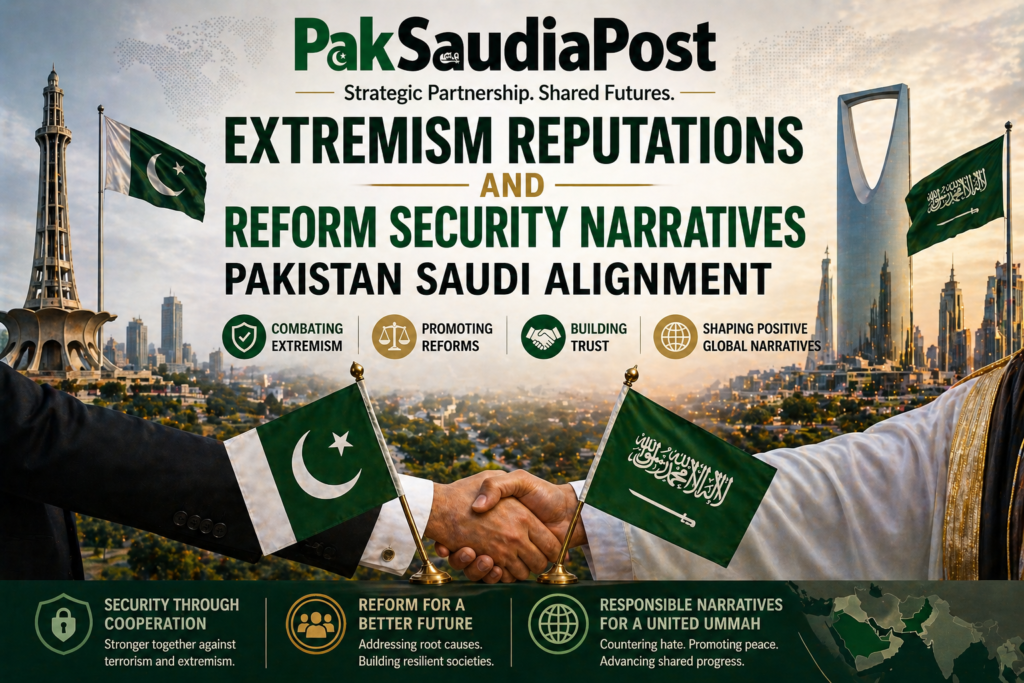
Extremism Reputations and Reform Security Narratives Pakistan Saudi Alignment

The security relationship between Pakistan and Saudi Arabia has long been anchored in a pragmatic convergence of strategic needs, religious affinity, and regional threat perceptions. Yet beneath this surface stability lies a more complex and evolving terrain, where reputational politics, narrative reconstruction, and counter extremism frameworks are becoming as significant as traditional defence cooperation. In the contemporary geopolitical environment, security is no longer defined solely by battlefield cooperation or intelligence sharing, but increasingly by the management of perception, the engineering of legitimacy, and the recalibration of historical associations that continue to shape external judgments about both states.
For decades, Pakistan and Saudi Arabia have been situated within global security narratives that often conflate disparate phenomena, including political Islam, transnational militancy, and labour migration networks. These associations, frequently amplified through Western media ecosystems and periodic crisis reporting, have created a residual reputational burden that both states now actively seek to recalibrate. In Saudi Arabia, the transformation is explicitly articulated through Vision 2030, which is not merely an economic blueprint but also a strategic narrative project aimed at repositioning the Kingdom as a modernising, moderate, and globally integrated actor. In Pakistan, a parallel but less coordinated effort is underway to shift international perception from episodic instability to managed resilience, particularly in the context of counterterrorism compliance, financial regulation reforms, and post conflict stabilization narratives.
The intersection of these two narrative projects is increasingly shaping bilateral security cooperation. What was once a primarily operational relationship, focused on training, defence exchanges, and intelligence coordination, is now expanding into the domain of reputational security. This refers to the strategic management of how states are perceived in global information environments, and how those perceptions influence investment flows, diplomatic flexibility, and strategic partnerships. In this sense, counter extremism is no longer only about dismantling networks, but also about dismantling inherited narratives that associate entire regions with monolithic security risks.
Saudi Arabia’s internal reform trajectory has been central to this shift. The Kingdom has invested heavily in redefining its domestic and international image architecture, emphasising cultural openness, economic diversification, and controlled religious discourse reform. These efforts are not cosmetic; they are structurally embedded in the state’s attempt to transition from rent based governance to post oil legitimacy. Within this framework, extremism is framed not only as a security threat but as a reputational liability that affects tourism, investment, and global integration. Consequently, counter extremism policies are increasingly integrated with media strategy, cultural diplomacy, and digital narrative management.
Pakistan’s trajectory is more fragmented but equally significant. The state has undergone successive phases of counterterrorism operations, legal reforms, and financial monitoring compliance, particularly in relation to global regulatory regimes. However, its international reputation remains partially shaped by earlier phases of conflict association, which continue to circulate in global media memory structures. This creates a lag between current policy realities and external perception frameworks. As a result, Pakistan often finds itself in a position where institutional reforms are under acknowledged relative to inherited narrative frames.
Within this context, Pakistan–Saudi security cooperation acquires a dual function. On one level, it remains grounded in tangible operational collaboration, including training programs, defence exchanges, and intelligence coordination mechanisms. On another level, it operates as a symbolic stabiliser, reinforcing the image of both states as responsible actors within the broader Islamic world. This symbolic dimension is increasingly important in a global environment where security legitimacy is partially constructed through media visibility, diplomatic signalling, and alignment narratives.
The role of media ecosystems in shaping these perceptions cannot be overstated. In Western policy discourse, security narratives often rely on episodic framing, where isolated incidents are extrapolated into broader regional generalisations. In South Asian media environments, narratives are frequently shaped by domestic political imperatives, which can amplify or suppress security discourse depending on internal cycles. In Saudi media, narrative construction is tightly managed through state aligned platforms that emphasise reform, stability, and controlled religious messaging. The result is a fragmented global information space where the same security realities are interpreted through fundamentally different epistemic filters.
Digital platforms have intensified this fragmentation. Algorithmically driven content distribution systems tend to amplify emotionally charged security content, often decoupled from institutional context. This has significant implications for Pakistan and Saudi Arabia, as isolated incidents involving extremism or security incidents can rapidly circulate across global networks, reinforcing outdated or simplified narratives. In response, both states have increasingly engaged in strategic communication practices aimed at preempting narrative escalation, including rapid diplomatic messaging, curated media releases, and selective transparency initiatives.
At the structural level, however, the challenge is more complex. Extremism is no longer understood solely as an internal security issue but as a transnational governance problem that intersects with migration, digital radicalisation, ideological contestation, and geopolitical competition. This requires a shift from reactive counterterrorism models to anticipatory governance frameworks. Saudi Arabia’s approach increasingly reflects this shift, with investments in ideological moderation programs, digital monitoring systems, and regional coordination mechanisms. Pakistan’s approach, while more constrained by resource limitations, has similarly evolved toward institutional compliance, legal reform, and military civilian coordination frameworks.
The bilateral dimension of this evolution is particularly significant. Pakistan and Saudi Arabia share overlapping concerns regarding regional instability, including conflicts in neighbouring theatres, maritime security challenges, and the spillover effects of transnational militant networks. However, the framing of these concerns has shifted from ideological alignment narratives to risk management frameworks. Security cooperation is increasingly justified not in civilisational terms but in functional terms, such as border stability, labour protection, and counter financing of illicit networks.
Yet despite these functional convergences, reputational asymmetries persist. Saudi Arabia’s global image transformation has been more systematically managed, supported by large scale investment in global media, entertainment, and cultural diplomacy. Pakistan’s narrative reconstruction has been more constrained, often reactive to external reporting rather than proactively shaping discourse. This asymmetry affects how bilateral cooperation is perceived externally, with Saudi initiatives often viewed through a reformist lens, while Pakistani initiatives are more frequently framed through a security risk lens.
This divergence has implications for the future trajectory of cooperation. If unaddressed, reputational asymmetry could create friction in how joint initiatives are perceived by external actors, particularly in investment and multilateral forums. Conversely, coordinated narrative strategies could enhance the strategic depth of the relationship, allowing both states to present a more unified framework of counter extremism cooperation that integrates security, development, and governance reform.
There is also an internal dimension to consider. Both states face generational shifts in their populations, with younger cohorts increasingly exposed to globalised digital environments, alternative ideological frameworks, and transnational identity formations. This creates new challenges for traditional counter extremism models, which were largely designed for hierarchical information environments. The new reality is one of decentralised information flows, where ideological influence is dispersed across platforms rather than concentrated in institutions.
In this environment, legitimacy becomes as important as enforcement. Security policies must be accompanied by credible narratives of inclusion, opportunity, and reform. Without this, counter extremism efforts risk being perceived as purely coercive, which can undermine their long term effectiveness. Both Pakistan and Saudi Arabia are therefore engaged in parallel efforts to integrate security policy with socio economic reform, educational restructuring, and media engagement strategies.
Ultimately, the Pakistan–Saudi security relationship is entering a phase of strategic narrative consolidation. The traditional focus on operational cooperation remains intact, but it is now embedded within a broader framework of reputational management and perception engineering. Extremism, once treated primarily as a security category, is increasingly being reframed as a governance, communication, and legitimacy challenge.
The success of this transition will depend not only on institutional capacity but also on the ability of both states to align their narratives with evolving global information ecosystems. In a world where perception increasingly shapes power, the management of reputational security may become as consequential as the management of physical security itself.
A Public Service Message