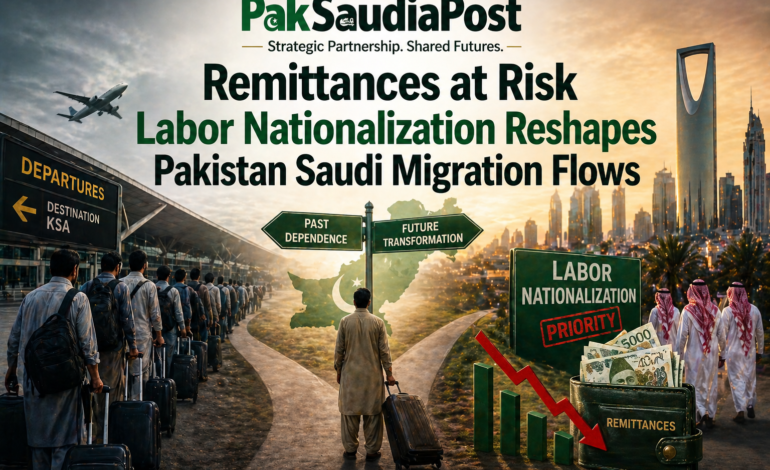
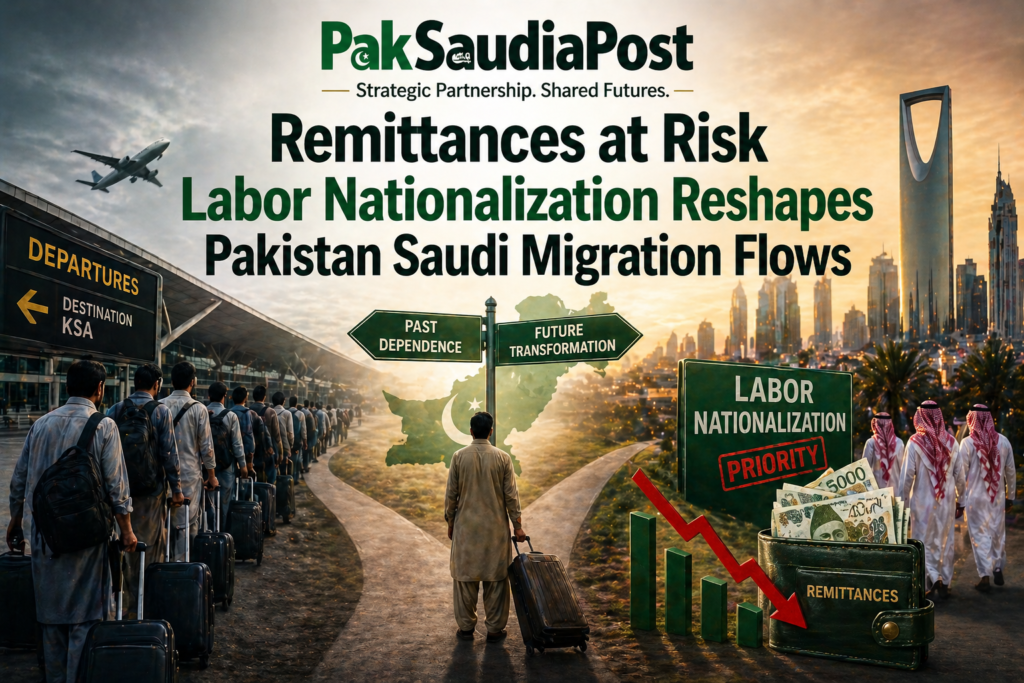
Remittances at Risk Labor Nationalization Reshapes Pakistan Saudi Migration Flows

The political economy of Pakistan’s external sector has long rested on a paradox of dependence and resilience, where structural vulnerabilities in domestic employment have been offset by the outward migration of labour to the Gulf, particularly Saudi Arabia. For decades, this arrangement functioned as a stabilising circuit between surplus labour and oil-financed labour demand, embedding remittances as a quasi-sovereign pillar of Pakistan’s balance of payments architecture. Yet this equilibrium is now being quietly reconfigured by a set of labour market transformations inside the Kingdom that are neither episodic nor reversible in the short term. Saudization, formalised through Vision 2030 and reinforced by sector-specific quotas, wage localisation policies, and digital labour governance systems, is reshaping the very grammar of migrant labour in Saudi Arabia. What was once a structurally open corridor for South Asian workers is increasingly becoming a regulated, performance-based, and politically nationalised labour market.
This transformation is not merely administrative. It reflects a deeper recalibration of the Saudi developmental state, one that is attempting to reconcile the imperatives of youth employment, fiscal diversification, and social contract reform. In this recalibration, expatriate labour is no longer treated as an elastic buffer but as a managed variable within a broader sovereignty project. The Saudi labour market is being re-engineered to prioritise nationals in retail, construction supervision, logistics, and even segments of technical services that historically absorbed large volumes of Pakistani workers. The introduction of occupation bans for foreigners in selected sectors, combined with rising fees on dependent visas and firm-level Saudization targets, signals a gradual tightening of what had been an open migration valve for decades.
For Pakistan, the implications are structurally asymmetric. Remittances from Saudi Arabia remain one of the largest external inflows, forming a critical stabiliser of foreign exchange reserves and current account deficits. The macroeconomic dependency is not marginal; it is systemic. In periods of fiscal stress, Pakistan’s economic planners have repeatedly leaned on Gulf inflows to offset trade imbalances, service debt obligations, and stabilise the rupee. The implicit assumption underpinning this model has been continuity, that Saudi labour demand would remain broadly stable, even if sectoral composition evolved. That assumption is now under pressure.
Recent labour market data from the Gulf suggests a gradual shift in hiring patterns, with increased emphasis on skilled national employment and automation-driven substitution in low-skill segments. Construction, once the backbone of Pakistani labour export to Saudi Arabia, is increasingly subject to mechanisation and contract consolidation. Service sectors such as retail and hospitality are undergoing similar transitions, with localisation quotas enforced through digital compliance platforms that reduce informal hiring flexibility. While the absolute stock of foreign workers remains substantial, the marginal space for new Pakistani entrants is narrowing, and wage dynamics are becoming more compressed.
The Pakistani policy discourse, however, has yet to fully internalise this structural shift. Official narratives continue to frame remittances as a stable, almost self-renewing resource, often invoking the emotional economy of diaspora contribution without sufficiently interrogating the regulatory evolution of Gulf labour markets. This reflects a broader epistemic gap between domestic economic imagination and external structural realities. In media representations within Pakistan, migrant labour is often romanticised as an extension of national resilience, a symbolic export of human capital that sustains households and macroeconomic indicators alike. Yet the lived experience of migrant workers in the Gulf is increasingly shaped by contractual precarity, wage uncertainty, and tightening residency regimes.
In Saudi Arabia, by contrast, the narrative is distinctly sovereign and developmental. Labour nationalisation is framed as a necessary correction to historical dependency on foreign labour, a recalibration aligned with youth empowerment and productivity enhancement. Within this narrative, expatriate labour is not rejected but reclassified, from structural necessity to conditional utility. This shift is critical because it alters the political economy of inclusion. Migrant labour is no longer embedded as an invisible constant but is subject to periodic reassessment based on national labour absorption capacity.
The intersection of these two narrative regimes produces a form of asymmetrical perception management. Pakistan continues to view Gulf labour markets through the lens of historical continuity, while Saudi Arabia increasingly operates on a logic of selective inclusion and strategic substitution. The result is a growing divergence between expectation and reality, particularly in relation to long-term remittance stability.
At the macroeconomic level, the risks are compounding. Remittances have functioned as a counter-cyclical buffer for Pakistan, smoothing external shocks and providing liquidity in foreign exchange constrained environments. Any structural slowdown in inflows from Saudi Arabia would not merely affect household consumption but would reverberate through currency markets, external debt servicing capacity, and fiscal planning. The elasticity of Pakistan’s external account is therefore indirectly tied to labour policy decisions taken in Riyadh, a dependency that is rarely acknowledged in formal policy discourse.
This dependency is further complicated by demographic shifts within Pakistan itself. The labour surplus that feeds migration is not infinite; it is increasingly urbanised, partially educated, and exposed to alternative migration destinations beyond the Gulf. At the same time, competition for Gulf jobs is intensifying as other labour-exporting countries in South and Southeast Asia recalibrate their own migration strategies. Pakistan is no longer the sole or even dominant supplier of low-cost labour to the Gulf. This diversification of labour sources reduces Pakistan’s bargaining position in the regional migration hierarchy.
Within Saudi Arabia, the political economy of Saudization is also not without internal constraints. The rapid expansion of domestic employment targets has created tensions between efficiency and localisation. In certain sectors, the substitution of expatriate labour with national workers has resulted in transitional productivity gaps, wage inflation pressures, and administrative enforcement burdens. However, these frictions have not reversed the overall trajectory; rather, they have led to more sophisticated forms of labour segmentation. The state is increasingly differentiating between strategic expatriate categories and replaceable labour segments, embedding hierarchy within migration itself.
Digital governance tools are central to this transformation. Labour compliance systems, visa tracking platforms, and firm-level localisation dashboards are enabling real-time monitoring of workforce composition. This reduces the informal elasticity that previously characterised Gulf labour markets and makes migrant labour flows more predictable but less flexible. For Pakistani workers, this translates into a more rigid entry system, higher compliance costs, and reduced negotiating power at the point of employment.
The broader geopolitical dimension cannot be ignored. Pakistan–Saudi relations have historically been anchored in a triad of security cooperation, religious affinity, and labour exchange. As the labour pillar becomes more conditional, the overall structure of bilateral engagement may shift toward security and investment-based cooperation. However, this also reduces the distributed economic connectivity that remittances once provided, potentially narrowing the social depth of the relationship.
In media ecosystems across both countries, this transformation is being framed in divergent ways. Pakistani digital and broadcast narratives often highlight individual success stories of migrant workers, reinforcing a moral economy of sacrifice and reward. Saudi media narratives, on the other hand, increasingly emphasise national transformation, efficiency gains, and workforce localisation as markers of sovereignty. The absence of a shared interpretive framework creates a discursive gap in which structural economic changes are not fully translated into public understanding.
The risk is not immediate collapse but gradual erosion. Remittance dependency rarely declines abruptly; it decays through incremental tightening of labour channels, wage compression, and generational substitution effects. Over time, this can produce a silent fiscal adjustment crisis in sending countries that are slow to diversify their external income sources. Pakistan’s vulnerability lies precisely in this delayed feedback loop, where structural shifts in Gulf labour policy translate into domestic macroeconomic stress with a time lag.
Policy responses in Pakistan have so far remained largely reactive. There is increasing emphasis on bilateral labour agreements, skill certification programs, and diplomatic engagement aimed at preserving labour market access. However, these measures operate within constraints set by the receiving state’s domestic political economy. No amount of bilateral negotiation can fully offset a structural shift toward labour nationalisation if it is embedded within a broader state-led transformation agenda.
The more fundamental challenge lies in economic diversification. Reducing reliance on a single labour corridor requires not only expanding alternative migration destinations but also restructuring domestic employment generation capacity. Without such adjustment, remittance volatility will remain a persistent macroeconomic risk factor, particularly in periods of global economic tightening or regional labour market reconfiguration.
Ultimately, what is unfolding is not the end of Pakistan–Saudi labour connectivity but its transformation from a structurally open system to a selectively regulated one. The implications are profound. Remittances, once treated as an external constant, are becoming an endogenous variable within Gulf domestic policy frameworks. For Pakistan, this means that external economic stability is increasingly subject to policy decisions over which it has limited influence.
The emerging reality is one of conditional interdependence. Labour flows will continue, but under tighter constraints, greater selectivity, and higher political visibility. In such a configuration, remittances cease to be a stable pillar and become a negotiated outcome. For a country structurally reliant on external labour income, this shift demands not only policy recalibration but a rethinking of the very architecture of economic security.
A Public Service Message