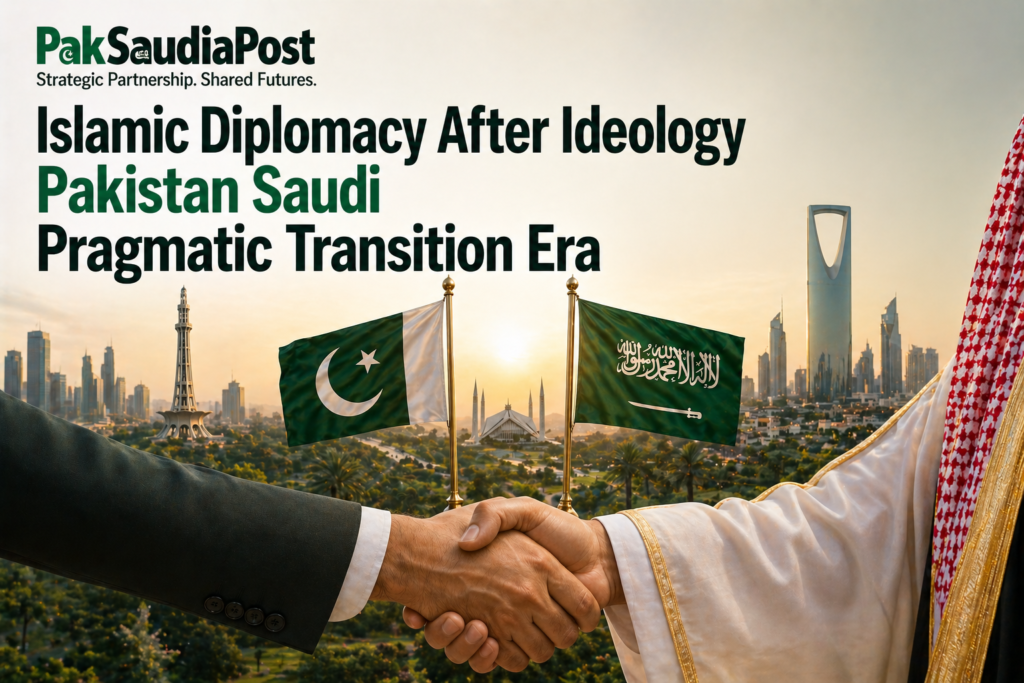
Islamic Diplomacy After Ideology Pakistan Saudi Pragmatic Transition Era

By : Shafqat Ali Qureshi
The evolution of Pakistan–Saudi relations reflects a broader structural transformation within the Muslim world, where ideological cohesion is gradually giving way to pragmatic statecraft shaped by economic interdependence, geopolitical recalibration, and institutional survival logic. What was once framed primarily through the language of Islamic solidarity, civilizational affinity, and shared religious identity is increasingly being reconstituted through a more complex grammar of interests, diversification strategies, and adaptive alignment. This shift does not represent the disappearance of ideology, but rather its gradual displacement from the centre of diplomatic utility toward the periphery of symbolic legitimacy.
Historically, Pakistan and Saudi Arabia have been bound by a relational matrix that combined religious symbolism with strategic necessity. Pakistan’s early decades were marked by economic fragility and security dependence, while Saudi Arabia’s emergence as an oil superpower created a natural asymmetry in which financial support, labour migration, and political alignment became foundational pillars of bilateral engagement. This relationship was frequently articulated in moral and ideological terms, reinforcing a sense of intra Islamic fraternity that transcended conventional geopolitical calculation.
However, the contemporary international environment has significantly altered the conditions under which this relationship operates. The post Cold War order has fragmented into overlapping regional systems, each characterized by fluid alliances, transactional diplomacy, and issue based cooperation. Within this environment, Saudi Arabia’s foreign policy has undergone a visible transition from ideological leadership of the Muslim world toward strategic moderation and economic globalization. Pakistan, simultaneously, has been compelled by structural economic pressures, security complexities, and shifting global alignments to rethink its own diplomatic posture.
The emergence of Saudi Arabia’s Vision driven transformation is central to this reconfiguration. The kingdom is actively repositioning itself as a global investment hub, logistics corridor, tourism destination, and technological adopter. This requires not only economic restructuring but also diplomatic diversification. Engagement with China, cautious normalization with Iran, recalibrated relations with Türkiye, and selective engagement with Western powers all reflect a broader strategy of reducing geopolitical dependency on any single axis. In such a framework, ideological alignment becomes insufficient as a basis for long term partnership unless it is reinforced by economic and institutional complementarity.
Pakistan’s position within this transition is both opportunistic and constrained. On one hand, its long standing relationship with Saudi Arabia provides it with a reservoir of trust, access, and historical goodwill that few other states in the region possess. On the other hand, Pakistan’s economic vulnerabilities, governance challenges, and limited export diversification reduce its bargaining power in a rapidly professionalizing global investment environment. The shift from ideological diplomacy to pragmatic partnership therefore requires Pakistan to upgrade its institutional capacity if it wishes to remain a relevant actor in Saudi Arabia’s evolving strategic horizon.
One of the most significant transformations in this relationship is the gradual decoupling of emotional narratives from policy execution. In earlier phases, bilateral relations were often framed through the lens of religious solidarity and historical fraternity, which provided political resilience during crises but also obscured structural inefficiencies. Today, however, both states are increasingly compelled to operate within frameworks defined by measurable outcomes, investment returns, labour productivity, and security risk assessments. This shift introduces a new form of accountability into the relationship that is less symbolic and more performance oriented.
The media environment plays a critical role in shaping perceptions of this transition. In South Asian public discourse, Pakistan–Saudi relations are still frequently represented through nostalgic and identity driven narratives that emphasize brotherhood and spiritual unity. In contrast, global media and policy analysis increasingly interpret the relationship through the lens of economic interdependence, labour markets, and regional security cooperation. This divergence creates a perceptual gap between domestic expectations and external realities, which can generate misunderstandings regarding the actual direction of policy evolution.
Saudi Arabia’s global media strategy further complicates this dynamic. The kingdom has significantly invested in reshaping its international image through sports diplomacy, cultural initiatives, mega infrastructure projects, and high visibility global events. This strategic communication effort is designed to reposition Saudi Arabia as a modernizing, globally integrated state rather than a purely oil dependent economy. Pakistan’s engagement with this narrative ecosystem remains comparatively limited, often relying on legacy frameworks rather than proactive narrative integration. This asymmetry affects the visibility and interpretation of bilateral cooperation.
The transition toward pragmatic diplomacy also alters the nature of security cooperation. In earlier periods, security ties were often framed in existential terms, emphasizing shared threats and ideological alignment. In the current phase, security cooperation is increasingly professionalized, technology driven, and embedded within broader regional stabilization strategies. Counter terrorism collaboration, intelligence sharing, and defence cooperation continue to be important, but they are now situated within a more diversified portfolio of bilateral engagement that includes economic, technological, and institutional dimensions.
Energy remains a central axis of pragmatic cooperation. Saudi Arabia’s role as a global energy supplier intersects directly with Pakistan’s chronic energy deficits. However, the nature of this interaction is evolving from simple supply dependency toward more complex arrangements involving investment in energy infrastructure, renewable energy cooperation, and downstream industrial participation. This reflects a broader shift from commodity based relations to integrated energy partnerships.
Labour migration, historically one of the most important dimensions of Pakistan–Saudi relations, is also undergoing structural transformation. Saudi Arabia’s domestic economic reforms and labour market localization policies are gradually reshaping the demand for foreign labour. This necessitates a shift in Pakistan’s approach from unskilled labour export toward skills development, vocational training, and certification alignment. The future sustainability of this relationship will depend significantly on Pakistan’s ability to adapt its human capital strategy to evolving Gulf requirements.
At the geopolitical level, the normalization of Saudi Iranian relations introduces a new layer of stability into Pakistan’s regional environment. The reduction of sectarian geopolitical competition in the Gulf allows Pakistan greater diplomatic flexibility, reducing the pressure to make binary alignments. However, this does not eliminate complexity; it reconfigures it. Pakistan must now navigate a more fluid regional order in which alliances are issue based, temporary, and frequently overlapping.
The broader implication of this transformation is the emergence of what can be described as post ideological Islamic diplomacy. In this model, religious identity remains an important source of legitimacy and soft power, but it is no longer the primary determinant of foreign policy alignment. Instead, states prioritize economic resilience, technological advancement, geopolitical diversification, and institutional capacity. Ideology becomes symbolic rather than structural.
This does not imply a complete erosion of Islamic identity in diplomacy. Rather, it suggests its repositioning within a more complex hierarchy of policy drivers. Symbolic solidarity continues to play a role in moments of crisis, humanitarian engagement, and multilateral positioning. However, day to day diplomatic practice is increasingly governed by pragmatic considerations that transcend ideological narratives.
For Pakistan, the central challenge is to adapt to this transition without losing the symbolic capital that has historically underpinned its relationship with Saudi Arabia. This requires a dual strategy of institutional modernization and narrative recalibration. On the one hand, Pakistan must strengthen its economic governance, investment frameworks, and policy consistency to meet the expectations of a more globally integrated Saudi economy. On the other hand, it must refine its diplomatic communication to align with evolving global narratives without abandoning its historical identity frameworks.
Saudi Arabia, for its part, faces the challenge of balancing its emerging global pragmatism with its traditional leadership role in the Muslim world. As it diversifies its alliances and redefines its economic priorities, it must also manage expectations within the broader Islamic community that continues to view it as a symbolic anchor of religious and cultural identity.
Ultimately, the transition from ideological to pragmatic diplomacy does not mark the end of Islamic diplomatic frameworks but their transformation. Pakistan and Saudi Arabia are not abandoning their historical relationship; they are recalibrating it within a more complex, interconnected, and performance driven international system. The success of this transition will depend on their ability to integrate symbolism with structure, identity with interest, and history with future oriented strategy.
In this emerging order, Islamic diplomacy is no longer defined by uniformity of ideology but by adaptability of engagement. Pakistan and Saudi Arabia, as two pivotal actors within this evolving landscape, are therefore not merely participants in a bilateral relationship but co architects of a broader transformation in how the Muslim world defines diplomacy in an age beyond ideology.
A Public Service Message