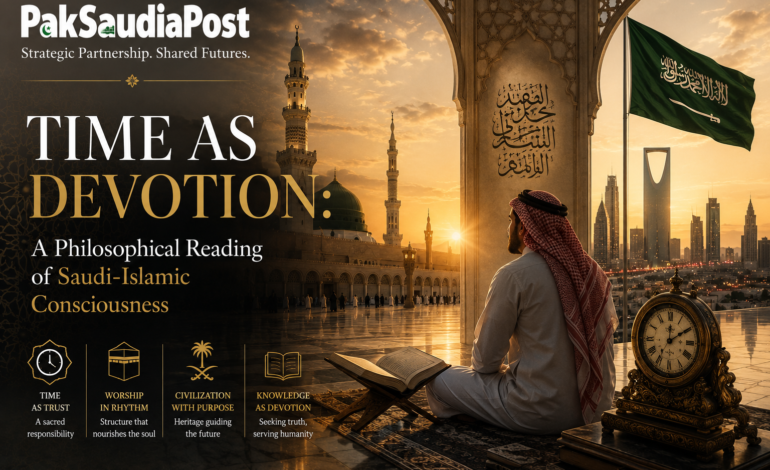
Time as Devotion: A Philosophical Reading of Saudi-Islamic Consciousness

In most modern intellectual traditions, time is treated as a straight movement from past to future, a continuous line along which societies advance, accumulate knowledge, and measure progress. Within this framework, time is something external to human beings, something they pass through, something that can be divided, scheduled, optimized, and ultimately mastered. It becomes a silent container in which history unfolds as a story of change. Yet when one enters the religious and cultural consciousness of Saudi Arabia, this assumption begins to shift. Time is no longer experienced primarily as linear progression but as alignment, return, and remembrance. It is not a neutral current carrying human life forward, but a structured rhythm that repeatedly calls human attention back toward meaning.
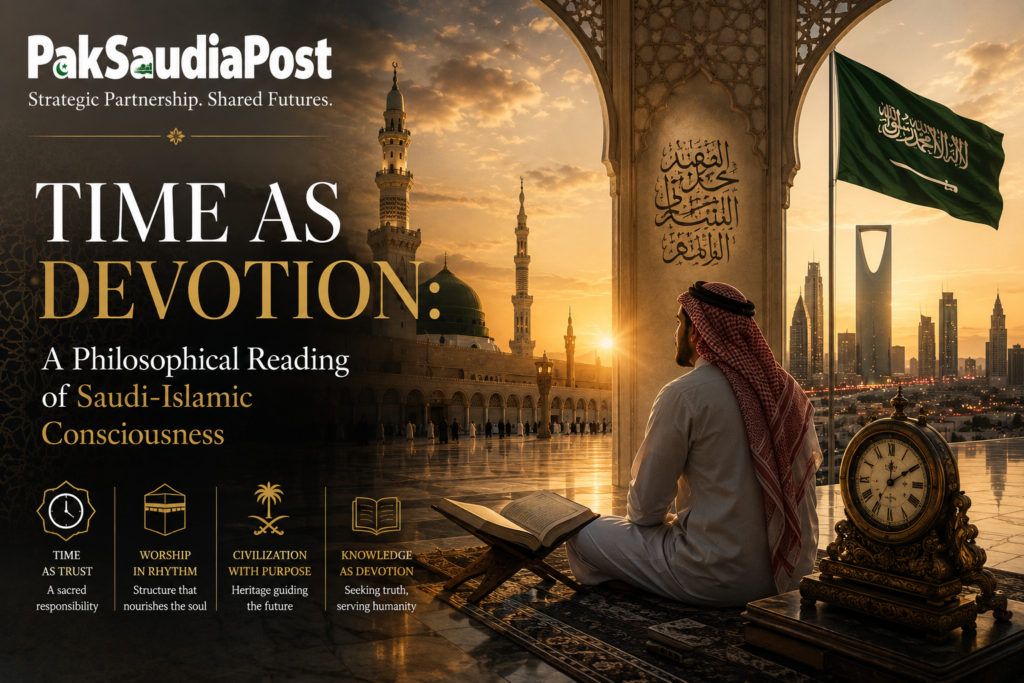
In the Saudi-Islamic worldview shaped by the presence of Makkah and Madinah, time is fundamentally devotional. It is not detached from spirituality but deeply embedded within it. The very structure of daily life is shaped by intervals of remembrance rather than continuous productivity. The five daily prayers are not simply rituals performed within time; they are interruptions of ordinary time that reorient consciousness toward a sacred axis. Each call to prayer is a reminder that time does not belong entirely to human control. It belongs also to a higher order of meaning that repeatedly reclaims attention from worldly absorption.
Morning does not function merely as the beginning of work, but as the beginning of remembrance. Midday is not only a peak of activity but a moment of interruption and reorientation. Evening is not simply the end of labor but a transition into reflection. Night is not the disappearance of time but its quiet folding into stillness. In this structure, time does not move in a straight uninterrupted line. It moves in cycles of return. Life is not defined only by what progresses forward but also by what repeatedly returns human consciousness to presence.
This cyclical structure of time becomes even more visible in the experience of pilgrimage toward Makkah. The journey of pilgrimage is not merely physical movement across geography. It is a reconfiguration of lifetime time. In modern secular understanding, a life is often measured through accumulation, education, career, achievement, and milestones that stretch across years. In devotional understanding, life is also measured through moments of return to origin, moments in which existence is re-centered and redefined. Pilgrimage becomes such a moment, compressing the meaning of an entire lifetime into a concentrated experience of presence before the sacred.
During pilgrimage, ordinary categories of identity weaken. Social distinction loses importance, economic position becomes irrelevant, and personal narratives temporarily dissolve into collective remembrance. What remains is the shared orientation toward the sacred center. Time itself feels different. It is no longer experienced as accumulation of days but as intensity of presence. Past and future lose their dominance and the present becomes fully charged with meaning. In this sense, pilgrimage does not extend time; it deepens it.
The most profound transformation of time occurs in relation to revelation itself. In the historical consciousness shaped around Madinah, time is not only personal and ritual but also civilizational. The arrival of revelation does not simply occur within history; it reorganizes the meaning of history itself. Events are no longer understood as isolated occurrences but as part of a moral and spiritual unfolding. The world before revelation and the world after revelation are not merely chronological phases. They represent different orientations of meaning, different ways of interpreting existence.
In this structure, history is not neutral. It is evaluative. It is shaped by moral reference points that redefine how time is understood. The past is not discarded but continuously reinterpreted through the lens of meaning. The future is not purely open possibility but unfolding within a framework already shaped by foundational truth. The present is not isolated but constantly connected to both memory and meaning. Thus historical time becomes devotional time at the level of civilization itself.
From daily prayer, pilgrimage, and revelation emerges a unified philosophical insight. Time is not something human beings move through as passive participants. It is something they continuously align with as active participants in meaning. Alignment becomes the key idea. To align with time is to recognize that not all moments are equal in meaning even if they are equal in measurement. Some moments demand remembrance, some demand reflection, some demand action, and some demand silence. Time becomes qualitative rather than purely quantitative.
In modern thought, especially within industrial and economic systems, time is treated as uniform. Every second is identical in value, every hour interchangeable, and efficiency is measured by how much can be produced within equal units of time. In devotional consciousness, time is not uniform in meaning. It is differentiated by sacred rhythm. The value of a moment is not determined only by productivity but by its alignment with remembrance and moral orientation.
This creates a distinct ethical relationship with time. Action is not only judged by outcome but also by timing, intention, and alignment. To act at the wrong moment is not merely inefficient, it is misaligned. To act at the right moment is not only effective, it is meaningful. Even waiting becomes meaningful. Even pause becomes meaningful. Silence is not absence of time but fullness of reflection within it.
The concept of return is central to this understanding. Time is not only forward movement but continuous return to meaning. Every prayer is a return, not to physical past but to presence. Every act of remembrance is a return to awareness. Every ritual repetition is a return that strengthens orientation. Return does not cancel progress. It stabilizes it. Without return, movement becomes disoriented. With return, movement acquires direction.
This produces a temporal structure that is neither purely linear nor purely circular but spiral in nature. Life moves forward, but it repeatedly revisits foundational points of meaning. Each return is not repetition in the sense of sameness, but deepening in the sense of renewed awareness. Time thus becomes layered rather than flat, textured rather than uniform.
In contemporary global conditions, where acceleration defines economic, technological, and social life, this understanding of time offers a different rhythm of existence. Modern systems often demand continuous speed, constant availability, and uninterrupted productivity. Within such a framework, time feels compressed and pressured. Devotional time introduces intervals that resist total acceleration. It does not reject modern time but interrupts its total dominance. It preserves space for reflection, remembrance, and reorientation.
This is not a conflict between tradition and modernity in simple terms. It is a coexistence of temporal logics. One logic emphasizes acceleration, the other emphasizes alignment. One emphasizes expansion through speed, the other emphasizes depth through return. Both operate simultaneously in lived reality.
In the broader cultural and religious consciousness of Saudi Arabia, time therefore becomes a moral and spiritual structure rather than a purely mechanical one. It organizes life not only in terms of schedule but in terms of meaning. It connects daily existence to civilizational memory and to transcendent orientation. It ensures that human life is not reduced to continuous motion but is periodically re-centered through remembrance.
Ultimately, time in this worldview is not something to be mastered or escaped. It is something to be understood as sacred rhythm. Human beings do not stand outside it as observers. They live within it as participants who are repeatedly called back to awareness. Time is not simply passage. It is presence that must be recognized again and again.
Thus the philosophical insight becomes clear. Time is not something human beings move through. Time is something they continuously align with, return to, and re-enter in order to remain meaningfully connected to existence itself.
A Public Service Message