Pakistan’s Tightrope: Iran–Saudi Oil Wars and Regional Realignment

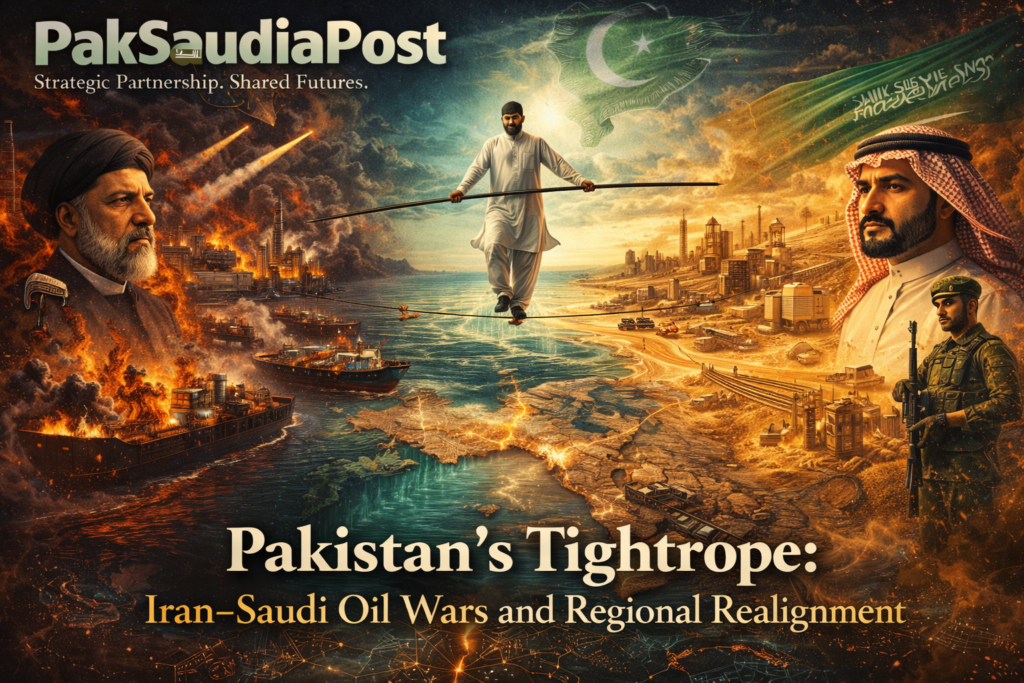
Pakistan today stands at a complex crossroads in the Middle East, where regional rivalries, energy politics, and strategic realignments converge in ways that directly affect its security, economy, and foreign policy calculus. The ongoing rupture in OPEC plus agreements, intensified proxy conflicts, and shifting alliances between Riyadh and Tehran place Pakistan in a delicate balancing act. Its historical ties with both states, combined with its economic vulnerabilities and strategic aspirations, compel it to navigate a narrow path that preserves sovereignty while seeking regional stability. The significance of Pakistan’s position extends beyond immediate economic considerations to encompass national security, border management, and diplomatic leverage.
Saudi Arabia’s recent posture in the Gulf reflects mounting internal and external pressures. Riyadh faces domestic demands to secure economic growth amidst fluctuating oil prices, while simultaneously asserting its leadership role in the Gulf Cooperation Council and broader Islamic bloc. The Houthi attacks on Saudi territory in March 2026, which targeted critical infrastructure and disrupted oil supply chains, underscore the volatility of the regional security environment. These attacks, framed as part of a broader Iran-aligned strategy, have intensified Saudi perceptions of strategic vulnerability, compelling a reconsideration of both defense posture and economic diplomacy. For Pakistan, this translates into both opportunity and risk. On one hand, Pakistan’s long-standing defense cooperation with Saudi Arabia, including military training and strategic support, positions it as a reliable partner in Riyadh’s security calculus. On the other hand, overt alignment with Saudi initiatives against Iran could jeopardize Pakistan’s border stability and trade relations with its western neighbor.
From Tehran’s perspective, the narrative is shaped by resilience under sanctions, border security imperatives, and the pursuit of regional influence. Iran’s engagement in proxy conflicts across the Arabian Peninsula, its technological and infrastructural adaptations under sanctions, and its sustained role in global energy markets reflect a strategic posture of cautious assertiveness. Pakistan’s eastern borders and trade corridors, including routes connecting to Chabahar, are critical for Iran’s economic ambitions and regional connectivity. For Pakistan, maintaining stable relations with Iran is not merely a diplomatic preference but a necessity dictated by trade, energy imports, and the need to prevent spillover of instability into its border provinces. Tehran’s perception of Pakistan as a neutral intermediary capable of balancing Gulf interests with Iranian security concerns creates a diplomatic space that Islamabad must carefully manage.
The OPEC plus dynamics have added further complexity to Pakistan’s strategic equation. Riyadh’s pursuit of higher production quotas and price stabilization often conflicts with Tehran’s emphasis on constrained output to protect revenue under sanctions. Pakistan, importing significant volumes of Saudi crude, benefits from discounted energy supplies and financial deposits that sustain its balance of payments. Simultaneously, trade relations with Iran, encompassing energy, transit fees, and border commerce, require Islamabad to avoid antagonizing Tehran. The resulting policy challenge is one of calibration, where Pakistan must demonstrate reliability to Saudi partners while retaining sufficient autonomy to engage constructively with Iran. The tension is not theoretical; it manifests in economic planning, diplomatic engagements, and military posture along borders that have historically been porous and sensitive to regional upheaval.
Energy politics intersects with economic dependency in ways that shape Pakistan’s strategic choices. The inflow of Saudi oil and deposits provides critical relief to Pakistan’s fiscal constraints, enabling domestic consumption and sustaining industrial activity. Simultaneously, Iran supplies gas and access to trade corridors that are vital for Pakistan’s western regions. Any disruption in these flows risks domestic economic stability, including inflationary pressures and energy shortages. Hence, Pakistan’s role evolves into that of a balancing actor, mediating interests without overtly committing to one side. This balancing act extends beyond energy to encompass labor migration, investment flows, and infrastructure projects, each reflecting the intertwined nature of economic and security considerations.
Diplomatically, Pakistan has leveraged its historical relations with both Tehran and Riyadh to position itself as a mediator in regional tensions. Shuttle diplomacy, facilitated by backchannel communications and personal relationships with political and military leadership in both countries, has allowed Islamabad to mitigate escalation while preserving its national interests. Pakistan’s role in hosting dialogue or facilitating negotiations, whether under the auspices of the Organization of Islamic Cooperation or through bilateral arrangements, underscores its potential as an active agent rather than a passive observer. The effectiveness of such mediation relies on Pakistan’s credibility, which is reinforced by consistency in policy, strategic neutrality, and the ability to communicate security sensitivities to both partners.
The evolving nature of proxy conflicts in the region adds another layer of complexity. Houthi activity in Yemen, Iranian-backed militia operations, and Saudi countermeasures create a fluid security environment with spillover effects along Pakistan’s western borders. Militancy, smuggling, and transnational movements of actors with vested interests in the Gulf conflict necessitate vigilant border management. Pakistan’s military and security institutions, therefore, must calibrate responses that protect national sovereignty while avoiding direct entanglement in Gulf confrontations. The dual pressures of economic reliance on Saudi Arabia and border stability with Iran compel a nuanced approach, balancing deterrence, engagement, and strategic foresight.
Pakistan’s technological and economic adaptations play a supporting role in its balancing strategy. Investment in energy infrastructure, diversification of import sources, and engagement in regional trade corridors such as Chabahar and Gwadar enhance Pakistan’s leverage. The integration of digital monitoring, border surveillance, and financial technologies enables more precise management of both economic flows and security risks. These measures, while technical, are critical to sustaining Pakistan’s position as a regional stabilizer capable of navigating competing pressures. Technology also supports policy articulation, providing data-driven insights that inform diplomatic engagement, energy negotiations, and contingency planning.
The interplay between strategic divergence and economic interdependence defines Pakistan’s foreign policy calculus. While Saudi Arabia and Iran pursue competing regional agendas, Pakistan’s interests require engagement with both. The divergence is particularly evident in defense alignment, proxy conflicts, and energy pricing strategies, whereas interdependence manifests in trade, labor movement, and shared security concerns. Pakistan’s challenge is to transform this duality into a coherent national strategy, leveraging its unique position to maintain autonomy, secure economic flows, and contribute to regional stability. The capacity to engage constructively with both neighbors reinforces Pakistan’s credibility as a regional actor capable of mitigating crises and facilitating dialogue.
Regional realignments, including the broader strategic reconfiguration of Gulf and South Asian relations, amplify the importance of Pakistan’s tightrope approach. The emergence of new alliances, shifts in US engagement, and the influence of China and other regional actors create a complex web in which Pakistan’s choices carry amplified consequences. Diplomatic foresight, economic prudence, and strategic patience become essential tools for navigating this evolving landscape. Pakistan’s ability to integrate immediate crisis management with long-term structural considerations determines its success in sustaining security, economic resilience, and international credibility.
The human dimension of these dynamics cannot be overlooked. Border communities, labor migrants, and civilian populations are directly affected by shifts in energy flows, trade restrictions, and security measures. Pakistan’s strategy, therefore, must account for social stability, equitable economic distribution, and protection of human capital. Policy decisions that neglect these considerations risk undermining the very stability that Pakistan seeks to preserve through its balancing efforts. Engagement with civil society, transparent communication of national priorities, and targeted economic initiatives are critical to sustaining domestic confidence in foreign policy choices.
Looking ahead, Pakistan’s tightrope approach will increasingly require strategic foresight, diplomatic agility, and economic innovation. Opportunities exist to formalize mediation frameworks, strengthen trade and energy linkages, and expand regional cooperation initiatives. Simultaneously, risks persist in the form of renewed proxy conflicts, energy shocks, and diplomatic pressures that may force alignment with one side at the expense of the other. Pakistan’s ability to maintain equilibrium, assert its agency, and manage complex regional networks will determine its role in shaping the security and economic landscape of the Gulf and South Asia.
In conclusion, Pakistan’s position between Iran and Saudi Arabia is both a challenge and an opportunity. The rupture in OPEC plus agreements, the escalation of proxy conflicts, and the evolving regional alliances place Islamabad in a unique position as a balancing state. By carefully managing economic dependencies, engaging in proactive diplomacy, and investing in technological and infrastructural resilience, Pakistan can preserve sovereignty while contributing to regional stability. Its role is not that of a passive observer but of an active agent capable of shaping outcomes through strategic mediation, informed policy, and adaptive engagement. The tightrope that Pakistan walks is delicate, yet with foresight, prudence, and consistent engagement, it can transform this precarious position into a platform for national advancement, regional peace, and sustainable economic development.
A Public Service Message