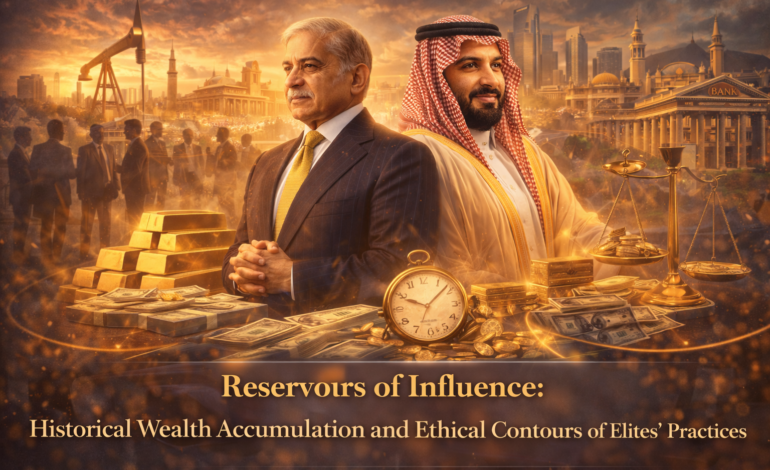
Reservoirs of Influence: Historical Wealth Accumulation and Ethical Contours of Elites’ Practices


The historical trajectory of wealth accumulation by influential elites across the Arabian Peninsula offers a unique lens through which one may explore the intersection of economics, power, and ethics. These figures have not merely accumulated wealth in conventional terms; they have systematically constructed financial empires through mechanisms that extend beyond trade into debt control, usury, strategic commerce, and human capital management. Their actions, often cloaked in the garb of ritual and tradition, reveal a sophisticated understanding of structural leverage, allowing them to consolidate influence and control over both populations and resources. This consolidation of wealth cannot be separated from the moral questions it raises, as history demonstrates patterns of deception, social exploitation, and systemic manipulation. In this examination the focus on debt instruments and banking control emerges as the primary variable around which other facets of wealth accumulation can be understood. This variable is not isolated; it intersects with informal commerce channels, lavish consumption, recreational indulgences, and the projection of symbolic power. Together, these mechanisms provide a multidimensional understanding of how wealth was not merely earned but orchestrated as a strategic instrument of influence and control.
The use of debt and usury as tools of social and economic leverage exemplifies the operational sophistication of these historical elites. By controlling access to financial instruments, they were able to create networks of dependency that extended across trade, agriculture, and emerging urban markets. Loans issued with high interest rates, or structured in a manner that guaranteed perpetual repayment obligations, generated steady inflows of capital while simultaneously restricting the economic autonomy of borrowers. These systems ensured that wealth flowed back to a centralized reservoir controlled by the elite while creating structural inequalities that entrenched their social dominance. In examining historical records and economic chronicles one observes repeated patterns in which families and communities became tied to the financial apparatus of these elites, effectively transforming credit dependency into a vehicle of both economic extraction and political influence. These mechanisms reflect a deep understanding of leverage, demonstrating that wealth is not solely a product of labor or trade but a function of institutionalized control over the financial ecosystem.
The strategic use of informal commerce channels further augmented the accumulation of wealth. While these networks may be described in modern terms as outside formal regulatory oversight, they functioned historically as extensions of economic influence, enabling access to goods, capital, and markets that were otherwise restricted. The elites’ command over these channels permitted them to navigate trade complexities and extract disproportionate benefit while minimizing exposure to legal or political accountability. These operations reinforced their financial reservoirs, creating a dual structure in which formal banking and credit systems interacted seamlessly with more fluid commerce mechanisms. This integration allowed the elite to maintain flexibility, adapt to market fluctuations, and exploit opportunities arising from regional instability or shifts in supply and demand. From an ethical perspective, the use of informal commerce as a revenue mechanism raises questions about transparency, fairness, and social accountability, highlighting a persistent tension between wealth optimization and moral responsibility.
The lifestyle of these historical figures was both a reflection and a reinforcement of their wealth. Lavish consumption, recreational indulgences, and elaborate displays of material affluence were not merely personal indulgences but strategic instruments to signal power, influence, and legitimacy. These practices reinforced social hierarchies, communicated authority, and cultivated a perception of untouchable status. Accounts from travelers, chroniclers, and contemporaneous observers repeatedly describe opulent residences, extensive feasting, elaborate ceremonies, and the maintenance of luxury fleets of animals, possessions, and attendants. Such conspicuous consumption served multiple purposes: it affirmed social stratification, demonstrated financial capability, and acted as a visual representation of control over resources. From an ethical standpoint, these practices illustrate a complex interplay between wealth, visibility, and moral perception, revealing a deliberate cultivation of social dependence and admiration. The lavish lifestyle, when juxtaposed against structural inequities, becomes a symbolic embodiment of the ethical compromises inherent in the accumulation and deployment of wealth.
The control over human capital, particularly through labor relations and patronage, was another dimension of strategic wealth management. By tying communities to employment, trade privileges, or access to financial instruments, these elites created a socio-economic network that ensured loyalty and reinforced dependency. The diaspora of skilled labor and traders, historically situated in urban centers and marketplaces, became both an instrument of economic output and a channel through which influence could be extended across regions. This control over human capital intersected with financial leverage, as the ability to regulate labor access and remuneration augmented the efficacy of debt and credit strategies. Ethical analysis of these mechanisms highlights the systemic moral challenges inherent in this approach, revealing patterns of coercion, manipulation, and social stratification that persist as historical phenomena with contemporary resonance.
The projection of symbolic power through rituals, ceremonies, and financial sponsorship further reinforced wealth consolidation. Religious, cultural, and civic events were strategically leveraged to solidify authority, cultivate loyalty, and signal generosity, yet these public displays often masked underlying mechanisms of economic extraction and social control. Through patronage of construction projects, ceremonial sponsorships, and strategic gifting, the elites reinforced their social dominance while subtly embedding financial obligations and dependencies. These acts, while ostensibly charitable or ritualistic, functioned as tools of governance and control, creating a system in which moral and social obligations were closely intertwined with economic leverage. The interplay between visible generosity and structural extraction exemplifies the trans-normative ethical landscape, where actions that appear morally virtuous coexist with mechanisms of exploitation and dominance.
A critical dimension of this analysis is the ethical lens applied to historical practices. Trans-normative ethics provides a framework to examine these actions beyond conventional moral judgment, highlighting systemic structures rather than focusing solely on individual behaviors. The elites’ engagement with debt, informal commerce channels, lavish lifestyle, and symbolic authority reflects not merely personal moral failings but a deliberate strategy to institutionalize influence and control. This perspective allows for a nuanced critique, revealing patterns of systemic immorality embedded in historical practices while recognizing the operational and strategic logic underpinning these behaviors. By adopting a trans-normative approach, one can interrogate the consequences of wealth concentration, structural dependency, and social inequity without reducing the analysis to simplistic moral condemnation.
The intersection of economic strategy and social influence is further illuminated through metaphorical analysis. Wealth can be conceptualized as reservoirs and channels, where capital is collected, stored, and directed with precision to maximize influence. Debt and usury function as controlled inflows, ensuring continuous replenishment of these reservoirs while creating conditions of dependency downstream. Informal commerce channels act as auxiliary tributaries, supplementing and stabilizing the primary flows of wealth. Lavish lifestyle and symbolic displays are visible outflows, signaling abundance and authority to both internal and external observers. Sediment within these flows represents moral and social compromise, accumulating imperceptibly yet shaping the character and perception of the system. This metaphorical framing allows for the simultaneous examination of economic efficacy, social impact, and ethical tension, providing a rich interpretive lens through which historical practices can be understood.
Historical materialism further contextualizes the structural dimensions of wealth accumulation. The ability to control financial instruments, commerce networks, and human capital created material conditions that reinforced social hierarchies and institutionalized inequality. Patterns of strategic deception, financial leverage, and dependency generation allowed the elites to consolidate power in ways that transcended personal agency, embedding influence within economic, political, and social structures. These patterns illustrate the dynamic interplay between wealth and authority, revealing how economic instruments were deployed as tools of governance, coercion, and cultural shaping. Ethical critique within this framework emphasizes the systemic consequences of these practices, highlighting structural immorality rather than isolated moral lapses.
The implications of these historical mechanisms extend into contemporary considerations of governance, economic ethics, and social equity. Understanding the operational logic of wealth accumulation through debt control, financial leverage, and symbolic power provides insight into modern financial systems, informal economic networks, and the persistence of structural inequalities. Contemporary policy analysis can benefit from recognizing the historical roots of systemic dependency and exploring strategies for economic empowerment, regulatory oversight, and ethical accountability. By studying the reservoirs, channels, and flows of historical wealth, scholars and policymakers can develop more nuanced approaches to financial governance and social equity in regions shaped by similar legacies.
The narrative of wealth accumulation by these historical elites underscores the complex relationship between economic strategy, social influence, and ethical responsibility. The deliberate orchestration of financial instruments, trade networks, human capital, and symbolic displays reflects a sophisticated understanding of leverage, risk management, and operational efficiency. Yet, the ethical implications of these practices are undeniable. Deception, coercion, dependency generation, and the concentration of resources in the hands of a few reveal enduring tensions between wealth, power, and morality. Trans-normative ethics allows these tensions to be examined in a structured, analytical manner, highlighting both strategic acumen and moral compromise.
In conclusion, the historical practices of elites in consolidating wealth demonstrate the convergence of economic, social, and ethical variables in the creation of enduring influence. Debt and usury in banking systems serve as the primary mechanisms, augmented by informal commerce channels, lavish consumption, and symbolic power projection. These mechanisms created reservoirs of wealth that functioned both as instruments of strategic control and as symbols of social dominance. Ethical analysis through a trans-normative lens reveals systemic immorality embedded in these practices while acknowledging the strategic rationale behind them. Metaphorical framing of wealth as reservoirs and flows further illuminates the interplay between visibility, influence, and moral compromise. By studying these historical patterns, contemporary scholars gain insight into the structural dimensions of power, the ethical complexities of wealth accumulation, and the enduring implications of financial, social, and cultural strategies employed by historical elites. This analysis provides a foundation for further research into historical economic behavior, ethical accountability, and the mechanisms through which influence and dependency are institutionalized.
The comprehensive understanding of these historical practices also informs the evaluation of contemporary financial systems, governance structures, and social hierarchies. The mechanisms of wealth accumulation and control employed by historical elites demonstrate the capacity for individuals to manipulate systemic levers to consolidate power and influence while simultaneously generating ethical challenges that resonate across generations. By examining these patterns through historical, economic, and ethical lenses, scholars and policymakers can develop frameworks for mitigating structural exploitation, promoting equitable economic systems, and fostering social accountability. The study of historical reservoirs of influence thus provides both a critical examination of past practices and a lens for understanding contemporary challenges in wealth distribution, governance, and ethical responsibility.
A Public Service Message