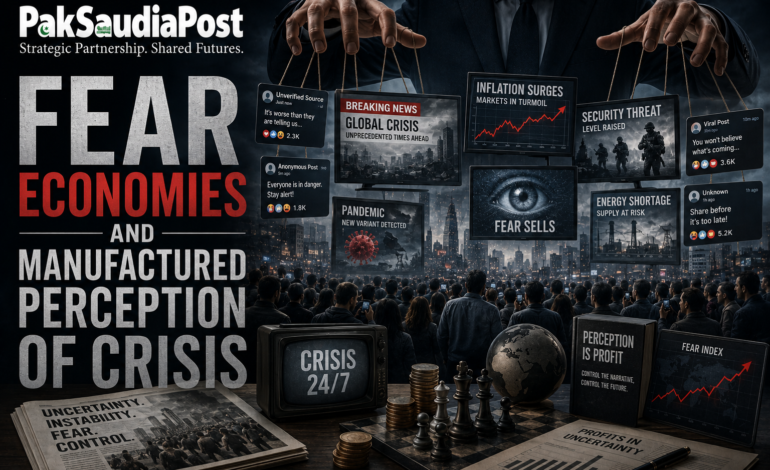
Fear Economies and Manufactured Perception of Crisis


Contemporary media systems are increasingly defined by a structural dependence on the circulation of fear as both a narrative device and an economic resource. What was once an episodic feature of crisis reporting has evolved into a continuous mode of informational production in which uncertainty is not merely described but systematically intensified. Within this environment, fear is no longer an incidental byproduct of breaking news cycles; it has become a governing logic of attention extraction, shaping editorial priorities, algorithmic distribution, and audience retention strategies across digital and broadcast ecosystems.
The transformation is rooted in the convergence of commercial imperatives and technological mediation. News production, historically anchored in verification hierarchies and institutional gatekeeping, now operates within a competitive attention economy where visibility is contingent upon emotional intensity. Content that signals danger, instability, or impending disruption consistently outperforms slower, more contextual reporting. As a result, crisis framing becomes structurally advantageous, encouraging media institutions to interpret events through heightened registers of urgency even when empirical conditions may not justify such amplification.
This recalibration of informational priorities has significant implications for collective psychological states. Persistent exposure to fear-oriented narratives produces a baseline condition of anticipatory anxiety, in which publics are conditioned to expect instability as a default rather than an exception. Over time, this alters cognitive orientation toward governance and society, reducing tolerance for uncertainty while simultaneously eroding confidence in institutional capacity. The public mind, saturated with signals of disruption, begins to interpret normal variability as latent crisis, thereby narrowing the space for measured assessment.
A critical dimension of this phenomenon lies in the operational design of algorithmic distribution systems. Engagement metrics such as click-through rates, dwell time, and interaction frequency serve as proxies for content value within digital ecosystems. Fear-based narratives, by virtue of their psychological salience, reliably generate elevated engagement outcomes. This creates a structural feedback loop in which emotional extremity is rewarded with visibility, thereby incentivizing producers to calibrate content toward heightened affective impact. The result is not necessarily intentional distortion but systemic amplification of risk-oriented perception.
The political consequences of this informational environment are increasingly evident. Policy discourse becomes vulnerable to episodic volatility, driven not by sustained analytical debate but by reactive cycles of media amplification. Governments find themselves compelled to respond to perceived crises that are partially constructed through narrative escalation rather than grounded structural change. This reactive posture constrains strategic planning, as decision-making timelines are compressed by the pressure of accelerated public sentiment shaped through continuous exposure to alarming content streams.
Within this context, institutional trust undergoes gradual erosion. When media systems consistently foreground instability, public perception of governance shifts from expectation of capacity to assumption of fragility. Even effective policy interventions risk being interpreted through a lens of skepticism, as audiences conditioned by fear-centric narratives become less receptive to signals of stability. This creates a paradox in which successful crisis management may fail to generate credibility because the informational environment is predisposed toward interpreting reassurance as temporary or performative.
The commercialization of fear is further reinforced by the structural incentives of platform capitalism. Digital intermediaries optimize content flows not for epistemic balance but for user engagement maximization. This optimization process, while technically neutral in design, produces systematically skewed informational outputs when applied to emotionally charged material. Fear, uncertainty, and threat perception function as high-yield engagement commodities, effectively converting psychological vulnerability into measurable economic value.
The cumulative effect of these dynamics is a reconfiguration of societal risk perception. Rather than distinguishing between probability and possibility, publics increasingly operate within an environment where potential threats are continuously foregrounded. This erodes the analytical distinction between structural risk and speculative amplification, leading to inflated perceptions of systemic instability. In such conditions, even low-probability events can acquire disproportionate psychological weight if they are repeatedly circulated within high-intensity narrative cycles.
For states operating in complex geopolitical and domestic environments, this shift presents a strategic dilemma. Traditional communication frameworks assume a relatively stable relationship between factual reporting and public interpretation. However, in fear-saturated ecosystems, informational accuracy alone is insufficient to stabilize perception. Messages are filtered through pre-existing emotional states shaped by continuous exposure to threat narratives. Consequently, even precise and measured communication can be reinterpreted as inadequate or evasive when juxtaposed against emotionally heightened media framing.
The policy implications are therefore substantial. Regulatory approaches focused solely on content moderation are unlikely to address the underlying structural drivers of fear amplification. A more sophisticated intervention would require engagement with the incentive architectures that prioritize emotional intensity over informational balance. This includes examining platform ranking systems, advertising models that reward engagement spikes, and editorial practices that equate urgency with relevance.
Equally important is the development of institutional communication resilience. States must increasingly operate within an informational environment where narrative distortion is not episodic but continuous. This requires the cultivation of adaptive communication strategies that emphasize consistency, transparency, and anticipatory messaging rather than reactive correction. The objective is not to eliminate fear from public discourse, which would be neither feasible nor desirable, but to prevent its systemic conversion into a dominant interpretive framework.
Educational reform also emerges as a long-term stabilizing instrument. Populations require cognitive tools to distinguish between informational content that reflects structural reality and content that amplifies emotional response beyond evidentiary grounding. Media literacy in this context must extend beyond source verification to include understanding of algorithmic influence, attention economics, and psychological framing techniques. Without such competencies, societies remain vulnerable to repeated cycles of perception-driven volatility.
Within strategic policy circles, particularly those concerned with national cohesion and informational security, fear-driven media environments must be understood as a form of soft systemic pressure. Unlike conventional information warfare, which is often intentional and targeted, this phenomenon operates diffusely through structural incentives embedded in global communication systems. Its impact is cumulative, shaping perceptions gradually rather than through discrete events, and therefore often eludes conventional analytical frameworks.
The challenge for governance is further complicated by the transnational nature of digital information flows. National regulatory regimes operate within fragmented jurisdictional boundaries, while media ecosystems function across integrated global infrastructures. This asymmetry limits the capacity of individual states to unilaterally reshape incentive structures without broader coordination. As a result, policy responses must increasingly consider multilateral frameworks, even in contexts where geopolitical alignment is partial or contested.
Ultimately, the commercialization of fear represents a deeper epistemological shift in how societies relate to uncertainty. Fear is no longer merely a response to external conditions but an internally generated product of systemic communication dynamics. This inversion complicates traditional assumptions about public perception, where information was once expected to reflect reality. In the current configuration, information actively constructs the experiential field through which reality is interpreted.
A Public Service Message