Industrial Security Through Technological Production Shift

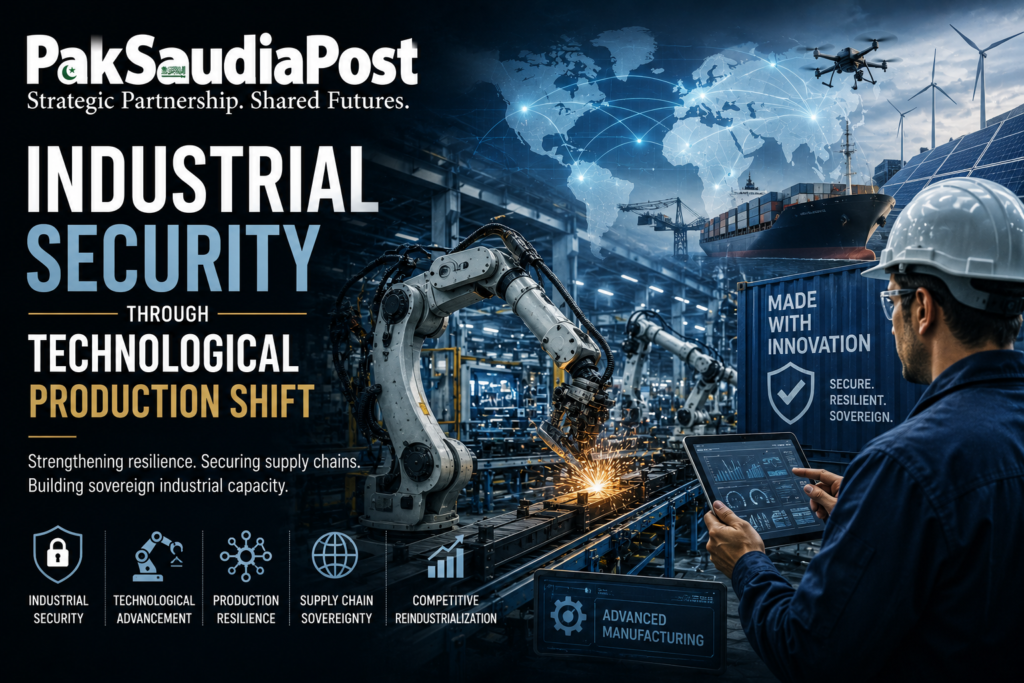
Industrial security in the contemporary global economy has ceased to be a peripheral concern of trade ministries and has instead become a central determinant of state resilience. It is no longer sufficient for a country to participate in global manufacturing through labour arbitrage or low value assembly functions. The decisive axis of industrial power now lies in control over technological production systems, embedded design capabilities, and the capacity to internalise complex supply chains within nationally anchored or strategically aligned ecosystems. This transformation is particularly visible across Asia, where semiconductor geopolitics, advanced manufacturing competition, rare earth dependency structures, and energy transition technologies are collectively reshaping industrial hierarchies in ways that render traditional development pathways increasingly obsolete.
The current global industrial environment is defined by an accelerating fragmentation of production authority. Advanced economies are increasingly relocating sensitive manufacturing segments closer to domestic jurisdictions or trusted allies, while simultaneously imposing regulatory constraints on technology transfer. This is most evident in semiconductor fabrication, high precision machinery, aerospace components, and battery technology ecosystems. In parallel, China has been constructing a parallel industrial architecture characterised by automation intensive production, vertically integrated supply chains, and state coordinated innovation clusters. The resulting configuration is not a uniform global market but a layered industrial order in which access to technology, not merely capital or labour, determines economic positioning.
Within this environment, Pakistan faces a structural inflection point. Its historical reliance on labour intensive manufacturing sectors has generated limited upward mobility within global value chains. Textile exports, basic manufacturing, and low complexity assembly processes have provided export earnings but have not enabled deep technological embedding. As global production systems evolve toward robotics driven manufacturing, artificial intelligence assisted design, and materials science intensive production, the comparative advantage of low cost labour diminishes significantly. This shift is not cyclical but structural, driven by capital substitution of labour and algorithmic optimisation of production processes.
The strategic question therefore is whether Pakistan can reposition itself within next generation production ecosystems in a manner that avoids marginalisation. This requires a fundamental departure from incremental industrial upgrading narratives and toward a comprehensive technological absorption strategy. China’s evolving production ecosystem offers a critical reference point in this regard. Its industrial transformation is characterised not only by scale but by systemic integration of research and development, manufacturing execution systems, and state guided industrial clustering. The key feature is not merely production capacity but production intelligence, where manufacturing is continuously optimised through digital feedback loops and machine learning integration.
For Pakistan, integration into such systems cannot be achieved through passive participation. It requires active restructuring of industrial policy around three core dimensions. The first is vocational reorientation, where the workforce is trained not for repetitive manual tasks but for adaptive technical functions involving robotics maintenance, digital system management, and precision engineering support. The second is institutional reform, where industrial policy is coordinated across fragmented ministries and aligned with long term technological objectives rather than short term fiscal targets. The third is strategic partnership architecture, where foreign investment is channelled into technology transfer intensive sectors rather than purely capital intensive or consumption oriented projects.
Saudi Arabia’s emerging industrial transformation strategy introduces a complementary vector into this equation. Its efforts to diversify away from hydrocarbon dependence have led to significant investments in advanced manufacturing zones, logistics infrastructure, and technology driven industrial clusters. However, the scale of human capital required for such transformation exceeds domestic supply in certain technical domains. This creates a structural convergence opportunity with Pakistan, which possesses a large labour base but requires technological upgrading pathways. The intersection of Saudi capital, Chinese industrial technology, and Pakistani labour potential forms a triadic configuration that could, if properly structured, generate a new industrial sub-ecosystem within the broader Asian manufacturing landscape.
Yet such an outcome is not automatic. Industrial integration at this level requires more than capital flows; it requires epistemic alignment. That is, a shared understanding of production logic, technological standards, and industrial governance frameworks. Without this, investments risk remaining compartmentalised, generating infrastructure without embedded technological capability. The historical experience of several developing economies demonstrates that infrastructure without technological absorption leads to dependency rather than transformation.
A critical dimension of industrial security in the current era is semiconductor dependency. Semiconductors now constitute the foundational substrate of all advanced industrial systems, from automotive manufacturing to defence technology and energy infrastructure. The concentration of semiconductor fabrication in a limited number of geographies has created systemic vulnerability across global supply chains. Export controls, technology restrictions, and geopolitical contestation over chip design architectures have transformed semiconductors into strategic assets rather than mere industrial inputs.
For Pakistan, direct participation in semiconductor fabrication is not immediately feasible at the leading edge. However, participation in adjacent ecosystems such as chip packaging, testing, embedded systems integration, and electronics assembly represents a viable entry point. These segments are critical nodes within the semiconductor value chain and offer pathways for gradual technological accumulation. Aligning with Chinese mid tier semiconductor ecosystems while simultaneously leveraging Saudi investment in electronics manufacturing zones could provide a structured pathway into this domain.
Another critical axis is rare earth and materials dependency. The global energy transition has intensified demand for critical minerals used in battery production, renewable energy systems, and high efficiency electronics. Countries with access to these materials or processing capabilities possess strategic leverage within emerging industrial systems. While Pakistan does not currently occupy a dominant position in this sector, geological exploration, mineral processing capability development, and strategic partnerships could enable partial integration into these value chains.
Energy transition politics further complicate industrial planning. Manufacturing systems are increasingly evaluated not only on cost efficiency but on carbon intensity. This introduces a dual requirement for industrial competitiveness: technological efficiency and environmental compliance. For Pakistan, where energy systems are still heavily reliant on conventional sources, this creates additional pressure on industrial exporters who must now adapt to external carbon accounting standards. Failure to do so risks exclusion from high value markets irrespective of production cost advantages.
Within this context, industrial security becomes a multidimensional concept encompassing technological autonomy, supply chain resilience, energy adaptability, and institutional coherence. It is not simply about protecting existing industries but about enabling adaptive capacity in the face of rapidly evolving production paradigms. States that fail to internalise this shift risk being locked into obsolete production structures while global value creation migrates elsewhere.
Policy recommendations must therefore move toward systemic industrial reengineering. First, Pakistan must establish dedicated technology absorption zones where Chinese industrial systems, Saudi capital investment, and domestic labour training are co-located under unified governance frameworks. These zones should not function as isolated export processing units but as integrated learning environments where technology transfer is structurally embedded into production processes.
Second, vocational training systems must be radically restructured to prioritise digital manufacturing competencies. This includes robotics operation, industrial software systems, data driven production management, and materials engineering literacy. Without this, labour remains disconnected from the technological core of modern manufacturing.
Third, industrial policy must be insulated from short term fiscal volatility. Frequent policy shifts driven by macroeconomic adjustment programmes undermine long term industrial planning. A stabilised industrial policy framework, co designed with strategic partners, is essential for sustained technological accumulation.
Fourth, Pakistan must pursue selective participation in semiconductor adjacent industries rather than attempting broad based entry into high end fabrication. Strategic focus on niche segments will enable gradual capability development without overextension of institutional capacity.
Finally, Saudi Arabia’s investment strategy should be aligned with technology transfer conditions rather than purely financial returns. This would ensure that capital inflows generate structural industrial transformation rather than transient economic stimulation.
In conclusion, industrial security in the contemporary era is defined by technological embeddedness rather than production volume. The decisive factor is not how much a country produces, but how deeply it is integrated into the systems that define production itself. For Pakistan, the challenge is to transition from a peripheral manufacturing role to a structurally embedded participant in next generation industrial ecosystems. For Saudi Arabia, the opportunity lies in shaping the capital architecture of this transition. Between these two lies a potential industrial realignment that, if strategically executed, could redefine the contours of economic participation in the Asian production order.
A Public Service Message