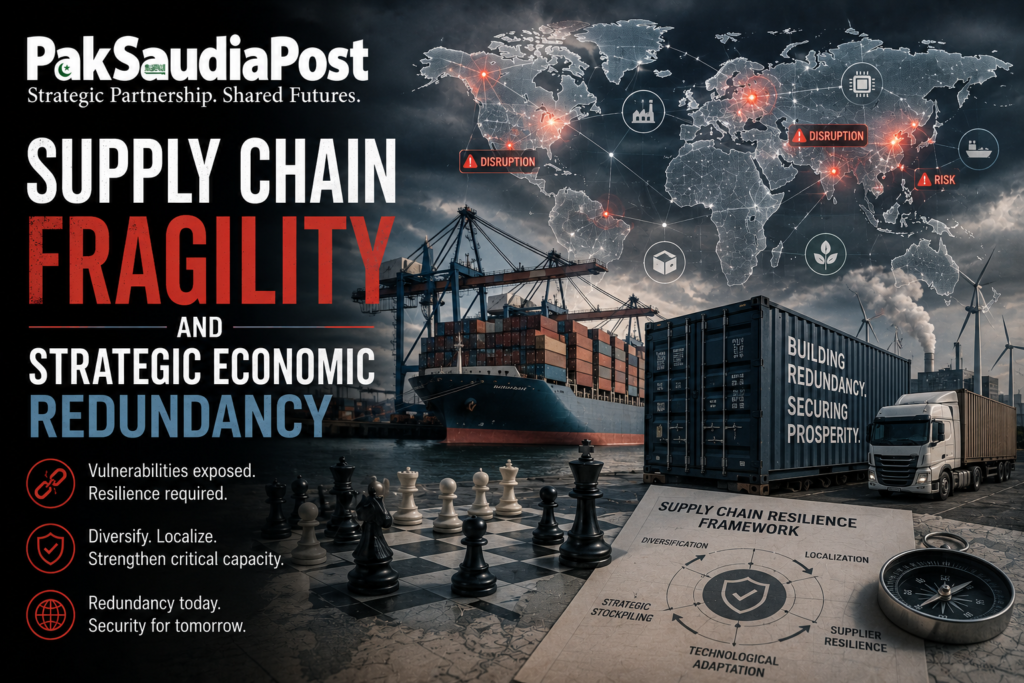
Supply Chain Fragility and Strategic Economic Redundancy

The contemporary global supply chain system, once celebrated as the apex of efficiency-driven globalisation, has increasingly evolved into a structured arena of geopolitical leverage, economic coercion, and logistical fragility. What was previously conceptualised as seamless interdependence has now been reconstituted into a complex field of strategic vulnerability, where maritime chokepoints, insurance pricing mechanisms, commodity volatility, and algorithmically governed logistics platforms collectively determine the stability of national economies. In this reconfigured environment, supply chains no longer function as neutral conduits of goods but as contested infrastructures through which power is exercised, delayed, redirected, or suspended.
Recent disruptions across maritime routes, fluctuating freight indices, energy shipment rerouting, and episodic bottlenecks in critical commodities have exposed the fragility embedded within hyper-optimised global trade systems. The reliance on just-in-time logistics, while economically efficient under conditions of stability, has proven structurally vulnerable under conditions of political tension, climate-induced disruption, and financial market stress. Insurance premiums for maritime transport now respond not only to physical risk but to geopolitical anticipation models, where perceived instability in specific corridors translates into immediate cost escalation across global supply chains.
Within this context, developing economies such as Pakistan face disproportionate exposure. Their import-dependent energy systems, food security sensitivities, and industrial reliance on external inputs create a structural condition in which external shocks rapidly translate into domestic inflationary cycles and fiscal stress. The absence of redundancy mechanisms within supply architecture intensifies this vulnerability, producing a state of economic sensitivity that is reactive rather than adaptive. In such a configuration, even minor disruptions in shipping lanes or commodity pricing cascades can produce macroeconomic instability.
China’s experience in recent years offers a contrasting model of supply chain resilience construction. Through deliberate diversification of sourcing networks, internalisation of critical production segments, and establishment of alternative logistics corridors, it has attempted to reduce exposure to single-point failures. This has involved not only physical infrastructure expansion but also financial hedging mechanisms, strategic stockpiling, and the development of parallel trade settlement systems. The objective is not autarky but controlled redundancy, where multiple pathways exist for critical inputs and outputs.
Saudi Arabia, positioned at the intersection of energy exports and emerging logistics ambitions, introduces another dimension to this evolving architecture. Its investments in port infrastructure, transnational connectivity projects, and logistics hubs reflect a strategic recognition that future economic influence will be partly determined by control over distribution nodes rather than production alone. The convergence of Saudi logistical expansion with Chinese industrial diversification and Pakistani geographic centrality creates a potential triadic structure capable of reconfiguring regional supply chain dynamics.
However, the operationalisation of such a configuration requires moving beyond infrastructure accumulation toward systemic redundancy engineering. Redundancy, in this context, does not imply inefficiency or duplication for its own sake, but rather the deliberate construction of alternative pathways that ensure continuity under stress conditions. It is a form of strategic elasticity embedded within economic systems, allowing states to absorb shocks without collapsing into fiscal or administrative paralysis.
At present, Pakistan’s supply chain architecture remains largely linear. Energy imports flow through a limited number of maritime routes, industrial inputs depend on concentrated sourcing channels, and logistics systems are heavily exposed to external pricing and availability fluctuations. This structural linearity reduces adaptive capacity and increases sensitivity to external disruption. The absence of diversified sourcing strategies and alternative routing mechanisms creates a condition where economic stability is contingent upon external continuity.
The increasing politicisation of maritime corridors further intensifies this vulnerability. Strategic chokepoints such as the Strait of Hormuz, the Bab el Mandeb corridor, and key transit routes in the Indo-Pacific are no longer merely geographic features but active nodes of geopolitical contestation. Insurance pricing models now incorporate geopolitical risk forecasting, effectively monetising instability. As a result, supply chain costs are no longer determined solely by distance or fuel prices but by anticipatory risk assessments embedded within financial systems.
Digital logistics platforms add another layer of complexity. The management of global trade flows is increasingly mediated by algorithmic systems that optimise routing, prioritise shipments, and allocate capacity based on real-time data analytics. While this enhances efficiency, it also concentrates decision-making power within a limited number of technological platforms. This introduces a form of digital dependency where access to global trade infrastructure is partially governed by proprietary systems outside national jurisdiction.
For Pakistan, the strategic challenge is therefore not only physical diversification of supply chains but also digital and financial diversification of logistics governance. Without participation in alternative settlement systems, diversified shipping alliances, and regionally controlled logistics platforms, vulnerability remains structurally embedded. The current reliance on external pricing and routing mechanisms limits sovereign control over economic continuity.
Within this framework, Pakistan Saudi Arabia cooperation offers a potential avenue for partial reconfiguration. Saudi investments in port development, logistics infrastructure, and transnational connectivity corridors can serve as stabilising anchors if integrated with Pakistani industrial planning and Chinese manufacturing networks. However, this requires a shift from project-based cooperation to system-based integration. Isolated infrastructure projects, while valuable, do not in themselves generate supply chain resilience unless embedded within broader redundancy architectures.
A critical operational issue is the absence of coordinated strategic stockpiling mechanisms. Many developing economies operate on minimal inventory systems due to fiscal constraints, thereby maximising efficiency at the cost of resilience. However, in an environment characterised by volatility, strategic reserves of energy, food, and industrial inputs become essential instruments of macroeconomic stability. The development of shared reserve frameworks between Pakistan and Saudi Arabia, potentially linked to Chinese supply networks, could provide a buffer against external shocks.
Another dimension is financial hedging of supply chain exposure. Commodity price volatility now directly translates into fiscal instability for import dependent economies. Without sophisticated hedging instruments, states are exposed to sudden fiscal shocks that can destabilise budgets and external accounts. The integration of financial risk management into trade architecture is therefore essential for supply chain resilience.
Policy design must also address institutional fragmentation. Supply chain governance in many developing states is distributed across multiple agencies without unified strategic coordination. This leads to delayed responses during disruptions and weak anticipatory capacity. A centralised or at least harmonised supply chain intelligence framework is necessary to monitor risks, simulate disruptions, and coordinate responses across sectors.
The broader implication is that supply chains must be reconceptualised as strategic infrastructures rather than commercial systems. Their stability directly affects national security, economic continuity, and social stability. Treating them as purely market driven mechanisms underestimates their systemic importance in a volatile global environment.
For Pakistan, the transition toward redundancy based economic design requires three simultaneous shifts. First, diversification of physical supply routes and sourcing networks must be accelerated. Second, integration into alternative financial and logistics platforms must be pursued to reduce dependency on singular systems. Third, institutional coordination mechanisms must be strengthened to ensure rapid response capability during disruptions.
Saudi Arabia’s role in this transformation is potentially pivotal. Its capital resources, infrastructural expansion capacity, and strategic positioning allow it to function as a stabilising node within emerging regional supply architectures. However, this requires alignment with long term systemic planning rather than short term transactional engagement.
China’s contribution lies in industrial depth and production diversification, offering multiple sourcing options and manufacturing redundancy. The integration of Chinese production ecosystems with Saudi logistics infrastructure and Pakistani geographic positioning could create a multi-nodal supply network capable of absorbing external shocks without systemic collapse.
Ultimately, the geopolitics of supply chains reflects a deeper transformation in global economic organisation. Efficiency is no longer the sole objective; resilience has become equally, if not more, important. States that fail to internalise this shift will remain exposed to external disruptions that manifest not as isolated events but as cascading systemic crises.
In this emerging order, supply chain redundancy is not an economic luxury but a strategic necessity. The ability to maintain continuity under conditions of disruption will define economic competitiveness as decisively as production capacity once did. For Pakistan and Saudi Arabia, the challenge is to construct an architecture of economic resilience that transforms vulnerability into structured adaptability, ensuring that external shocks do not translate into internal systemic instability.
A Public Service Message