Saudi Energy Diplomacy After Hormuz Disruption and Implications for Pakistan

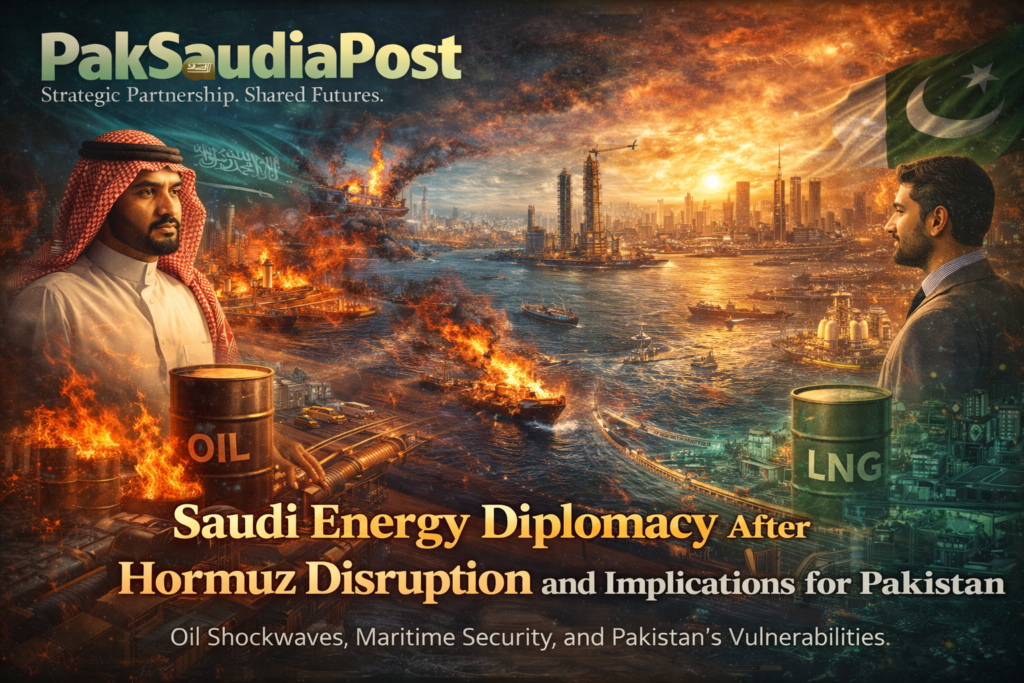
In 2026, the Kingdom of Saudi Arabia faces a pivotal moment in its energy diplomacy, shaped by escalating regional tensions, repeated disruptions in the Strait of Hormuz, and the complex interplay of global energy markets. The Kingdom, long reliant on Gulf maritime corridors for oil exports, has recalibrated its logistical and strategic approach to ensure uninterrupted energy flows, maintain market confidence, and safeguard geopolitical leverage. The disruption of Hormuz shipping lanes by regional proxies and strategic competitors has exposed vulnerabilities not only in Saudi supply chains but also in the broader energy security of dependent economies, including Pakistan. This evolving context requires a nuanced analysis that encompasses maritime strategy, OPEC+ coordination, alternative export routes, and the implications for Pakistan’s domestic energy stability and long-term economic planning.
The Strait of Hormuz, a strategic chokepoint through which approximately twenty percent of global oil passes, has increasingly become a theater of regional tension. Houthi drone strikes, maritime harassment, and Iranian proxy activity have intermittently threatened shipping lanes, creating volatility in energy prices and raising the specter of prolonged supply disruptions. Saudi Arabia, as the world’s leading oil exporter, perceives these threats not merely as operational challenges but as existential to its economic and strategic influence. Ensuring uninterrupted flows requires both defensive measures and strategic rerouting, demonstrating the Kingdom’s capacity to maintain energy dominance despite adversarial pressures.
In response, Saudi energy policymakers have accelerated diversification of export infrastructure. Ports such as Yanbu on the Red Sea have been upgraded and integrated into high-capacity logistics networks, enabling the Kingdom to bypass vulnerable Gulf chokepoints while maintaining market commitments. Pipeline expansions, including those connecting inland production hubs to Red Sea terminals, provide redundancy and operational resilience, ensuring that crude volumes reach global markets even under adverse conditions. These initiatives are part of a broader strategy to hedge against uncertainty, maintain credibility with international buyers, and assert Saudi sovereignty over energy flows.
OPEC+ coordination remains central to Saudi strategy. As the de facto leader of the cartel, Riyadh must balance domestic production priorities, alliance cohesion, and price stabilization in the face of external shocks. Hormuz disruptions exacerbate the tension between short-term market responses and long-term strategic objectives. By managing production quotas, maintaining flexible spare capacity, and engaging in diplomatic dialogue with member states, Saudi Arabia seeks to stabilize markets while reinforcing its leadership role. This balancing act has direct implications for Pakistan, which depends on Saudi oil imports for both industrial consumption and domestic energy supply. Any disruption in Saudi output or reallocation of cargoes can reverberate through Pakistan’s energy sector, affecting fuel pricing, power generation, and industrial competitiveness.
The Kingdom’s approach to energy diplomacy also incorporates financial instruments and strategic reserves. Long-term contracts, hedging arrangements, and contingency stockpiling reduce exposure to market volatility, allowing Saudi Arabia to exercise influence over global pricing mechanisms. For Pakistan, these dynamics necessitate proactive engagement with Saudi energy authorities, coordination on supply security, and consideration of alternative sourcing strategies to mitigate risk. Reliance on a single maritime corridor, while historically efficient, now entails geopolitical vulnerability that requires diversified logistical and contractual approaches.
Maritime security remains a critical component of Saudi energy strategy. The Kingdom has invested in naval capabilities, surveillance systems, and allied cooperation to protect shipping lanes and deter hostile actions. Collaboration with regional partners and international navies enhances operational security while signaling deterrence to potential aggressors. These measures are not solely defensive; they also serve diplomatic purposes, reinforcing Saudi credibility and ensuring that energy diplomacy is underpinned by strategic resilience. Pakistan, reliant on Saudi energy for both economic stability and industrial growth, must closely monitor these developments, understanding that maritime security in the Gulf directly affects domestic supply chains, fuel imports, and national energy policy.
The implications for Pakistan’s energy security are multifaceted. Direct oil imports from Saudi Arabia constitute a significant portion of domestic consumption, underpinning electricity generation, transportation fuel, and industrial operations. Disruptions in supply, whether temporary or protracted, can trigger inflationary pressures, disrupt production cycles, and exacerbate fiscal imbalances, particularly when combined with existing IMF commitments and foreign exchange constraints. Pakistan’s strategic response must therefore integrate diversified sourcing, investment in domestic energy efficiency, and bilateral dialogue with Riyadh to ensure continuity of supply under varying geopolitical conditions.
Saudi energy diplomacy also intersects with regional power dynamics. The Kingdom’s efforts to secure alternative routes and maintain market stability are interpreted by competitors and allies alike as indicators of strategic resolve. Iran, observing Riyadh’s operational shifts, may recalibrate its own influence over Gulf shipping lanes, employing asymmetric tactics or leveraging regional proxies to challenge Saudi dominance. These interactions contribute to a complex security environment in which energy flows, geopolitical signaling, and economic stability are deeply intertwined. Pakistan’s positioning within this matrix requires careful diplomacy, balancing relationships with Saudi Arabia, Iran, and other Gulf actors while protecting its energy interests and maintaining regional credibility.
The evolution of Saudi energy infrastructure further underscores the interdependence of strategic and economic considerations. Investments in pipelines, port facilities, and logistics hubs are not merely operational; they are instruments of geopolitical influence. By controlling the means of energy distribution, Saudi Arabia enhances bargaining power with importers, shapes global pricing narratives, and reinforces its leadership within OPEC+. For Pakistan, this underscores the importance of bilateral engagement, including long-term supply contracts, investment in joint infrastructure projects, and active participation in regional energy dialogues. Such engagement ensures that Pakistan’s energy needs are integrated into Saudi strategic planning rather than treated as peripheral considerations.
Technological innovation is increasingly central to Saudi energy strategy. Smart pipeline monitoring, real-time logistics tracking, and advanced storage management enable the Kingdom to optimize flows and rapidly respond to disruptions. These technological investments create opportunities for Pakistan to contribute expertise in energy management systems, digital monitoring, and logistical optimization, thereby enhancing bilateral cooperation while reinforcing Pakistan’s role as a strategic partner in energy security. Beyond immediate operational gains, this collaboration signals a forward-looking partnership capable of mitigating risk, increasing efficiency, and strengthening resilience against both geopolitical and market volatility.
The broader economic ramifications are also significant. Saudi Arabia’s ability to maintain stable energy flows underlines its influence in global markets, affecting oil pricing, investment confidence, and the strategic calculations of energy-dependent economies. For Pakistan, stable access to Saudi energy is critical not only for operational continuity but also for macroeconomic stability, including current account management, currency valuation, and inflation control. Strategic planning must therefore integrate Saudi supply assurances with domestic measures such as energy diversification, renewable integration, and efficiency initiatives to create a resilient and adaptive national energy strategy.
Diplomatically, Saudi energy diplomacy after Hormuz disruptions reinforces Riyadh’s role as a regional stabilizer. By demonstrating operational redundancy, market discipline, and strategic foresight, the Kingdom communicates both strength and reliability to partners and competitors alike. Pakistan, as a key importer and regional ally, benefits from these signals, gaining predictability in energy supply and enhanced credibility in regional policy circles. Engagement with Saudi energy authorities, participation in regional energy forums, and integration into logistical planning are essential to ensure that Pakistan’s interests are safeguarded within the broader geostrategic framework.
Finally, the convergence of energy security, regional stability, and bilateral diplomacy highlights the interdependence of economic, strategic, and political considerations. Saudi Arabia’s post-Hormuz energy strategy illustrates the complexity of modern Gulf geopolitics, where operational planning, market management, and geopolitical signaling are inseparable. For Pakistan, effective engagement requires not only economic foresight but also diplomatic agility, technological collaboration, and strategic alignment with Saudi priorities. The challenge lies in transforming dependency into partnership, ensuring that domestic energy security is reinforced by regional cooperation, technological innovation, and proactive engagement in strategic energy planning.
In conclusion, Saudi Arabia’s energy diplomacy following disruptions in the Strait of Hormuz demonstrates a sophisticated integration of strategic foresight, operational resilience, and geopolitical signaling. For Pakistan, the stakes extend beyond immediate imports to encompass macroeconomic stability, industrial continuity, and bilateral strategic engagement. By diversifying sourcing, participating in infrastructure planning, and leveraging technological collaboration, Pakistan can secure energy flows while strengthening its role as a trusted partner in Gulf energy security. The evolving Saudi strategy underscores the inseparability of energy, geopolitics, and regional stability, illustrating that in a volatile Gulf environment, strategic foresight, operational flexibility, and collaborative diplomacy are essential to sustaining national and regional security.
A Public Service Message