Financial Sovereignty Under Invisible Monetary Pressure Systems Brief

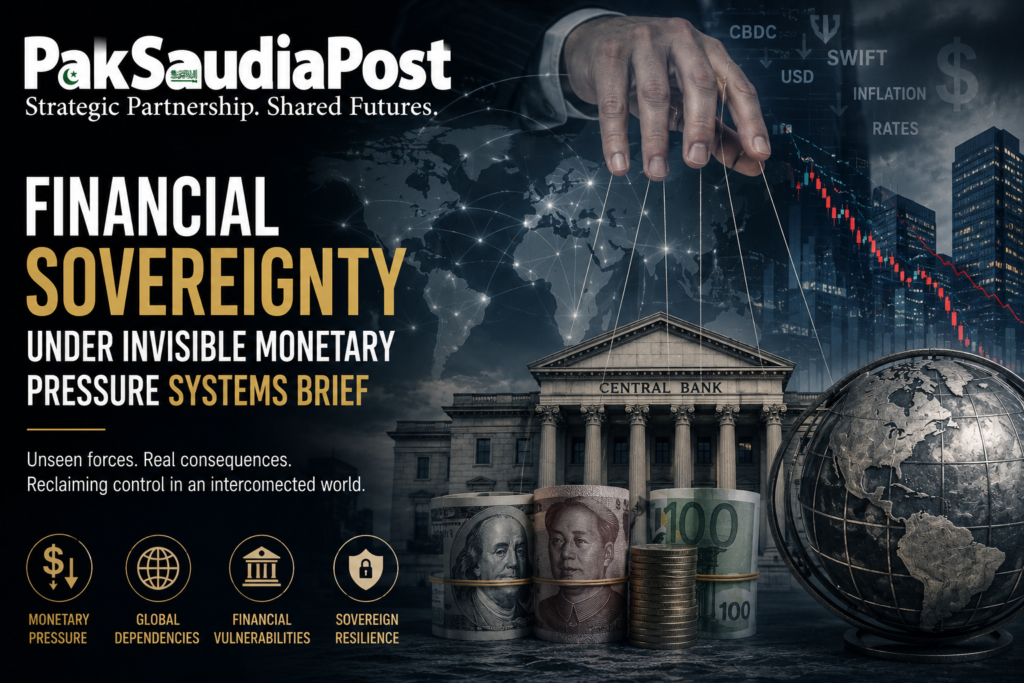
Financial sovereignty in the early decades of the twenty first century has ceased to be a visible attribute of statehood expressed through control over interest rates, currency issuance, or fiscal autonomy in the classical sense. It has instead migrated into a more opaque domain where compliance architectures, conditional liquidity arrangements, digital settlement layers, and climate linked fiscal instruments collectively determine the extent to which a state can meaningfully exercise economic discretion. For developing economies such as Pakistan, this transformation is not theoretical but operational, unfolding through recurring negotiations with multilateral lenders, evolving taxation frameworks tied to energy consumption, and externally influenced fiscal recalibrations that gradually reshape domestic policy space. Within this shifting environment, Saudi Arabia emerges not merely as a bilateral partner but as a parallel stabilisation anchor whose capital reserves and investment orientation intersect with Pakistan’s chronic external account pressures. The interaction between these two realities forms the backdrop against which financial sovereignty must now be reinterpreted.
At the centre of the current configuration is a renewed phase of engagement between Pakistan and the International Monetary Fund, in which fiscal consolidation is increasingly linked to energy sector restructuring, taxation adjustments, and the gradual removal of implicit subsidies. While officially framed as macroeconomic stabilisation, these measures operate in practice as a reengineering of the domestic energy economy, where pricing mechanisms for electricity, petroleum consumption, and carbon intensive inputs are recalibrated to align with global sustainability and revenue generation benchmarks. The introduction and expansion of energy related taxation, often justified through climate aligned fiscal reforms or revenue enhancement requirements, has introduced a new layer of complexity. It is not simply a matter of raising revenue; it is a structural insertion of external priorities into domestic consumption architecture.
The operational reality of these adjustments is visible in Pakistan’s ongoing energy tariff revisions, petroleum levy adjustments, and the gradual alignment of fiscal instruments with IMF conditional benchmarks. These are not isolated administrative decisions but interconnected components of a broader framework in which fiscal space is traded for liquidity access. The consequence is a subtle but persistent contraction in discretionary economic governance. Energy pricing, once a sovereign policy lever tied to domestic industrial planning and social stability considerations, is increasingly influenced by external programmatic requirements that prioritise fiscal balance sheets over developmental elasticity.
Simultaneously, the emergence of global carbon related financial instruments has introduced an additional constraint layer. While not formally imposed as a uniform global tax, mechanisms such as carbon border adjustment frameworks in advanced economies and climate linked financing conditions in multilateral institutions are beginning to shape the fiscal environment of energy importing states. For Pakistan, where energy imports constitute a significant portion of external expenditure, the convergence of IMF driven fiscal consolidation and climate aligned taxation logic produces a dual pressure structure. One dimension focuses on revenue generation to service debt obligations, while the other incentivises structural shifts in energy consumption patterns without necessarily providing equivalent transition financing.
Within this context, the notion of invisible economic pressure becomes particularly relevant. Pressure is no longer exerted through direct sanctions or explicit directives but through conditional access to liquidity, risk rating adjustments, and compliance based financial integration. Sovereignty is thus redefined as the capacity to operate within these constraints without losing macroeconomic coherence. For Pakistan, this means navigating a narrow corridor where energy affordability, fiscal stability, and external financing requirements must be balanced simultaneously, often with limited policy elasticity.
Saudi Arabia’s role in this configuration introduces a distinct but complementary dimension. As a state with substantial fiscal surpluses and an evolving investment strategy oriented towards diversification, it occupies a position that can potentially offset some of the liquidity constraints faced by Pakistan. However, this is not a simple donor recipient dynamic. The emerging relationship is increasingly characterised by structured investment alignment, where capital flows are tied to infrastructure development, energy sector participation, and long term economic integration projects. In this sense, Saudi financial engagement functions as a counterweight to IMF driven conditional liquidity, offering an alternative channel through which economic stabilisation can be partially achieved without complete reliance on multilateral frameworks.
Yet the coexistence of these two financial vectors does not eliminate structural tension. IMF programmes are designed around standardised fiscal discipline metrics, whereas bilateral investment frameworks are shaped by strategic and developmental considerations. The result is a dual dependency environment in which Pakistan must reconcile divergent financial logics. On one side lies the requirement for fiscal austerity, energy pricing rationalisation, and tax base expansion. On the other lies the imperative to maintain investment attractiveness, infrastructure expansion, and domestic economic continuity. This tension defines the contemporary boundaries of financial sovereignty.
A critical operational issue currently emerging within this landscape is the restructuring of energy taxation under IMF supervision in conjunction with global energy transition narratives. Pakistan’s incremental adjustments to petroleum levies and electricity tariffs are not purely domestic fiscal choices but responses to a composite set of external expectations. These include debt servicing requirements, subsidy rationalisation targets, and implicit alignment with global climate financing norms. The introduction of higher energy related taxation, while improving short term revenue performance, has generated secondary effects on industrial competitiveness, transport costs, and household consumption stability. These effects are not always fully internalised within policy discourse but manifest in broader economic stress indicators.
From a structural perspective, the challenge lies in the fact that energy taxation has become a proxy instrument for multiple objectives simultaneously. It is used to bridge fiscal deficits, signal compliance with international financial institutions, and align with environmental transition expectations. However, the multiplicity of objectives reduces policy clarity and increases implementation volatility. When energy pricing becomes the primary adjustment variable in fiscal stabilisation, it absorbs shocks that would otherwise be distributed across broader tax reforms or expenditure rationalisation strategies.
In parallel, digital financial infrastructures are beginning to influence the architecture of fiscal sovereignty in more subtle ways. Cross border payment systems, digital settlement platforms, and emerging central bank digital currency experiments are gradually redefining how value is transferred and recorded. For developing economies, participation in these systems offers efficiency gains but also introduces new dependencies on technological standards and regulatory frameworks set outside national jurisdictions. In the absence of indigenous alternatives, integration into these systems can lead to structural alignment with external financial governance protocols.
Within Pakistan Saudi Arabia economic interactions, this digital dimension is increasingly relevant. The potential for bilateral trade settlement mechanisms that reduce reliance on traditional hard currency corridors is being explored in various policy discussions. Such mechanisms, if institutionalised, could reduce exposure to external liquidity fluctuations and provide a partial buffer against IMF programme rigidity. However, the operationalisation of such systems requires significant coordination in regulatory frameworks, financial technology infrastructure, and monetary policy alignment, none of which can be achieved rapidly.
The broader implication is that financial sovereignty is becoming a function of infrastructural integration rather than policy autonomy alone. States that possess diversified financial linkages, access to alternative liquidity sources, and embeddedness in multiple settlement systems retain greater flexibility. Conversely, states dependent on a narrow set of financing channels face increasing policy compression. Pakistan’s current position reflects the latter condition, though strategic engagement with Saudi Arabia introduces a potential pathway toward diversification.
At the policy level, a recalibration is required in how energy taxation and fiscal consolidation are conceptualised. Rather than treating them as isolated compliance requirements, they must be integrated into a coherent industrial and social stability framework. Energy pricing reforms should be aligned with productivity enhancement strategies, industrial upgrading, and targeted social protection mechanisms to prevent systemic economic fatigue. Without such integration, fiscal consolidation risks generating diminishing returns through reduced economic activity and expanded informal sector growth.
For Saudi Arabia, the strategic interest lies in supporting a stable and economically resilient Pakistan that can function as a reliable partner in regional investment flows, labour mobility frameworks, and infrastructure connectivity projects. This necessitates moving beyond episodic financial support toward structured, long horizon investment planning that is insulated from short term fiscal volatility in Pakistan’s external account. Such an approach would also enhance Saudi Arabia’s own diversification objectives by embedding capital in emerging growth markets with demographic scale.
For multilateral institutions, the current configuration highlights the need to reconsider the sequencing and composition of conditionalities. Energy taxation, while fiscally efficient, cannot be treated as an isolated adjustment tool without accounting for its systemic impact on industrial competitiveness and social stability. A more nuanced framework would distribute adjustment burdens across multiple fiscal instruments rather than concentrating them within the energy sector alone.
The evolving architecture of financial sovereignty thus reflects a transition from direct control to negotiated constraint management. States are no longer fully autonomous nor entirely dependent; they operate within layered systems of obligation, opportunity, and conditional access. The key determinant of resilience lies in the ability to construct overlapping financial relationships that reduce exposure to any single source of pressure.
In this environment, Pakistan’s interaction with Saudi Arabia represents more than bilateral cooperation. It constitutes a potential rebalancing mechanism within a broader financial ecosystem dominated by IMF conditionality and global fiscal tightening cycles. The effectiveness of this mechanism will depend on institutional depth, policy coherence, and the ability to align investment flows with domestic economic transformation rather than short term stabilisation alone.
Ultimately, financial sovereignty is no longer about isolation from external influence but about the capacity to absorb, redistribute, and neutralise that influence without structural distortion. For Pakistan, the challenge is to convert external financial engagement into internal economic strengthening rather than cyclical dependency. For Saudi Arabia, the opportunity lies in shaping a stable investment corridor that reinforces both economic returns and strategic alignment. Between these two imperatives lies the emerging grammar of twenty first century financial governance, defined not by visible control but by invisible pressure systems that quietly determine the boundaries of national economic choice.
A Public Service Message