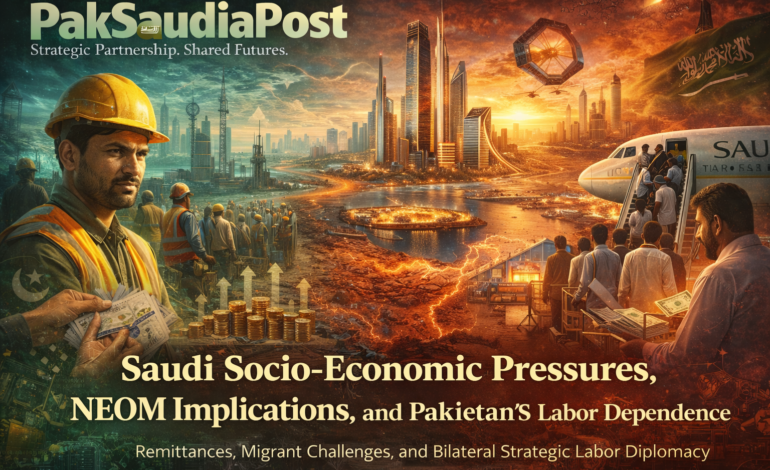
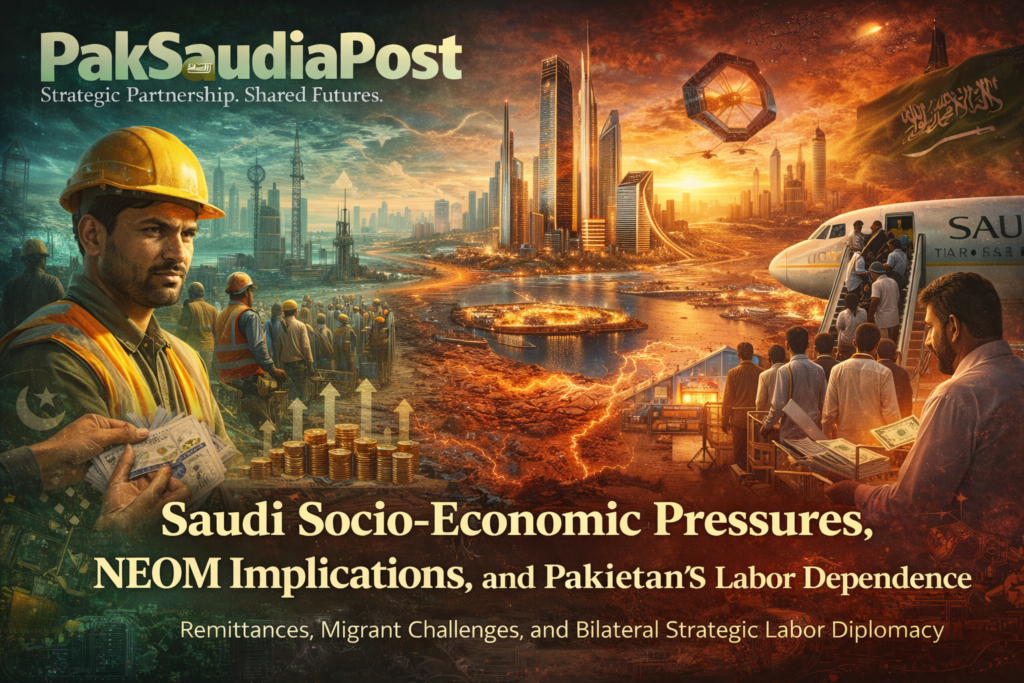
Saudi socio-economic pressures, NEOM implications, Pakistan’s labor dependence, remittances, and bilateral strategic labor diplomacy

The Kingdom of Saudi Arabia in 2026 is facing an unprecedented socio-economic crossroads, where the ambitious promises of Vision 2030 increasingly collide with structural realities and domestic discontent. Across major urban hubs and planned mega-project zones, particularly NEOM, the aspirations for futuristic employment and high-value economic engagement have not fully materialized. The result is a palpable tension among Saudi youth, who represent both the demographic dividend and the epicenter of societal expectation. Their growing frustration has immediate and profound implications for Pakistan, a nation whose economy is intricately linked to the Kingdom through labor migration and remittance inflows. Understanding this intersection requires a granular analysis that encompasses domestic socio-economic dynamics in Saudi Arabia, Pakistan’s labor and fiscal reliance, and the broader geopolitical-economic entanglement of the Gulf labor ecosystem.
The unrest among Saudi youth has multiple origins. Firstly, the Kingdom’s rapid modernization and urban development projects have generated high expectations for employment in technology, renewable energy, tourism, and advanced service sectors. NEOM, envisioned as a globally competitive urban megaproject, symbolizes these ambitions, combining artificial intelligence infrastructure, sustainable energy initiatives, and cutting-edge logistics. However, the reality on the ground contrasts sharply with projections. Recruitment bottlenecks, high entry requirements, and sectoral skills mismatches have left many young Saudis either underemployed or excluded from participation. Secondly, generational expectations, amplified by social media and global exposure, have heightened the sense of urgency among youth, who perceive a disconnect between their educational achievements and meaningful economic participation. Consequently, protests and localized demonstrations are not simply episodic; they reflect deeper structural strains in the social contract between the state and its emerging workforce.
This domestic volatility carries direct ramifications for Pakistan, which is the largest exporter of labor to the Kingdom. According to official estimates, millions of Pakistani workers are employed across construction, healthcare, technical services, retail, and domestic sectors, while remittances from Saudi Arabia contribute significantly to Pakistan’s foreign exchange reserves. The United Nations and Gulf labor data indicate that Pakistani remittances from Saudi Arabia alone constitute approximately thirty percent of the country’s total inflows, underscoring their systemic importance. Any reduction in labor absorption, wage delays, or restrictive employment policies triggered by domestic unrest therefore has immediate consequences for macroeconomic stability, currency reserves, and social welfare in Pakistan.
The Kingdom’s recalibration of labor policies, particularly through Saudization initiatives, adds a structural dimension to this challenge. By prioritizing employment opportunities for Saudi nationals in both private and public sectors, the government aims to address unemployment and integrate youth into high-skill economic segments. While this approach is necessary for domestic stability, it constrains foreign labor participation, including that of Pakistani workers. The tension is compounded by NEOM and other mega-projects, which, while ambitious, are undergoing operational slowdowns due to social unrest and resource reallocation toward internal stabilization. For Pakistan, the challenge lies in negotiating access and continuity for its workforce while aligning skill development with the evolving needs of the Kingdom.
The economic ripple effects extend beyond employment alone. Remittances from Saudi Arabia have historically stabilized Pakistan’s current account, supported consumption in lower and middle-income households, and underpinned domestic fiscal resilience. Any contraction in these inflows could amplify inflationary pressures, reduce household spending, and create ripple effects in local economies. Moreover, the timing of remittance volatility coinciding with IMF conditionalities and domestic fiscal tightening magnifies its impact, highlighting the interdependence of Saudi domestic policies and Pakistan’s macroeconomic equilibrium.
Furthermore, the socio-cultural and regulatory landscape in Saudi Arabia influences labor dynamics. Pakistani expatriates are increasingly subject to more stringent visa regulations, labor compliance requirements, and verification processes that ensure prioritization of domestic employment. In addition, labor integration policies emphasize skill credentialing and workforce alignment with specific high-value sectors. These developments necessitate a proactive response from Pakistan, including strategic workforce upskilling, credential recognition programs, and bilateral engagement to safeguard labor mobility while ensuring Pakistani workers remain competitive and compliant in a rapidly transforming labor market.
Beyond bilateral economic considerations, Saudi youth unrest is intertwined with broader regional economic stability. The Kingdom’s internal pressures affect not only labor absorption but also investment flows, infrastructure development timelines, and regional supply chains. For instance, delays in construction or energy projects due to labor unrest can shift project timelines, reduce foreign contractor participation, and limit Pakistan’s access to strategic labor deployment opportunities. In addition, regional competition for migrant labor, particularly from the Philippines, India, and other South Asian economies, adds further complexity, challenging Pakistan to maintain preferential positioning in a labor market that is both finite and politically sensitive.
The nexus of Saudi domestic challenges and Pakistan’s labor dependence also carries strategic implications. Pakistani workers are not merely economic contributors; they represent a bridge of bilateral trust and a component of Saudi operational capacity across critical sectors. Disruptions in labor inflows can strain the perception of reliability, potentially impacting investment confidence and diplomatic goodwill. Therefore, labor diplomacy must go beyond employment contracts and encompass engagement with Saudi policymakers, alignment with domestic skill development, and proactive adaptation to emerging socio-economic priorities within the Kingdom.
Furthermore, the interplay between youth unrest, labor policy, and mega-project ambitions underscores a deeper economic paradox. While Vision 2030 seeks to position Saudi Arabia as a global technological and financial hub, the Kingdom simultaneously faces the challenge of reconciling domestic social expectations, demographic pressures, and regional labor reliance. For Pakistan, this paradox manifests in the need to maintain flexible and adaptive labor deployment strategies, diversify remittance sources, and ensure that workforce engagement aligns with strategic priorities in both countries.
In conclusion, the convergence of Saudi youth unrest with Pakistan’s labor export dependency forms a highly complex and consequential dynamic. The limitations of Vision 2030 implementation, coupled with socio-economic pressures and Saudization policies, directly influence the employment prospects of Pakistani workers and the stability of critical remittance flows. Managing this interdependence requires sophisticated labor diplomacy, strategic workforce development, and continuous engagement with Saudi policymakers to anticipate regulatory changes and policy shifts. Only through a multi-dimensional and forward-looking approach can Pakistan protect its economic interests while contributing constructively to the Kingdom’s broader socio-economic objectives. Ensuring resilience in this bilateral relationship requires recognizing that Saudi domestic stability, youth expectations, and employment policies are inseparable from Pakistan’s economic wellbeing and strategic labor positioning in the Gulf.
A Public Service Message