Saudi Nuclear Ambitions and Pakistan’s Technological Shadow

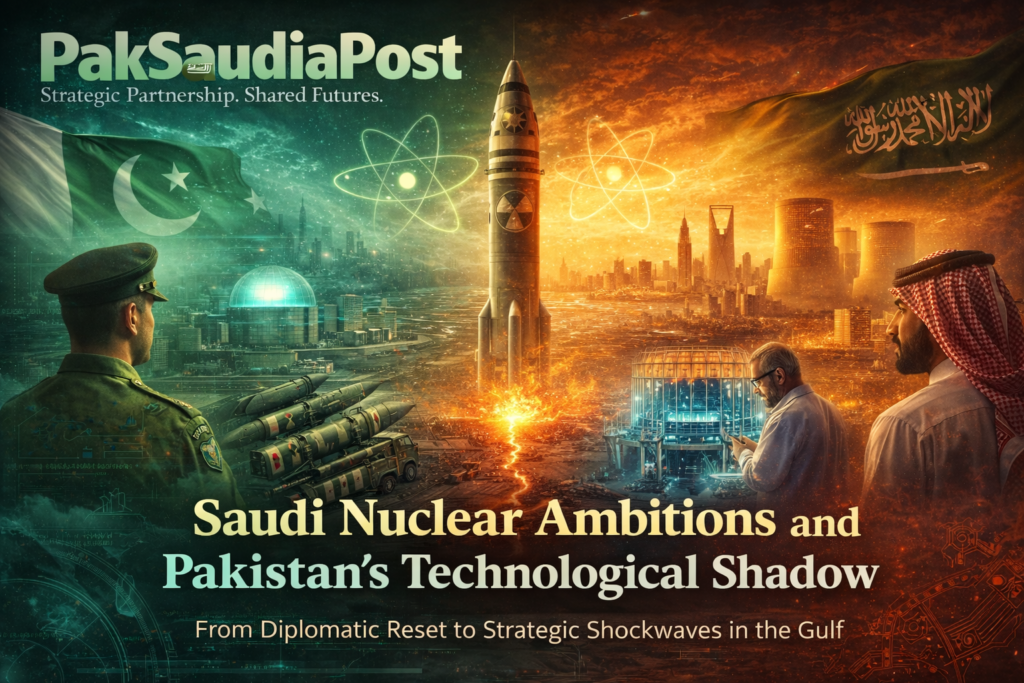
Saudi Arabia’s nuclear trajectory in 2026 has emerged as one of the most consequential strategic developments in the Middle East, reflecting both the Kingdom’s ambition to assert technological sovereignty and its heightened sensitivity to regional security dynamics. The recent leaks suggesting increased activity in yellowcake procurement and interest in nuclear fuel cycle capabilities have amplified concerns across Gulf and regional capitals. Riyadh’s pursuit is not merely a domestic energy diversification initiative but represents a calculated geopolitical statement signaling deterrence potential, regional strategic parity, and influence over Iran’s nuclear posture. For Pakistan, this evolving landscape intersects with its technological expertise, nuclear diplomacy, and long-standing strategic calculus in the Gulf, creating a nuanced and multi-dimensional security engagement scenario that extends from intelligence collaboration to diplomatic signaling and technological support within permissible frameworks.
Saudi Arabia’s nuclear ambitions are framed within several convergent imperatives. Firstly, energy diversification under Vision 2030 aims to reduce dependence on hydrocarbons by integrating nuclear power as a component of the Kingdom’s energy matrix. This is particularly pertinent given growing domestic electricity demand, industrial expansion, and the Kingdom’s intention to sustain megaprojects such as NEOM, which rely on high-density, uninterrupted energy supply. Nuclear energy offers a high-yield, low-carbon alternative that complements renewable initiatives, allowing Saudi Arabia to maintain global competitiveness in technology-driven economic sectors.
Secondly, the nuclear ambitions have a strategic-security dimension. The Kingdom faces asymmetric threats in the form of proxy conflicts in Yemen, regional tension with Iran, and broader geopolitical uncertainty along its northern and southern frontiers. A nuclear capability, whether civilian or latent, functions as a geopolitical signaling mechanism, enhancing deterrence credibility and providing leverage in diplomatic negotiations with both regional and extraregional actors. Saudi planners are acutely aware that Iran’s nuclear program and regional influence through allied proxies create a security calculus that necessitates strategic hedging. In this context, the nuclear initiative is as much a political instrument as it is an energy strategy.
The Kingdom’s approach to nuclear technology is characterized by a combination of international cooperation and indigenous development. Engagements with global nuclear suppliers, alongside investments in domestic scientific infrastructure, reflect a desire to achieve operational readiness while adhering to international regulatory standards. The International Atomic Energy Agency’s recent reports, highlighting increased yellowcake procurement and facility expansions, underscore the delicate balance Saudi Arabia seeks to maintain between credible energy independence and international compliance. For Pakistan, which possesses both advanced nuclear technology and a robust scientific-industrial base, these developments present an intersection of opportunity and caution. Islamabad’s historical discretion in sharing technological expertise positions it uniquely to act as a regional advisor or partner within frameworks that emphasize safety, regulatory compliance, and strategic stability.
Pakistan’s technological shadow in this context is multi-faceted. Beyond nuclear engineering, Islamabad’s experience in reactor design, enrichment technologies, and nuclear safety protocols represents an institutional reservoir of expertise that can indirectly inform Saudi planning, either through advisory capacities, personnel training, or collaborative engagement in civilian nuclear initiatives. Moreover, Pakistan’s role as a trusted regional partner provides Riyadh with access to knowledge networks that are both technically sophisticated and politically discreet. Such engagement allows Saudi Arabia to accelerate domestic capability development without overtly breaching non-proliferation norms or attracting destabilizing international scrutiny.
Regional dynamics are central to understanding the significance of Saudi nuclear ambitions. Iran, historically the primary regional competitor in nuclear capability, perceives Riyadh’s initiatives as both a challenge and a recalibration of the strategic balance. Tehran’s response is likely to be multifaceted, including diplomatic signaling, acceleration of indigenous enrichment efforts, and leveraging allied proxies to reinforce asymmetric deterrence in the Gulf. This creates a high-stakes environment in which the interplay of nuclear signaling, conventional military capability, and proxy conflict management shapes both perception and strategic calculation. Pakistan, as a key player with stakes in both Gulf security and nuclear stability, must navigate a delicate diplomatic corridor. The challenge lies in reinforcing regional stability, maintaining technological credibility, and preventing escalation that could disrupt broader Gulf security architectures.
The intelligence dimension of this development is equally consequential. Monitoring nuclear procurement, facility expansion, and technological acquisition requires sophisticated surveillance, data analysis, and predictive modeling. Pakistan, with decades of experience in strategic intelligence and nuclear security, is positioned to provide insight on both technical feasibility and risk assessment. Such engagement extends beyond conventional defense alliances and into the realm of strategic foresight, helping Riyadh anticipate vulnerabilities, optimize resource allocation, and ensure compliance with international safeguards. Simultaneously, Islamabad benefits from access to early-warning intelligence regarding regional nuclear developments, enhancing its own strategic posture vis-à-vis Tehran, Abu Dhabi, and other Gulf capitals.
From an economic perspective, nuclear ambitions also interface with broader energy diplomacy. Saudi Arabia’s move toward nuclear energy is part of a comprehensive strategy to diversify the national energy basket, reduce domestic oil consumption for electricity generation, and sustain export volumes to global markets. By stabilizing internal energy demand through nuclear deployment, the Kingdom can maintain its role as a key energy supplier, thereby reinforcing its economic leverage in global oil and gas markets. For Pakistan, which relies on Saudi energy cooperation for both direct imports and fiscal stability, the nuclear dimension is indirectly consequential. A stable, diversified Saudi energy portfolio reduces volatility, ensures predictable supply channels, and mitigates risks associated with regional disruptions, including those in the Strait of Hormuz or Red Sea corridors.
Technological collaboration between Pakistan and Saudi Arabia must also consider the regulatory and non-proliferation frameworks that govern nuclear activity. Both nations are bound by international norms that preclude weapons proliferation, and any bilateral technical engagement must operate within stringent legal and ethical boundaries. Civilian nuclear projects, research reactors, and training programs can be structured to enhance scientific capacity, operational safety, and energy efficiency without compromising global security commitments. Pakistan’s experience in maintaining a credible nuclear deterrent while participating in civilian nuclear cooperation provides a template for Saudi Arabia to emulate, balancing ambition with compliance and stability.
The strategic implications extend into maritime and regional security domains. Saudi nuclear ambitions, coupled with conventional military modernization, influence the balance of power in the Gulf and Arabian Peninsula. Iran, observing these developments, may adjust its regional posture, accelerate strategic deterrence measures, or reinforce asymmetric capabilities through proxy networks. Pakistan’s security calculus, therefore, encompasses not only direct technological collaboration but also intelligence, diplomatic mediation, and alignment of regional security frameworks. By providing advisory, technological, and training support, Pakistan can help ensure that Saudi nuclear initiatives contribute to stability rather than provoke escalatory responses.
Diplomatically, Saudi nuclear advancement signals to Gulf neighbors, the United States, and international institutions a commitment to regional influence and strategic independence. For Pakistan, engagement with Riyadh in this context reinforces bilateral trust, positions Islamabad as a credible partner in technological and strategic affairs, and enhances the country’s regional leverage. Simultaneously, Pakistan must balance its relationship with Iran, manage perceptions among multilateral stakeholders, and ensure that knowledge transfer is confined to civilian and regulatory applications rather than capabilities with weapons potential. This nuanced diplomacy requires foresight, transparency, and careful calibration of bilateral technical exchanges.
Furthermore, nuclear ambitions intersect with domestic Saudi policy and human capital development. Advanced reactor construction, fuel cycle management, and scientific research necessitate a skilled workforce capable of operating within high-precision, high-security environments. Pakistan, with a pool of nuclear engineers, physicists, and regulatory experts, can contribute to workforce development programs, training initiatives, and institutional capacity-building in Riyadh. Such collaboration not only accelerates Saudi operational readiness but also strengthens the institutional ties that underpin strategic trust between the two nations.
In addition to direct collaboration, Pakistan’s technological shadow influences broader regional deterrence psychology. Riyadh’s nuclear trajectory is perceived through the lens of both conventional and unconventional deterrence, creating strategic signaling that extends to Gulf Cooperation Council states, Iran, and external powers such as the United States and China. The presence of Pakistan as a discreet, experienced advisor amplifies the credibility of Saudi initiatives, reducing the likelihood of misperception or unintended escalation. By contributing to procedural rigor, technical safety, and strategic assessment, Pakistan indirectly shapes the stability calculus in the Gulf while reinforcing bilateral ties.
Finally, the integration of nuclear ambition with broader regional diplomacy highlights the interdependence of technology, strategy, and geopolitics. Saudi Arabia’s energy diversification, security assurance, and strategic signaling cannot be analyzed in isolation. They are intrinsically linked to Pakistan’s expertise, Gulf regional balances, Iran’s strategic calculations, and global non-proliferation norms. The convergence of these dimensions creates a highly complex strategic environment where technology serves not only as a tool for energy and industrial development but also as a lever of regional power, a component of deterrence, and a mechanism for diplomatic engagement.
In conclusion, Saudi Arabia’s nuclear ambitions represent a multi-layered strategic initiative that intertwines energy diversification, regional deterrence, and technological advancement. Pakistan’s technological shadow, encompassing expertise in nuclear engineering, regulatory compliance, workforce training, and strategic intelligence, positions Islamabad as a unique and influential partner in this evolving landscape. By carefully navigating regulatory boundaries, fostering civilian nuclear collaboration, and reinforcing bilateral trust, Pakistan can contribute to regional stability, support Saudi operational objectives, and ensure that Gulf nuclear initiatives enhance rather than destabilize the broader strategic environment. The convergence of technology, diplomacy, and security underscores the profound interdependence of Pakistan and Saudi Arabia, demonstrating that in the modern Gulf, strategic foresight and technological proficiency are inseparable from regional influence and geopolitical equilibrium.
A Public Service Message