Cognitive Warfare Redefines Power in Digital Age

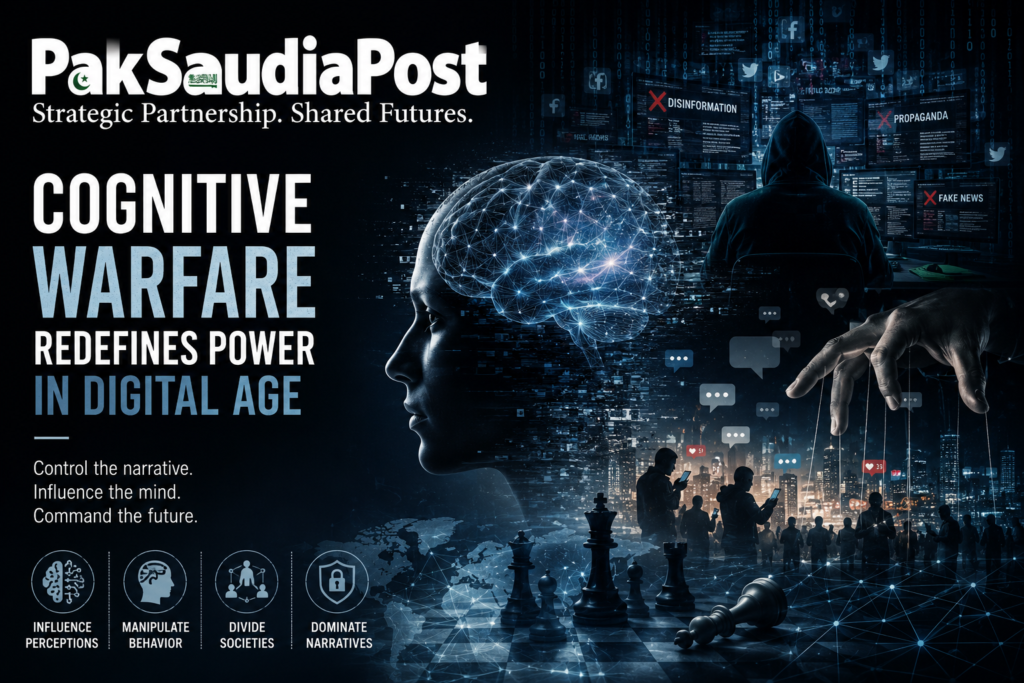
The architecture of contemporary strategic competition is undergoing a quiet but far-reaching transformation in which the locus of power is increasingly shifting from physical coercion to cognitive influence, from territorial control to perceptual engineering, and from kinetic dominance to algorithmic persuasion. This transition is not merely technological in nature; it is epistemological, altering how truth is constructed, how legitimacy is sustained, and how states maintain coherence under conditions of informational saturation.
Modern information ecosystems are no longer passive conduits of communication but active arenas of contestation in which narratives are continuously generated, modified, and redistributed at machine speed. Within this environment, cognitive warfare emerges not as an auxiliary instrument of statecraft but as a central theatre of strategic competition. It operates through subtle modulation of attention, selective amplification of uncertainty, and the systematic erosion of interpretive consensus across societies and institutions.
The proliferation of synthetic media systems has intensified this dynamic. AI generated content, deep learning based image fabrication, and automated narrative replication systems have introduced a condition in which informational authenticity is no longer self evident. Instead, credibility must be continuously reconstructed through verification mechanisms that themselves are vulnerable to manipulation. This creates a paradoxical environment where even efforts to verify truth can be weaponised to generate further ambiguity.
For states operating in such conditions, the primary vulnerability is no longer only misinformation in the traditional sense but structural disorientation. This refers to a sustained condition in which institutions, markets, and publics operate under persistent uncertainty regarding the reliability of signals they receive. In such environments, decision latency increases, policy coherence weakens, and strategic forecasting becomes progressively probabilistic rather than deterministic.
Pakistan and China are both situated within this evolving informational landscape, albeit with different exposure profiles and institutional architectures. For Pakistan, the challenge is compounded by external narrative pressures that often intersect with domestic political volatility, economic sensitivity, and high information permeability. The result is a complex cognitive environment where perception management becomes inseparable from governance stability.
For China, the challenge is more systemic and global in scale. Its expanding digital footprint, technological integration across global markets, and infrastructural connectivity initiatives expose it to diversified information ecosystems where narratives are not centrally controllable and where external perception can rapidly influence economic and diplomatic variables. This introduces a strategic requirement to engage in what can be described as anticipatory narrative calibration rather than reactive communication.
Algorithmic systems play a central role in this transformation. Platform driven content distribution mechanisms increasingly determine what information is visible, amplified, or suppressed within digital environments. These systems operate through opaque ranking architectures that prioritize engagement metrics, behavioural prediction, and network responsiveness rather than factual integrity. As a result, strategic narratives are often shaped not by state actors directly but by the structural logic of digital intermediaries.
This shift has profound implications for sovereignty. Traditional notions of informational sovereignty assumed that states could control or regulate domestic information flows within territorial boundaries. In contrast, contemporary digital ecosystems are transnational, decentralised, and continuously adaptive. Influence now flows through platform architectures that are themselves governed by complex interactions between commercial incentives, computational optimisation, and user behaviour patterns.
Within such systems, cognitive resilience becomes a critical strategic requirement. It refers not simply to resistance against misinformation but to the institutional capacity to maintain coherence under conditions of narrative fragmentation. This includes the ability to preserve policy continuity despite external perceptual distortions, sustain investor confidence amid informational volatility, and prevent the erosion of institutional trust through sustained cognitive pressure.
For Pakistan, cognitive resilience must be embedded within governance structures that are capable of distinguishing between organic public sentiment and externally amplified narrative distortions. This requires integration of data analytics, media monitoring systems, and strategic communication frameworks that operate in real time rather than retrospective cycles.
For China, cognitive resilience is increasingly linked to global perception management in diversified informational environments. As Chinese institutions and enterprises operate across multiple jurisdictions, they encounter heterogeneous narrative ecosystems that require adaptive communication strategies tailored to regional informational cultures rather than uniform messaging frameworks.
The militarisation of information space does not necessarily manifest through overt propaganda alone. It increasingly operates through subtle mechanisms of amplification, fragmentation, and selective attention capture. Strategic actors may not directly control narratives but can influence the probability distribution of narratives gaining prominence within digital ecosystems. This probabilistic influence is often more effective than direct assertion, as it preserves plausible deniability while shaping interpretive outcomes.
Economic systems are also deeply implicated in this cognitive domain. Investor sentiment is increasingly sensitive to informational fluctuations that may have limited grounding in material conditions but significant impact on perceived risk. Market volatility can thus be triggered or amplified through narrative shifts that alter expectations rather than fundamentals. This creates a feedback loop in which perception influences capital flows, which in turn reinforces perception.
Diplomatic environments are similarly affected. Negotiation dynamics are increasingly shaped by pre existing narrative conditions that influence interpretive framing before formal engagement even begins. States enter diplomatic interactions already positioned within informational narratives that shape expectations, trust levels, and perceived credibility.
In response, strategic planning in Pakistan and China must evolve toward integrated cognitive domain awareness. This involves the development of analytical systems capable of mapping narrative flows across platforms, identifying early signals of perceptual shifts, and assessing the potential strategic implications of informational cascades before they fully materialise.
It also requires institutional restraint in communication practices. In highly volatile information environments, excessive signalling can sometimes exacerbate instability rather than mitigate it. The objective is therefore not constant communication but calibrated communication that aligns informational output with strategic stability objectives.
At the structural level, the cognitive domain is becoming as consequential as the military and economic domains. It operates continuously, invisibly, and across all sectors of state activity. Its influence is cumulative rather than episodic, shaping long term perceptions of legitimacy, capability, and intent.
For Pakistan and China, the convergence of technological capability and narrative exposure creates both opportunity and vulnerability. The same systems that enable advanced data analysis and communication efficiency also create surfaces for cognitive interference. Managing this duality requires a shift from defensive information control to proactive cognitive architecture design.
Ultimately, cognitive warfare reflects a deeper transformation in power itself. Power is no longer solely the ability to compel action but increasingly the ability to shape perception environments within which action becomes possible. In this sense, the most consequential strategic contest of the present era is not over territory or resources alone, but over the stability of meaning in a world where meaning itself has become fluid, contested, and continuously reconstructed.
A Public Service Message