

Youth Culture And Soft Power Transform Pakistan Saudi Relations Evolving

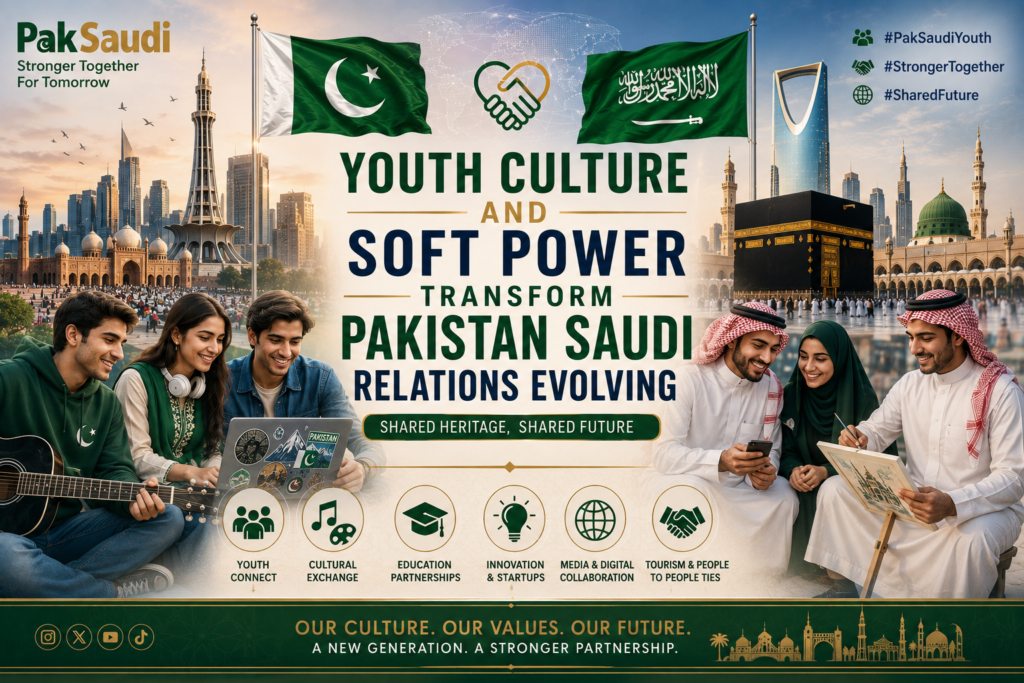
The evolution of Pakistan–Saudi relations in the twenty first century is increasingly being shaped not only by state centric diplomacy, strategic security cooperation, and economic interdependence, but by a more subtle and socially embedded force, the expansion of youth driven cultural exchange and the gradual consolidation of soft power networks. This transformation is neither abrupt nor formally codified; rather, it is incremental, dispersed, and deeply embedded in the everyday circulatory systems of migration, digital culture, religious mobility, and entertainment economies. What is emerging is a relational architecture in which emotional affinity, cultural familiarity, and generational experience increasingly complement traditional geopolitical imperatives.
Historically, the Pakistan–Saudi relationship has been anchored in three primary pillars, religious affinity, labour migration, and security cooperation. Yet these pillars, while still structurally significant, are being reinterpreted through the lens of a younger demographic cohort whose worldview is shaped less by ideological binaries and more by transnational exposure, digital connectivity, and aspirational mobility. In both societies, youth constitute a dominant demographic force, and their interactions, both direct and mediated, are gradually reshaping the symbolic texture of bilateral relations.
One of the most significant vectors of this transformation is labour mobility. Millions of Pakistani workers in Saudi Arabia form an invisible but structurally critical bridge between the two societies. Yet this migration is no longer purely economic in its meaning. The second and third generation of migrant families, increasingly educated and digitally connected, inhabit hybrid cultural identities that blend South Asian linguistic traditions with Gulf urban modernity. Their lived experience becomes a repository of informal diplomacy, where everyday interactions subtly recalibrate perceptions of cultural proximity and difference.
Simultaneously, Saudi Arabia’s own rapid socio cultural transformation under Vision 2030 has generated new forms of engagement with global youth cultures. The expansion of entertainment sectors, sports diplomacy, tourism infrastructure, and cultural festivals has repositioned the kingdom as a site of accelerated social change. For Pakistani youth, this transformation is not abstract; it is experienced through employment opportunities, digital consumption, travel, and increasingly through educational exchanges. The result is a shifting perception of Saudi Arabia, not merely as a religious center or labor destination, but as a complex and evolving society undergoing rapid modernization.
Religious tourism remains one of the most enduring and emotionally charged dimensions of the bilateral relationship. The pilgrimage experience, particularly Hajj and Umrah, continues to function as a powerful mechanism of spiritual connectivity. However, what is changing is the mediation of this experience. Pilgrimage is increasingly documented, shared, and circulated through digital platforms, transforming it into a form of participatory storytelling. Young pilgrims become content producers, narrating their spiritual journeys through visual media that reaches transnational audiences in real time. This phenomenon introduces a new layer of soft power, where sacred experience intersects with digital visibility.
The implications of this shift are profound. Religious mobility is no longer confined to physical space; it is extended into the digital sphere where narratives of devotion, hospitality, and emotional encounter circulate widely. Saudi Arabia’s role as custodian of Islamic holy sites thus acquires an additional dimension, one that is continuously shaped by user generated content and global audience interpretation. Pakistan, as one of the largest contributors to pilgrimage flows, becomes an integral participant in this narrative economy, producing a continuous stream of cultural and emotional representations that reinforce bilateral affinity.
Entertainment industries represent another emergent domain of soft power convergence. Saudi Arabia’s investment in cultural infrastructure, including cinemas, music festivals, sports mega events, and international entertainment partnerships, has opened new channels of interaction with South Asian creative sectors. Pakistani artists, musicians, and media professionals increasingly find opportunities within Gulf cultural circuits, contributing to a gradual normalization of cross cultural artistic exchange. At the same time, Pakistani television dramas, digital content, and music continue to enjoy substantial popularity among Gulf audiences, particularly within expatriate communities.
This cultural circulation is not merely aesthetic; it carries political and social implications. It contributes to the normalization of cultural familiarity, reducing perceptual distance and enabling more nuanced understandings of societal differences. Soft power in this context does not operate through coercion or formal persuasion but through repeated exposure, emotional resonance, and cultural recognition. The gradual accumulation of such interactions produces what can be described as relational familiarity, a condition in which societies begin to interpret each other through shared cultural reference points rather than abstract geopolitical categories.
Youth exchanges, both formal and informal, further intensify this process. Educational scholarships, vocational training programs, and professional mobility initiatives create structured pathways of interaction between Pakistani and Saudi youth. These exchanges are not merely capacity building exercises; they function as experiential platforms of mutual perception formation. Students and trainees return with altered cognitive maps of the other society, carrying with them impressions that often extend beyond institutional narratives.
Digital culture plays a central role in amplifying these dynamics. Social media platforms have become primary spaces of cultural interaction between Pakistani and Saudi youth. Short form video content, lifestyle blogging, religious commentary, and entertainment consumption create overlapping digital publics where cultural boundaries are continuously negotiated. In these spaces, identity is not fixed but performative, shaped by trends, aesthetics, and algorithmic visibility. The result is a form of soft power that is decentralized, participatory, and continuously evolving.
However, this transformation is not without tensions. Cultural conservatism in both societies occasionally intersects with the rapid pace of digital and entertainment driven change, producing friction over norms, values, and public expression. Regulatory frameworks, while adapting, often lag behind the speed of cultural production. This creates periodic disjunctures between official cultural policy and lived cultural practice. Yet these tensions do not necessarily undermine the broader trajectory of convergence; rather, they reflect the complexity of managing cultural transformation in an interconnected world.
From a policy perspective, the rise of youth centered soft power dynamics necessitates a recalibration of bilateral engagement strategies. Traditional diplomacy, focused primarily on state level agreements and economic cooperation, must now be complemented by structured cultural diplomacy frameworks. These frameworks should prioritize long term institutional partnerships in education, media production, creative industries, and digital innovation.
Joint cultural production funds could serve as a mechanism for facilitating co created content that reflects shared narratives while respecting cultural specificity. Similarly, expanded scholarship programs and reciprocal university collaborations would deepen intellectual exchange between younger generations. Sports diplomacy, already gaining traction in the Gulf region, offers another avenue for building mass cultural engagement, particularly given the immense popularity of cricket in Pakistan and the growing diversification of sports interests in Saudi Arabia.
It is also essential to recognize that soft power is not unidirectional. While Saudi Arabia’s cultural transformation projects generate significant global visibility, Pakistan’s cultural and human capital contributions remain deeply embedded in Gulf societies. The Pakistani diaspora in Saudi Arabia functions as a living cultural interface, transmitting language, cuisine, media preferences, and social practices across generations. This embedded presence constitutes a form of quiet but persistent cultural influence that is often underappreciated in formal policy discourse.
At a broader structural level, the convergence of youth culture and soft power between Pakistan and Saudi Arabia reflects a shift from hierarchical diplomacy to networked relationality. The bilateral relationship is increasingly sustained not only by elite negotiations but by dense webs of interpersonal, digital, and cultural interaction. These networks are not centrally controlled, yet they exert significant influence on perception, sentiment, and long term relational stability.
In this evolving context, the future of Pakistan–Saudi relations will depend on the ability of both states to engage constructively with youth as active agents of diplomacy rather than passive recipients of policy. This requires a departure from purely instrumental approaches toward more participatory and dialogical forms of engagement. Youth are not merely demographic statistics; they are cultural interpreters, digital narrators, and transnational connectors whose experiences will increasingly define the emotional and symbolic content of bilateral relations.
The strategic significance of this shift should not be underestimated. While traditional geopolitical variables such as energy, security, and investment will continue to shape the structural foundation of the relationship, it is the softer dimensions of cultural affinity, generational experience, and digital interaction that will determine its long term resilience. Soft power, in this sense, is not an auxiliary layer of diplomacy but an underlying infrastructure of trust and mutual perception.
As Pakistan and Saudi Arabia navigate the complexities of a rapidly changing global order, their ability to harness the transformative potential of youth culture will become a defining factor in the sustainability of their partnership. The convergence of entertainment, education, religion, and digital culture is not merely reshaping how the two societies see each other; it is redefining what their relationship fundamentally is.
In this emerging landscape, diplomacy is no longer confined to statecraft alone. It is increasingly distributed across generations, platforms, and cultural expressions. The task ahead is not to control this transformation but to engage with it intelligently, ensuring that the evolving soft power ecosystem becomes a source of cohesion rather than fragmentation, and a foundation for deeper, more resilient bilateral understanding.
A Public Service Message


