Sea Lanes Drive New Strategic Redundancy

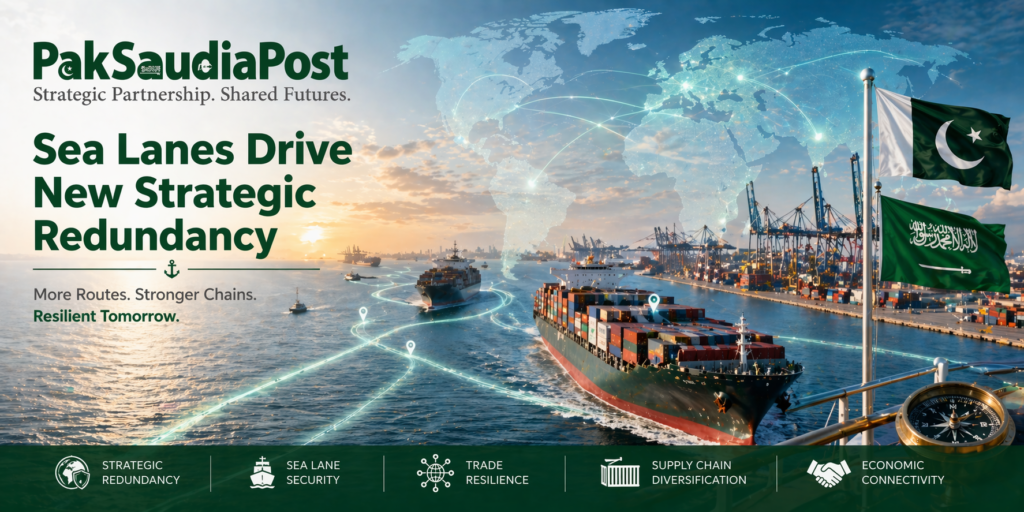
When trade routes function smoothly, geography appears almost invisible. Oil moves, containers arrive, insurance remains manageable, and consumers rarely consider the narrow waterways through which global commerce passes. Yet whenever crisis erupts, maps suddenly regain their authority. Straits, chokepoints, ports, and maritime corridors become decisive strategic facts. The recent disruptions surrounding the Strait of Hormuz have reminded states across Asia and the Gulf that a few nautical miles can influence inflation, diplomacy, and military planning across continents. For Pakistan and Saudi Arabia, the lesson has been especially sharp. Both states depend, in different ways, on secure maritime circulation. Both now have stronger incentives to build strategic redundancy, the creation of alternative routes, backup systems, reserve capacity, and diversified logistics able to withstand coercion or conflict.
The Strait of Hormuz occupies a unique place in world affairs because it combines narrow geography with vast economic consequence. A substantial share of globally traded hydrocarbons passes through waters vulnerable to tension, harassment, and military escalation. Even temporary uncertainty can raise shipping premiums, delay cargoes, and unsettle markets. Full closure is difficult and costly for all parties, yet partial disruption alone can generate significant pressure. In strategic terms, chokepoints need not be sealed entirely to become effective instruments of leverage. Mere risk can be enough.
Saudi Arabia has understood this reality for years, but recent events have accelerated its response. Pipelines connecting eastern production zones to western Red Sea terminals have become more than commercial infrastructure. They are arteries of sovereign resilience. Facilities once justified by efficiency or export flexibility are now interpreted as insurance against maritime vulnerability. The Red Sea route permits outward flow even when Gulf passage becomes uncertain. This does not eliminate dependence on Hormuz entirely, but it reduces the monopoly of that chokepoint over Saudi strategic options.
For Pakistan, the challenge differs but converges. Pakistan is not a major oil exporter. It is a large importer vulnerable to price spikes, shipment delays, and balance of payments stress whenever maritime disruption unsettles energy markets. A country already managing fiscal constraints can suffer disproportionately from freight shocks and sudden import costs. Strategic redundancy for Pakistan therefore means supply assurance rather than export continuity. It involves storage reserves, diversified suppliers, improved port efficiency, and access to alternative commercial arrangements with trusted partners.
This creates natural alignment between Islamabad and Riyadh. Saudi Arabia seeks reliable outlets, downstream partnerships, and diversified regional logistics. Pakistan seeks energy security, investment, and greater relevance in transregional trade networks. The intersection of these needs points toward deeper cooperation in ports, storage, transport corridors, and maritime security.
Ports are the visible front line of this transformation. Karachi remains Pakistan’s historic commercial gateway, handling large shares of national trade and industrial imports. Port Qasim adds specialised capacity. Gwadar, though still evolving, carries outsized strategic symbolism because of its location near Gulf approaches and its connection to wider corridor ambitions. For Saudi planners thinking beyond single route dependence, Pakistani ports offer geographic options on the Arabian Sea that complement Gulf and Red Sea assets. For Pakistan, Saudi participation in logistics infrastructure could bring capital, throughput, and strategic anchoring.
Yet redundancy is not only about ports. It is also about reserves. A country with fuel storage measured in weeks rather than days possesses greater room for diplomatic calm during crises. Strategic petroleum reserves, whether state owned or jointly financed, convert time into leverage. They allow governments to avoid panic buying, stagger purchases, and negotiate from less desperate positions. Saudi Arabia, with deep energy expertise and capital, could become a natural partner in helping Pakistan expand reserve capacity. Such cooperation would serve both sides. Pakistan gains resilience. Saudi Arabia gains reliable downstream relationships and regional influence.
Maritime security is another pillar. Sea lanes cannot be diversified if ships fear attack, mines, piracy, or harassment. Naval cooperation between Pakistan and Saudi Arabia could therefore deepen through surveillance sharing, joint exercises, escort doctrines, and port protection systems. Neither state alone can dominate the wider oceanic space, but together they can improve awareness across crucial routes linking Gulf terminals to South Asian waters. In an age of drones and autonomous systems, even modest naval actors can magnify effectiveness through sensors and intelligence fusion.
There is also the possibility of overland supplementation. While maritime transport remains cheaper for bulk commodities, land based corridors can provide selective resilience for higher value cargo, emergency supplies, or regional trade diversification. Rail links, trucking networks, and inland logistics parks connected to ports create options during maritime stress. Pakistan’s geography, bordering China, Afghanistan, Iran, and close to the Gulf by sea, gives it latent value as a connector if infrastructure and governance improve.
Still, strategic redundancy comes at a price. Efficiency and resilience are not identical goals. The cheapest route is often a concentrated route. Building spare pipelines, underused storage tanks, duplicate terminals, or backup rail lines may seem wasteful during calm years. Economists focused narrowly on cost minimisation can dismiss such projects as redundant excess. Geopolitics repeatedly proves otherwise. Capacity that looks idle in peace can become priceless in crisis. The challenge for governments is political, persuading publics to finance insurance before disaster arrives.
Pakistan faces particular obstacles. Fiscal space is limited. Bureaucratic delays can weaken investor confidence. Security concerns in some regions raise project costs. Regulatory inconsistency deters long term capital. If Islamabad wishes to convert geography into advantage, governance must improve alongside grand strategic narratives. Ports without efficient customs, reliable power, and credible contracts do not become hubs merely by map location.
Saudi Arabia faces its own balancing act. It seeks diversification through Vision style economic transformation while managing regional security risks and global energy market shifts. Investing abroad in logistics partnerships can be rational, but returns depend on political stability and competent execution in partner states. Saudi strategy will therefore likely remain selective, favouring projects with clear commercial and strategic merit.
The broader international environment strengthens the case for redundancy. Great power rivalry is intensifying. Supply chains are being reconsidered after pandemics, wars, sanctions episodes, and technological competition. Companies and states alike now speak of resilience, friend shoring, de risking, and multi sourcing. What was once a niche security concept has entered mainstream economic planning. Pakistan and Saudi Arabia are responding to the same global mood, though from different positions.
China’s role is relevant too. As a major energy importer and investor in infrastructure, Beijing values stable sea lanes and diversified corridors. Pakistan already occupies a notable place in Chinese connectivity plans. Saudi Arabia is deepening economic links with China. This creates the possibility of overlapping interests where Gulf capital, Pakistani geography, and Asian demand reinforce one another. Yet such triangulation must be managed carefully amid U.S. Chinese competition.
The United States remains central to Gulf maritime security, but regional states increasingly prefer supplementary autonomy. Depending entirely on one external guarantor now appears riskier than in earlier decades. Strategic redundancy in alliances mirrors redundancy in logistics. States seek multiple partners just as they seek multiple routes. Pakistan Saudi cooperation should be read partly through this lens.
There is also a psychological dimension. Chokepoints create vulnerability because they narrow imagination. If leaders believe only one route matters, adversaries gain leverage. Once alternatives exist, even imperfect ones, confidence rises. Markets stabilise more easily when participants know substitutes are available. Strategy often works through expectations as much as through physical movement.
Environmental and technological shifts may further alter calculations. Energy transition will gradually reshape hydrocarbon demand, yet maritime trade in minerals, manufactured goods, hydrogen derivatives, and foodstuffs will remain substantial. Ports built for oil can adapt to broader commerce if planned wisely. Thus redundancy investments made today need not become stranded tomorrow.
For Pakistan, the moment carries unusual promise. Too often its geography has been described as cursed, exposed to rivalry, conflict, and external shocks. Geography can also be monetised through competence. If Pakistan becomes a reliable logistics partner with credible storage, efficient ports, and stable maritime policy, vulnerability can be converted into leverage. That transformation is not automatic, but it is possible.
For Saudi Arabia, cooperation with Pakistan offers reach into South Asian markets, maritime depth beyond the Gulf, and strategic partnership with a populous nuclear armed Muslim state whose location matters increasingly. It also offers diversification of influence, something every prudent power seeks.
The phrase strategic redundancy may sound technical, even dull. In truth it describes one of the oldest instincts of statecraft. Never rely entirely on a single road, a single ally, a single source, or a single assumption. Empires ignored that lesson and declined. Modern states that remember it endure shocks better than those that do not.
The Strait of Hormuz will remain important. No pipeline or port can erase geography entirely. But geography can be balanced by alternative geography. That is what Pakistan and Saudi Arabia are beginning to pursue, not escape from chokepoints, but reduction of their tyranny.
In the years ahead, success will depend less on speeches than on cranes, storage tanks, dredging schedules, customs software, naval drills, financing terms, and patient execution. Grand strategy is often built from mundane details. Sea lanes may inspire headlines, but redundancy is created by engineers, administrators, and planners.
If the present crisis has clarified anything, it is that prosperity travels through narrow passages. Wise states widen their options before the next closure comes.
A Public Service Message