Security Pact Becoming Wider Shield for Region

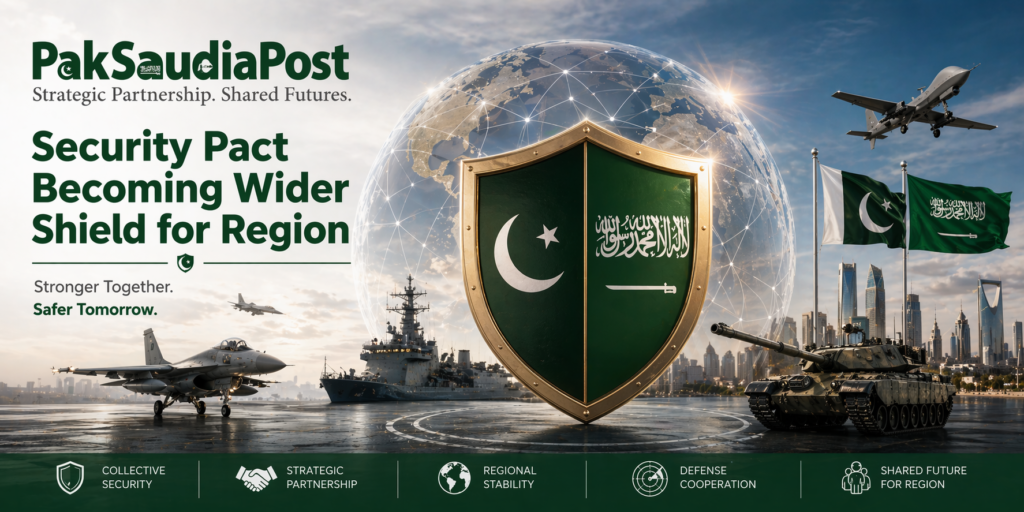
The Pakistan Saudi security relationship has often been described through familiar phrases such as brotherhood, religious affinity, strategic friendship, and longstanding partnership. These expressions contain partial truth, yet they obscure the harder logic that has sustained the connection for decades. Saudi Arabia has required dependable external military cooperation, training depth, and access to a capable Muslim armed force beyond the Arab world. Pakistan has required financial support, labour market access, diplomatic backing, and strategic relevance in the Gulf. Beneath ceremonial language stood a durable exchange of interests. What is changing now is not the existence of that relationship, but its scale, purpose, and possible future form. A bilateral security pact once interpreted mainly as insurance between two states is increasingly being examined as the nucleus of a broader regional shield against twenty first century threats.
The timing is not accidental. The Middle East has entered a period where conventional armies remain important, yet many immediate dangers arise from unconventional means. Drones strike refineries. Missiles threaten airports. Cyber intrusions target infrastructure. Maritime harassment disrupts shipping. Proxy militias generate plausible deniability. Information warfare amplifies panic. These pressures expose the limits of traditional defence models built around heavy armour, static bases, and prestige procurement. States now seek layered protection rather than symbolic arsenals. They need early warning, rapid interception, integrated command systems, redundancy in logistics, and partners able to mobilise quickly.
This strategic environment makes the Pakistan Saudi pact more consequential than earlier arrangements. Reports of military deployments, expanded defence consultations, and visible readiness measures suggest that the relationship is moving from latent reassurance toward operational relevance. A treaty matters most when it alters behaviour in crisis. If assets move, planners coordinate, and adversaries recalculate, the pact has crossed the threshold from rhetoric into deterrent fact.
The immediate significance lies in credibility. Many regional agreements are announced with fanfare and then vanish into bureaucratic sleep. Their clauses remain unread until irrelevance overtakes them. By contrast, a pact that produces exercises, deployments, technical cooperation, and institutional familiarity acquires weight. Credibility in defence affairs is cumulative. Every joint drill, officer exchange, and integrated response plan increases the plausibility that commitments will be honoured under pressure.
Could such a bilateral framework evolve into a wider Sunni security umbrella. The phrase is politically attractive but strategically imprecise. The Sunni world is not a coherent bloc waiting for formal mobilisation. It includes monarchies, republics, military states, democratically contested systems, wealthy hydrocarbon exporters, debt burdened populous societies, and powers with competing ambitions. Threat perceptions differ sharply. Some states prioritise Iran. Others fear internal unrest, jihadist movements, water scarcity, migration shocks, or economic stagnation. Several prefer balancing among great powers rather than joining rigid camps. Therefore, the notion of a neat alliance stretching from Rabat to Jakarta belongs more to rhetoric than reality.
Yet dismissing broader cooperation would also be mistaken. Formal alliances are not the only form of collective security. Modern geopolitics increasingly favoursminilateralism, smaller, flexible coalitions organised around specific tasks rather than grand ideology. A regional shield need not resemble NATO to matter. It may instead consist of interoperable radar networks, coordinated air defence, shared maritime intelligence, joint cyber response teams, standardised training, and rapid deployment mechanisms for infrastructure protection. Such arrangements can produce real security benefits without forcing every participant into every dispute.
Pakistan brings assets that many Gulf states cannot easily generate domestically. It possesses a large military establishment, professional officer corps, operational experience in difficult terrains, nuclear deterrent status, and substantial manpower. Saudi Arabia brings financial capacity, strategic geography, custodianship prestige, and increasing investment in defencemodernisation. Combined intelligently, these capabilities create complementarity. One side supplies scale and experience, the other resources and central location.
There is historical precedent for this pattern. Pakistan has trained Gulf forces, provided advisory support, and stationed personnel in Saudi Arabia in earlier decades. What differs now is the technological and strategic context. Earlier cooperation focused heavily on conventional readiness. Today it must adapt to drone warfare, missile defence, electronic warfare, and protection of energy networks. The old relationship can survive only by becoming more sophisticated.
The maritime domain is especially important. The Red Sea, Bab al Mandab, Gulf waters, and Arabian Sea form a connected arc through which energy exports, pilgrim traffic, container trade, and military movements pass. Disruption in one zone affects insurance rates and freight flows elsewhere. A wider regional shield might therefore prioritise naval patrol coordination, mine countermeasure capability, unmanned surveillance, and port security. Pakistan’s Arabian Sea position complements Saudi Arabia’s dual coastlines on the Gulf and Red Sea. Geography itself encourages cooperation.
Still, any expansion of the pact faces political constraints. Pakistan cannot become an openly anti Iran spear without endangering border stability and domestic sectarian balance. Saudi Arabia itself has at times pursued de escalation with Tehran and may prefer deterrence without perpetual hostility. Türkiye seeks strategic autonomy and may resist security frameworks perceived as Saudi led. Egypt values independence and is cautious about burdensome commitments. Smaller Gulf states hedge among multiple partners. Thus, a wider shield must be pragmatic rather than ideological.
The most realistic path is issue based cooperation. Counter drone defence is easier to coordinate than grand anti Iran rhetoric. Protecting pilgrimage routes is easier than collective expeditionary war. Cybersecurity for banking systems is easier than a permanent joint army. Crisis logistics planning is easier than constitutional mutual defence clauses. States participate where interests converge and abstain where risks exceed gains.
Domestic legitimacy also matters. Populations across the Muslim world are often sceptical of military blocs seen as serving elites or foreign agendas. To endure, a regional shield would need to present itself as defensive, stability oriented, and economically rational. Protecting ports, airlines, power grids, and pilgrims resonates more than abstract balance of power language. Security narratives tied to everyday welfare are politically stronger than those tied solely to elite geopolitics.
There is also a geoeconomic incentive. Insurance premiums, investor confidence, shipping reliability, and tourism flows all depend partly on perceived stability. If cooperative security lowers risk, it generates financial dividends. Saudi Arabia’s economic diversification agenda requires a calmer region. Pakistan’s development ambitions require energy access and remittance continuity. Security, in this sense, becomes an input to growth rather than merely a cost centre.
External powers will watch closely. The United States may welcome burden sharing so long as it complements rather than displaces existing partnerships. China may appreciate stability for energy routes while cultivating its own ties. Russia may view any cohesive regional order with mixed feelings depending on market effects and diplomatic alignments. A Pakistan Saudi centred shield therefore exists within larger global competition, not outside it.
For Pakistan, participation offers prestige but also hazards. Strategic relevance can tempt overcommitment. Islamabad’s economy remains constrained, and public appetite for distant entanglements is limited. The country’s military planners are likely aware that advisory roles and selective deployments differ greatly from open ended regional policing. Prudence will push Pakistan toward bounded commitments with clear objectives.
For Saudi Arabia, the pact can supplement but not replace domestic defence reform. No external partner can permanently compensate for fragmented command systems, procurement inefficiencies, or overreliance on imported expertise. Lasting security requires institutional depth at home. Partnerships are multipliers, not substitutes.
A subtler benefit of the pact is psychological. Regional actors often doubt one another’s staying power. When cooperation persists across decades and adapts across eras, it creates confidence that relationships are not merely episodic. Confidence itself deters opportunism. Adversaries prefer to test weak or uncertain partnerships, not resilient ones.
The concept of a shield is worth examining carefully. Shields are defensive by nature, yet they also enable action by reducing vulnerability. A state confident in protecting infrastructure can negotiate more calmly. A government less fearful of sudden disruption can pursue reform more boldly. Deterrence and development are therefore linked. Security cushions permit economic experimentation.
If the Pakistan Saudi pact matures into a wider framework, it will likely remain decentralised, modular, and technologically focused. Expect more exercises, more intelligence fusion, more procurement partnerships, more maritime coordination, and more training institutions. Expect fewer dramatic treaty ceremonies than commentators imagine. Real integration usually grows through spreadsheets, doctrine manuals, logistics depots, and encrypted networks rather than summit theatrics.
Could it eventually become a recognised regional shield. Yes, if it solves practical problems consistently. No, if it chases ideological grandeur. The Middle East has seen many loudly proclaimed coalitions that dissolved under the weight of vanity and contradiction. Durable security emerges from narrower competence.
The Pakistan Saudi relationship now stands at such a crossroads. It can remain a familiar bilateral arrangement anchored in history, or it can evolve into something more functional for a turbulent age. The pressures of missiles, drones, maritime chokepoints, and uncertain great power guarantees are pushing it toward evolution.
In international politics, structures harden when repeated necessity gives them form. If crises continue to reveal common vulnerabilities, cooperation once considered optional becomes indispensable. That is how pacts become institutions, and institutions become regional shields.
A Public Service Message