Reserves, Riyadh, and Pakistan’s Unequal Stability


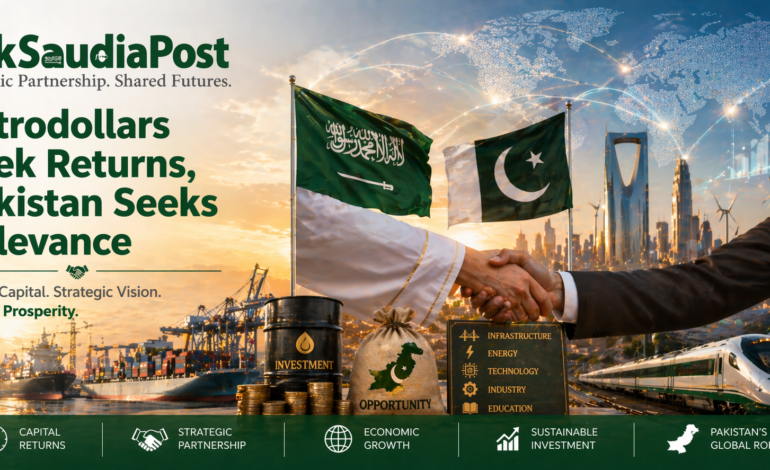
Pakistan’s economic history can be read as a recurring contest between structural weakness and temporary rescue. Whenever foreign exchange reserves begin to evaporate, the currency weakens, import financing tightens, and markets price in another crisis, Islamabad turns outward in search of relief. Sometimes the lender is multilateral, sometimes commercial, sometimes friendly capitals with strategic motives. In recent years, no external partner has played a more decisive role in that emergency architecture than Saudi Arabia. Riyadh’s fresh financial backing has again helped steady Pakistan’s reserves, soothe market anxieties, and buy time for policymakers. Yet each intervention also sharpens a deeper question. Is this partnership a stabilizing fraternity or an unequal dependence dressed as solidarity.
Pakistan’s balance of payments vulnerability is neither new nor mysterious. The country imports more value than it exports, relies heavily on energy purchases denominated in dollars, services substantial external debt, and struggles to widen its tax base enough to finance development internally. Growth cycles often begin with optimism and cheap imports, only to end in reserve depletion when global financing conditions tighten. In that moment, foreign currency becomes more precious than rhetoric. Saudi deposits, deferred oil payments, and rollover facilities become macroeconomic instruments of immediate consequence.
The mechanics are straightforward. When Saudi Arabia places deposits with Pakistan’s central bank or extends financing support, reserve adequacy improves. Even if the funds are not freely spendable in the same way as earned export proceeds, they strengthen the optics and arithmetic of solvency. Creditors feel less nervous. The local currency faces less immediate pressure. Importers gain confidence that letters of credit will remain available. Domestic politics receives breathing space. Governments that looked cornered suddenly gain weeks or months to negotiate reforms or new programs.
That breathing space has real value. In economies where inflation can quickly become political unrest, time itself is an economic asset. Saudi support can prevent abrupt devaluation, reduce panic buying, and soften the social shock that accompanies stabilization programs. Critics who dismiss such support as mere geopolitics often underestimate the practical relief it can provide to ordinary citizens who would otherwise bear the costs of sudden adjustment.
Yet relief is not reform. Pakistan’s repeated return to emergency support reveals a pattern in which short term financing substitutes for long term competitiveness. Export growth remains too narrow, productivity too weak, industrial energy costs too high, and fiscal discipline too episodic. In such an environment, bilateral rescue money becomes not a bridge to reform but an incentive to postpone it. Political leaders can defer hard choices when they expect strategic friends to intervene before collapse.
This is where asymmetry enters the story. Saudi Arabia is not simply another creditor. It is a regional power with capital surpluses, diplomatic reach, religious influence, and growing strategic ambitions. Pakistan, by contrast, seeks liquidity, labor market access for its workers, energy security, and diplomatic goodwill. The relationship contains mutual benefit, but not equal leverage. Riyadh can choose when and how to assist. Islamabad cannot easily choose whether it needs assistance.
Asymmetry does not require coercion to be real. It often appears through subtle preference shaping. A country reliant on another for reserve support may become more attentive to that partner’s security concerns, regional preferences, and commercial interests. It may not be ordered to act, but it learns which positions preserve goodwill. That is how dependency usually works in the modern world. It is less about commands than calibrated incentives.
Saudi Arabia’s own transformation intensifies this dynamic. Under its diversification drive, Riyadh increasingly thinks like an investor rather than a donor. Capital deployed abroad is expected to produce returns, strategic positioning, or both. The age of sentimental patronage is narrowing. Pakistan therefore confronts a tougher environment in which financial assistance may come tied not through public conditions but through implicit expectations of access, alignment, or preferential opportunities.
Still, to portray Pakistan as passive would be inaccurate. Islamabad also possesses leverage. It offers military cooperation, diplomatic support in Islamic forums, a large labor force employed across the Gulf, and geographic relevance at the junction of South Asia, Central Asia, and the Arabian Sea. Saudi Arabia values stability in Pakistan for reasons that exceed charity. A populous nuclear state with deep military institutions and significant religious influence is not an irrelevant partner.
This mutuality matters because it suggests the relationship can evolve beyond rescue cycles. The current model, however, remains skewed toward crisis management. Pakistan approaches Riyadh when reserves thin. Riyadh provides support calibrated to stabilize but not transform. Markets relax temporarily. Reform momentum fades. The next crisis arrives. It is a loop sustained by political convenience on both sides.
Breaking that loop requires Pakistan to use each episode of support as a platform for structural repair. The first imperative is export capacity. A country of Pakistan’s size should not rely so heavily on textiles and remittances while underperforming in engineering goods, pharmaceuticals, information services, agribusiness processing, and higher value manufacturing. Without diversified exports, reserve pressure will repeatedly return.
The second imperative is energy rationalization. Imported fuel remains a major source of external stress. Transmission losses, circular debt, and pricing distortions turn energy from an input into a fiscal trap. Accelerated investment in domestic renewables, grid reform, storage, and efficient transport would reduce the dollar intensity of growth.
The third imperative is taxation. Pakistan cannot sustainably finance development while large segments of wealth remain undertaxed and compliance burdens fall disproportionately on the documented minority. A narrow tax base forces dependence on debt and foreign assistance. Fiscal sovereignty begins with revenue legitimacy.
The fourth imperative is institutional credibility. Investors, including Saudi investors, seek predictable contracts, timely dispute resolution, consistent regulation, and protection from arbitrary policy reversals. Rescue financing may tolerate uncertainty because it is strategic. Productive investment rarely does.
For Saudi Arabia, there is also a strategic choice. Continuing to provide episodic liquidity preserves influence but does little to build durable prosperity in a key partner. Redirecting portions of support into commercially disciplined investment could yield better long term outcomes. Mining ventures, logistics platforms, agricultural technology, petrochemicals, data centers, and vocational training partnerships would generate assets rather than merely postpone liabilities.
Such a shift would also fit Saudi Arabia’s broader ambitions. As the kingdom seeks global relevance beyond oil, relationships built solely on deposits appear dated. Partnerships built on co production, technology transfer, and shared returns are more modern instruments of power. Helping Pakistan become investable would ultimately produce more influence than helping it remain fragile.
There are risks to this vision. Pakistan’s domestic politics often reward short horizons. Coalition pressures, bureaucratic inertia, and elite resistance to reform can neutralize windows of opportunity. Meanwhile Saudi capital has alternatives. It can flow to faster growing markets with clearer rules. Friendship does not erase opportunity cost.
The global context adds urgency. Higher interest rates, geopolitical fragmentation, supply chain shifts, and volatile energy markets make recurring external vulnerability more dangerous than before. Countries that once survived on ad hoc rescues now face harsher scrutiny from markets and institutions. Reserve support can calm today’s panic, but it cannot indefinitely fool tomorrow’s investors.
Public perception inside Pakistan is equally important. Many citizens appreciate Saudi assistance, especially when it helps avoid immediate hardship. Yet repeated reliance can also feed a sense of diminished autonomy. National confidence suffers when every macroeconomic storm seems to require outside umbrellas. Economic dignity is difficult to quantify, but politically potent when absent.
Some argue that all states depend on others and that interdependence is simply modern reality. That is true to a point. Germany depends on export markets, Japan on imported energy, the Gulf on external labor and technology. But healthy interdependence is reciprocal and productive. Unhealthy dependence is recurrent, one sided, and crisis driven. Pakistan must move from the latter toward the former.
This means reframing relations with Riyadh not as a source of emergency cash but as a partner in economic modernization. Pakistan can offer bankable projects, strategic geography, youthful labor, and growing consumer demand. Saudi Arabia can offer capital, managerial expertise, market access, and geopolitical weight. If those assets are combined seriously, both sides gain.
There is precedent for such reinvention elsewhere. Resource rich states increasingly deploy sovereign wealth into global logistics, infrastructure, and technology rather than merely holding reserves in passive assets. Labor abundant states increasingly seek joint ventures rather than aid. The Pakistan Saudi relationship can fit that pattern if both capitals escape old habits.
None of this negates the immediate importance of reserve support. When a country stands near the edge of external stress, liquidity matters enormously. But one must distinguish medicine from nutrition. Emergency deposits can treat the symptoms of crisis. They cannot build the muscles of competitiveness. For that, Pakistan needs domestic reform and foreign investment structured around production.
The coming years may determine whether Pakistan’s external financing model matures or hardens into permanent fragility. If Saudi support is paired with reform, historians may describe these interventions as bridges across a dangerous transition. If not, they will be remembered as expensive pauses between recurring emergencies.
The relationship between Riyadh and Islamabad contains deep cultural, strategic, and political layers that exceed economics. Yet economics increasingly defines credibility in international affairs. A partner perpetually in need commands sympathy but not always respect. A partner that converts support into strength commands both.
For Pakistan, the challenge is therefore not whether to accept Saudi assistance. In moments of strain, refusing helpful capital would be imprudent. The challenge is what to do next. If the answer remains delay, then dependence deepens. If the answer becomes reform, then assistance becomes leverage for renewal.
Saudi capital today steadies Pakistan’s reserves. Whether it also steadies Pakistan’s future depends less on Riyadh than on Islamabad.
A Public Service Message