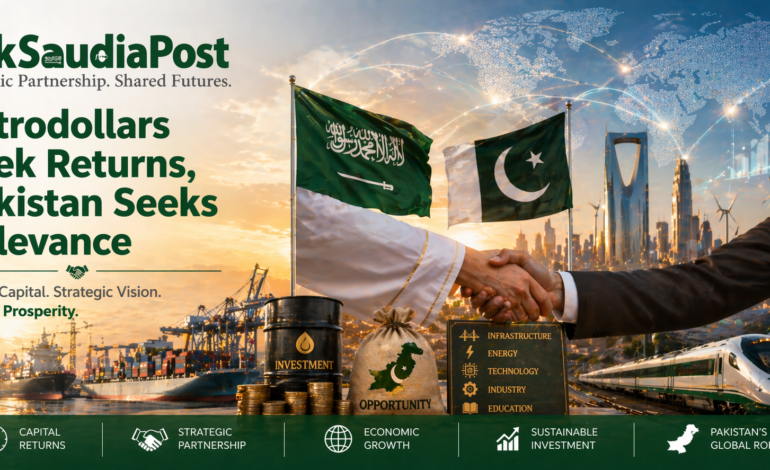
Petrodollars Seek Returns, Pakistan Seeks Relevance


Saudi Arabia is changing faster than many of its long time partners have fully understood. For decades the kingdom was seen primarily as a hydrocarbon giant whose overseas economic footprint moved through aid, deposits, energy diplomacy, prestige acquisitions, and selective strategic patronage. That era is not entirely over, but it is no longer sufficient to explain Riyadh’s behavior. The modern Saudi state increasingly deploys capital through a harder lens of productivity, diversification, technology acquisition, and measurable returns. Vision has replaced habit. Efficiency is displacing sentiment. For countries such as Pakistan, this shift carries a blunt message. Historical warmth is welcome, but future money must be earned.
The old assumption in Islamabad was simple. Strategic closeness with Riyadh would naturally translate into periodic financial relief and occasional investment announcements. Sometimes it did. Deposits arrived in moments of stress. Oil payment facilities softened external accounts. Delegations promised large projects. Political language emphasized brotherhood. Yet the actual stock of transformational investment often lagged the rhetoric. Too much of the relationship remained reactive rather than developmental.
Saudi Arabia’s domestic transformation explains why that model is under pressure. The kingdom seeks to build new industries, attract tourism, create advanced logistics platforms, develop renewable energy, expand entertainment, scale digital ecosystems, and nurture sovereign investment vehicles capable of shaping global markets. Capital is being directed inward at a scale that would once have seemed improbable. External investments continue, but they are increasingly expected to complement national strategy rather than substitute for it.
This matters greatly for Pakistan because it means competition for Gulf money has intensified. Pakistan is no longer judged mainly against its diplomatic significance. It is judged against Indonesia’s manufacturing zones, Egypt’s logistics position, Morocco’s automotive clusters, Vietnam’s export discipline, and India’s market scale. In such a field, nostalgia is not an asset class.
Yet the conclusion should not be pessimistic. Saudi Arabia’s new posture creates challenges, but also opportunities for countries able to align with its strategic needs. Pakistan can still attract Gulf sovereign wealth if it identifies sectors where its comparative advantages intersect with Saudi priorities. The question is no longer whether money exists. It does. The question is whether Pakistan can become a compelling destination for it.
Mining stands near the top of that list. The global economy is entering a resource intensive transition driven by electrification, battery storage, grid expansion, and defense technology. Copper, gold, lithium adjacent ecosystems, rare earth processing, and industrial metals are gaining strategic value. Pakistan possesses significant underdeveloped mineral potential. If extraction frameworks become transparent and security conditions credible, the country could offer long duration resource opportunities attractive to sovereign investors seeking exposure beyond traditional hydrocarbons.
For Saudi Arabia, mining is not merely about owning ore. It is about securing future supply chains. A state seeking to build manufacturing and advanced industry must think upstream as well as downstream. Pakistan’s geology therefore intersects with Saudi industrial strategy. Properly structured partnerships in exploration, processing, rail connectivity, and export infrastructure could produce gains for both sides.
Agriculture is another underappreciated frontier. Saudi Arabia faces natural constraints in water and arable land. Food security has become a strategic concern for many Gulf states after years of supply disruptions, shipping shocks, and climate volatility. Pakistan, despite chronic inefficiencies, retains fertile regions, a large rural labor force, and agro climatic diversity. Yet it exports too much raw produce and too little branded value.
The real opportunity lies in agri- technology. Cold chains, precision irrigation, seed innovation, halal processing, dairy modernization, warehousing, and traceable export systems could transform Pakistan from commodity supplier into food platform. Saudi investors with patient capital may find such sectors more durable than speculative real estate. Pakistan would gain jobs, exports, and technology transfer.
Logistics and maritime connectivity also deserve serious attention. Saudi Arabia is investing heavily in ports, shipping corridors, and transport nodes linking Asia, Africa, and Europe. Pakistan sits at the edge of the Arabian Sea with proximity to Gulf shipping lanes and access routes toward Central Asia. If customs systems modernize, port governance improves, and inland freight bottlenecks ease, Pakistan could integrate into a wider regional logistics architecture.
This possibility has often been discussed more than built. Ports without efficient hinterlands become monuments rather than engines. Corridors without predictable regulation become slogans. To attract Saudi logistics capital, Pakistan must demonstrate that containers can move with speed, contracts can be enforced, and ancillary services can operate profitably.
Digital infrastructure may be the most surprising opportunity of all. Saudi Arabia is pushing into artificial intelligence, data centers, fintech, cybersecurity, cloud services, and smart city systems. Pakistan has one major asset in this domain that it often undervalues. Human capital. Its young population includes a growing base of software developers, freelancers, engineers, and English capable service workers. Labor costs remain competitive. Entrepreneurial energy is visible despite weak systems.
A serious Saudi Pakistan digital partnership could include venture funds, coding academies, Arabic language AI tools, payment systems, health technology platforms, and outsourced service hubs. Unlike heavy industry, such ventures need less steel and more trust. They can scale faster if policy permits.
Energy transition is another natural bridge. Pakistan’s import dependence on fuel remains economically punishing. Saudi Arabia, though an oil power, is simultaneously investing in solar, hydrogen, advanced materials, and petrochemical upgrading. Joint ventures in solar panel assembly, battery storage, transmission modernization, and cleaner fuels could serve both commercial and strategic interests. Pakistan needs lower cost power. Saudi capital needs diversified returns.
Why then has progress remained slower than potential suggests. The answer lies less in Saudi caution than in Pakistani execution. Investors can tolerate risk. They struggle with uncertainty. Pakistan too often offers the latter. Tax regimes shift abruptly. Approval processes multiply. Provincial and federal jurisdictions overlap. Contracts face delays. Land records remain contested. Courts move slowly. Political transitions rewrite priorities. Security narratives, fair or not, add another discount factor.
When sovereign wealth evaluates destinations, it compares friction as carefully as opportunity. A mine with vast reserves but unclear rules may lose to a smaller project in a steadier jurisdiction. A tech market with talent but unstable taxation may lose to one with cleaner compliance. Pakistan’s challenge is therefore institutional before it is promotional.
There is also a cultural adjustment required inside Pakistan’s policymaking elite. Many still approach Gulf capital through ceremony rather than preparation. High level visits produce headlines, but sophisticated investors seek data rooms, bankable feasibility studies, environmental clarity, arbitration frameworks, and realistic return models. Friendship may open the door. Only professionalism closes the deal.
Saudi Arabia, for its part, will also need nuance. Pakistan is not a turnkey market. It is a large, complex federation with political noise, uneven governance, and significant upside. Success often requires patience, local partnerships, and tolerance for imperfect beginnings. Investors expecting instant efficiency may misread the terrain. But investors willing to shape ecosystems rather than merely purchase assets may be rewarded.
The geopolitical environment strengthens the case for deeper economic ties. Supply chains are fragmenting. Major powers are using trade, technology, and finance more strategically. Middle powers are seeking resilient partnerships. In such a world, Gulf capital paired with South Asian labor and geography could become a powerful formula. Pakistan should wish to be part of that formula rather than watch others capture it.
Domestic opinion in Pakistan often swings between unrealistic optimism and cynical fatalism. One week every delegation is hailed as transformative. The next, disappointment breeds claims that nothing will ever change. Both instincts are unhelpful. Serious investment relationships are incremental. They require pipelines of projects, repeated trust, and gradual institutional learning.
What sectors should Pakistan prioritize first. Mining where scale justifies complexity. Agriculture where comparative advantage already exists. Digital services where human capital is strong. Renewable energy where national need is acute. Logistics where geography provides latent value. Attempting everything at once usually means delivering nothing well.
Policy consistency would be the single most valuable signal Pakistan could send. If incentives offered today survive tomorrow’s cabinet reshuffle, capital notices. If disputes are resolved commercially rather than politically, capital notices. If agencies coordinate instead of competing, capital notices. Sovereign funds are patient, but not blind.
There is a deeper philosophical shift underway in global finance. Capital once flowed heavily toward cheap labor alone. Then it favored large consumer markets. Increasingly it now seeks states that combine market opportunity with institutional reliability. Pakistan already has population and location. It must still prove reliability.
For Saudi Arabia, engaging Pakistan productively also serves a wider purpose. It helps demonstrate that Gulf wealth can catalyze development rather than merely purchase prestige. It broadens Riyadh’s influence through co creation instead of episodic rescue. It links an energy power with a populous neighboring region whose long term trajectory matters.
The alternative is a continuation of the old script. Pakistan faces periodic stress. Saudi Arabia extends support. Headlines celebrate solidarity. Structural weaknesses remain. Another crisis returns. Such a cycle preserves familiarity but wastes possibility.
Petrodollars today are more selective than before. They seek yield, security, strategic logic, and institutional confidence. Pakistan still seeks capital, but it must also seek relevance in the eyes of those who provide it. That relevance cannot be inherited from history. It must be built through competence.
The coming decade may reveal whether Pakistan can reposition itself from bailout recipient to investment destination. If it does, Saudi capital could become catalytic rather than palliative. If it does not, money will flow elsewhere while speeches remain generous.
In economics, affection is pleasant but insufficient. Returns decide movement. Pakistan’s task is to make returns and partnership point in the same direction.
A Public Service Message