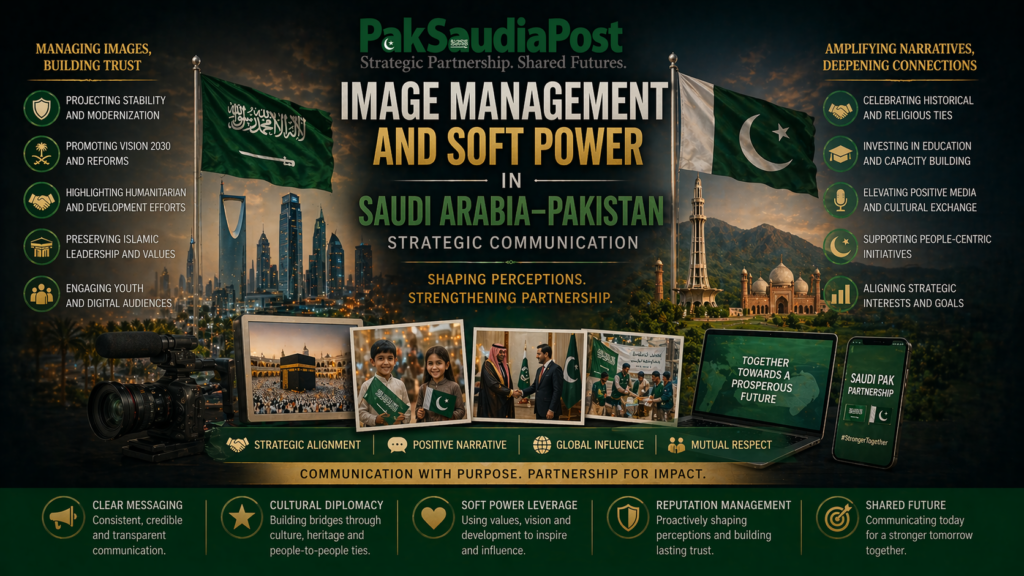
Image Management and Soft Power in Saudi Arabia–Pakistan Strategic Communication

The contemporary strategic relationship between Saudi Arabia and Pakistan is increasingly shaped not only by material cooperation in the domains of energy, finance, and security, but also by an expanding architecture of image management and soft power projection. In an era where international legitimacy is mediated through global media visibility and digital narrative competition, both states have come to recognize that diplomacy is no longer confined to formal treaties or elite negotiations. Instead, it is performed, staged, and continuously reproduced through carefully curated media representations that seek to stabilize political authority, manage external perceptions, and sustain domestic legitimacy during periods of economic or geopolitical strain.
At the core of this evolving dynamic lies a sophisticated process of media diplomacy in which symbolic communication is not secondary to policy but structurally embedded within it. Saudi Arabia has invested heavily in transforming its global image under the framework of Vision 2030, positioning itself as a modernizing state, an emerging investment hub, and a stabilizing force within the broader Middle East. This transformation is not purely economic; it is deeply communicative, relying on international media partnerships, global branding campaigns, cultural diplomacy initiatives, and high-visibility diplomatic engagements that collectively construct a narrative of reform and strategic centrality.
Pakistan, while operating under significantly more constrained economic and institutional conditions, has similarly engaged in image management strategies that emphasize its role as a resilient state within the Islamic world, a key security partner, and a contributor to regional stability. However, the asymmetry between the two states in terms of financial capacity, media infrastructure, and global communicative reach is substantial. Saudi Arabia possesses the resources to shape international narratives on a global scale, while Pakistan’s soft power projection is more episodic, often reactive, and heavily dependent on crisis-driven visibility.
This asymmetry is particularly evident in the way bilateral interactions are represented in global media spaces. High-profile visits, investment announcements, defense agreements, and humanitarian initiatives are often framed through different narrative lenses depending on the originating media ecosystem. In Saudi-centric narratives, Pakistan is frequently positioned within a broader strategic portfolio that includes labor markets, security cooperation, and regional geopolitical alignment. In Pakistani media, however, these same interactions are more often framed through the language of fraternity, mutual respect, and Islamic solidarity, reflecting both cultural affinity and the need to domestically legitimize external dependency.
The concept of soft power, originally articulated in international relations theory as the ability of a state to shape preferences through attraction rather than coercion, has thus acquired a distinctly strategic dimension in the Saudi–Pakistan context. It is no longer limited to cultural influence or reputational appeal but has become a mechanism through which states manage vulnerability, particularly during periods of economic stress or geopolitical uncertainty. Media diplomacy functions as a stabilizing instrument, ensuring that strategic partnerships are perceived as continuous, legitimate, and mutually beneficial even when underlying material conditions are uneven or asymmetrical.
In Saudi Arabia’s case, image management is closely linked to its broader effort to reposition itself within the global order. The diversification of its economy away from oil dependence has required not only structural reforms but also a parallel transformation of its international image. Mega-projects, cultural festivals, sports investments, and high-profile diplomatic summits are all part of a coordinated strategy to reframe the Kingdom as a forward-looking global actor. Within this framework, relations with Pakistan are often presented as part of a wider narrative of South–South cooperation, Islamic solidarity, and regional stability.
Pakistan’s approach to soft power, by contrast, is shaped by different constraints and priorities. Facing recurring fiscal pressures, external debt obligations, and security challenges, Pakistan’s media diplomacy tends to emphasize strategic reliability and ideological affinity rather than global branding. The Pakistan–Saudi relationship is often highlighted as a cornerstone of its foreign policy identity, reinforcing narratives of trust, loyalty, and shared religious heritage. However, this narrative construction is frequently reactive, emerging in response to specific events or diplomatic milestones rather than as part of a sustained global branding strategy.
The interaction between these two approaches produces a layered communicative environment in which image management becomes a shared but unevenly resourced practice. Saudi Arabia’s global media investments allow it to project narratives across multiple continents simultaneously, shaping perceptions in Western, Asian, and Middle Eastern audiences. Pakistan, while active in regional media ecosystems, lacks comparable reach, resulting in a reliance on symbolic amplification during key diplomatic moments to maintain visibility within global discourse.
Digital platforms have further complicated this landscape by democratizing the production and circulation of narratives. Social media, online news portals, and influencer networks now play a significant role in shaping how Pakistan–Saudi relations are perceived by both domestic and international audiences. In these spaces, state narratives coexist with non-state interpretations, creating a fragmented informational environment where official messaging competes with user-generated content, commentary, and algorithmically amplified discourse.
This fragmentation introduces both opportunities and risks for image management. On one hand, digital platforms enable states to engage directly with global audiences without relying exclusively on traditional media intermediaries. On the other hand, the same platforms can amplify misinterpretations, distortions, or emotionally charged narratives that diverge from official diplomatic intent. The speed and scale of digital communication often outpace the ability of state institutions to respond effectively, creating gaps between policy and perception.
Saudi Arabia has responded to these challenges by developing increasingly sophisticated digital diplomacy strategies that integrate traditional media management with real-time online engagement. State-affiliated media organizations, international public relations firms, and strategic communication units work in coordination to ensure narrative coherence across multiple platforms. Pakistan, while also expanding its digital outreach capacity, faces institutional and resource limitations that constrain its ability to maintain consistent global messaging at comparable scale.
The role of crisis moments in shaping soft power narratives is particularly significant in this context. Economic downturns, regional conflicts, or diplomatic tensions often trigger intensified media activity, as states seek to reassure domestic audiences and signal stability to external partners. In such moments, image management becomes not merely a matter of reputation but a form of political risk mitigation. Carefully curated messaging around bilateral cooperation serves to reinforce perceptions of continuity even in the face of uncertainty.
Within the Saudi–Pakistan relationship, such crisis-driven communication is evident in the way financial assistance packages, energy agreements, and defense cooperation are publicly framed. These arrangements are frequently accompanied by symbolic gestures, joint statements, and high-visibility media coverage that emphasize trust and mutual commitment. While these representations reflect genuine strategic interests, they also function as performative acts designed to stabilize perception during periods of economic or geopolitical volatility.
The sustainability of this approach depends on the continued alignment between symbolic representation and material reality. When the gap between image and substance becomes too wide, the credibility of soft power narratives risks erosion. Conversely, when image management accurately reflects underlying strategic conditions, it can enhance trust, reinforce cooperation, and provide a stable communicative foundation for long-term partnership.
A further dimension of this dynamic is the role of audience segmentation in shaping media diplomacy. Domestic audiences in both Saudi Arabia and Pakistan interpret bilateral relations through different cognitive and emotional frameworks than international observers. Media strategies must therefore operate on multiple levels simultaneously, producing narratives that are coherent across diverse cultural, linguistic, and geopolitical contexts. This requires a high degree of narrative flexibility, allowing the same event to be framed differently depending on the target audience without generating contradictions that undermine credibility.
The increasing importance of image management in international relations reflects a broader transformation in the structure of global power. In a media-saturated environment, legitimacy is no longer derived solely from material capabilities but also from the ability to shape perception across fragmented informational ecosystems. Soft power has thus become inseparable from strategic power, and media diplomacy has emerged as a central instrument of statecraft.
For Saudi Arabia and Pakistan, this evolution presents both strategic opportunities and institutional challenges. It enables deeper engagement with global audiences and strengthens bilateral visibility, but it also demands continuous investment in narrative infrastructure, digital capabilities, and communication coherence. As both states navigate an increasingly complex regional and global environment, the management of image and perception will remain a critical component of their strategic partnership.
Ultimately, the Saudi–Pakistan media relationship illustrates how contemporary diplomacy operates at the intersection of symbolism and strategy. Soft power is no longer an auxiliary dimension of foreign policy but a central arena in which political legitimacy is constructed, contested, and maintained. The effectiveness of bilateral relations will therefore depend not only on the durability of economic and security cooperation but also on the ability of both states to manage the evolving architecture of global perception in a rapidly changing media landscape.
A Public Service Message