

Digital Nationalism in Gulf Crises and Sectarian Amplification across South Asian Media Spaces

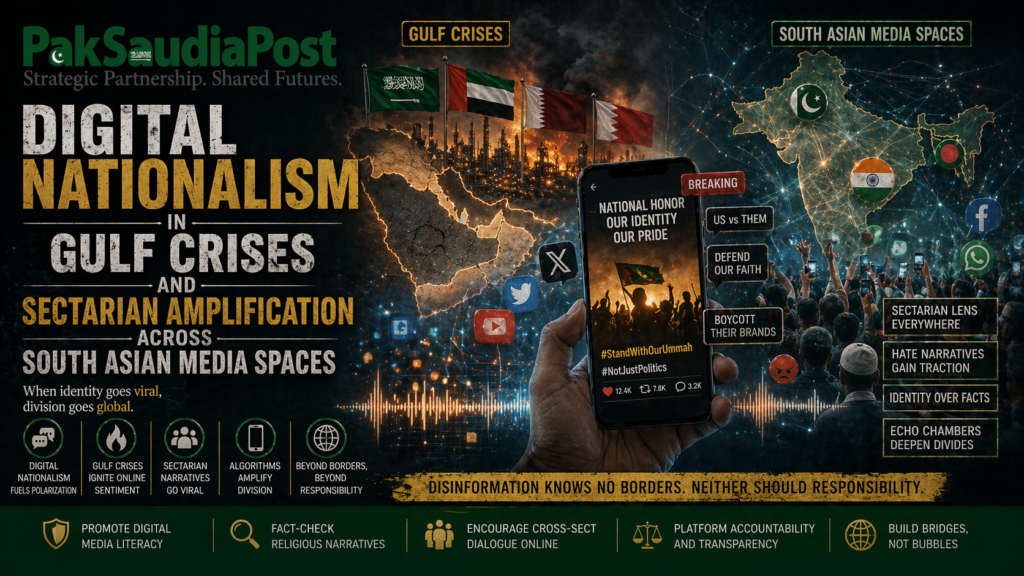
The contemporary global information order has undergone a profound transformation in which geopolitical crises are no longer confined to diplomatic circuits or traditional news cycles. Instead, they are rapidly absorbed into expansive digital ecosystems where emotion, identity, and algorithmic visibility reshape the meaning of international conflict. Nowhere is this transformation more evident than in the recurrent cycles of tension between Saudi Arabia and Iran, which repeatedly reverberate through South Asian social media landscapes, particularly in Pakistan. What emerges from this circulation is not merely public awareness of foreign policy disputes but the formation of digitally mediated political emotions that reconfigure how societies interpret sectarian identity, regional alliances, and strategic alignment.
In Pakistan, the digital reception of Gulf crises is deeply embedded within historical, religious, and structural relationships. Saudi Arabia occupies a privileged symbolic position in the national imagination due to decades of labor migration, religious pilgrimage networks, financial assistance, and defense cooperation. These ties have created a durable emotional infrastructure that shapes how geopolitical information is interpreted in moments of crisis. When tensions escalate between Riyadh and Tehran, digital publics in Pakistan frequently respond not as detached observers but as emotionally invested participants in a broader ideological narrative. This investment is not uniform, yet it is sufficiently widespread to produce discernible patterns of alignment, sympathy, and opposition across online platforms.
A significant feature of this digital response is the tendency to translate geopolitical complexity into simplified moral binaries. State-level strategic calculations are often reframed in sectarian or civilizational terms, where Saudi Arabia and Iran become symbolic proxies for broader religious identities. This transformation is not solely the product of public misunderstanding; rather, it is reinforced by the structural dynamics of social media platforms. Algorithmic systems prioritize content that generates engagement, and emotionally charged narratives consistently outperform analytical or nuanced interpretations. As a result, digital ecosystems privilege expressions of outrage, solidarity, fear, or moral certainty, thereby amplifying sectarian framing during periods of regional instability.
Within this environment, Pakistani digital discourse frequently oscillates between intense expressions of solidarity with Saudi Arabia and counter-narratives that reflect alternative geopolitical or ideological perspectives. These competing narratives rarely engage in sustained dialogue. Instead, they form fragmented informational clusters that coexist without meaningful interaction. The absence of a shared interpretive framework contributes to epistemic segmentation, where different segments of the digital population inhabit distinct informational realities. This fragmentation becomes particularly pronounced during episodes of heightened Saudi Iranian tension, when online activity intensifies and identity-based discourse becomes more visible.
Saudi Arabia’s own media ecosystem, while comparatively more centralized and institutionally regulated, is not isolated from these dynamics. The expansion of digital platforms, multilingual content networks, and diaspora communication channels has introduced new vectors of narrative circulation that extend beyond state-managed messaging. Influencers, transnational commentators, and regional media actors contribute to a complex communicative environment in which official diplomatic positions coexist with alternative interpretations of regional developments. Although state institutions retain significant control over domestic media narratives, the permeability of digital borders ensures that external interpretations of Saudi foreign policy circulate within broader global audiences, including South Asia.
This transregional flow of information generates a feedback loop between Gulf and South Asian digital spaces. Narratives originating in one context are reinterpreted, reshaped, and reintroduced into another, often with altered meaning and intensified emotional charge. In this process, geopolitical events are continuously reframed through culturally specific lenses, reinforcing identity-based interpretations of international relations. The result is a dynamic but unstable informational ecosystem in which meaning is constantly in flux and rarely anchored in institutional or diplomatic clarification.
A central mechanism driving this transformation is what can be described as algorithmic sectarian amplification. Social media platforms are not neutral conduits of information; they are structured environments designed to optimize user engagement. In practice, this means that content eliciting strong emotional reactions is systematically prioritized over content that encourages critical reflection or contextual understanding. During periods of Gulf crisis escalation, this structural bias results in the rapid proliferation of sectarianized interpretations of geopolitical events. Strategic disputes between states are reframed as existential conflicts between religious identities, even when official diplomatic language remains carefully calibrated and non-sectarian.
In Pakistan, the consequences of this algorithmic environment are particularly significant due to the country’s internal sectarian diversity. Digital nationalism, when activated by external geopolitical crises, has the potential to intersect with domestic identity cleavages in ways that amplify social sensitivity. Online expressions of solidarity or opposition in relation to Saudi Iranian tensions can inadvertently reinforce existing fault lines within Pakistani society, even when such outcomes are not intended by participants. This creates a complex policy challenge in which external information flows intersect with internal social cohesion.
The phenomenon of digital nationalism in this context is not merely reactive but structurally embedded within broader transformations of political communication. National identity is increasingly expressed through participation in transnational digital debates, where users perform loyalty, affiliation, or ideological positioning through content sharing, commentary, and engagement. These performances are shaped by platform incentives that reward visibility and emotional resonance, thereby encouraging users to adopt more pronounced and simplified positions on complex geopolitical issues.
At the same time, state institutions in both Saudi Arabia and Pakistan face constraints in managing these dynamics. Traditional instruments of diplomatic communication are often too slow or too formal to effectively intervene in rapidly evolving digital narratives. By the time official statements are released, interpretive frameworks may already have been established within online communities. This temporal mismatch between diplomatic communication and digital information cycles further weakens institutional influence over public perception.
In response, both states have increasingly engaged in forms of digital diplomacy that seek to shape narrative environments more proactively. These efforts include strategic communication campaigns, curated media events, and engagement with digital influencers who can disseminate preferred narratives across platform networks. However, such interventions remain limited in their capacity to counteract the structural incentives of platform capitalism, which continue to prioritize engagement over accuracy or contextual depth.
The broader implication of these dynamics is the emergence of geopolitics as a digitally mediated emotional economy. In this economy, the value of information is determined not only by its factual content but also by its capacity to generate affective response. States, therefore, find themselves operating in an environment where strategic communication must compete with viral emotional narratives that may have little connection to official policy but significant influence over public perception.
For Pakistan, this transformation introduces a dual vulnerability. Externally, it increases susceptibility to narrative alignment pressures during periods of Gulf instability. Internally, it risks intensifying sectarian sensitivities through the importation of external geopolitical tensions into domestic digital spaces. For Saudi Arabia, the challenge lies in managing its global image across diverse audiences who interpret its foreign policy through varying ideological and cultural frameworks, often outside the boundaries of state-controlled messaging.
Addressing these challenges requires a shift from conventional information management toward a more comprehensive framework of digital resilience. This includes strengthening institutional capacity for real-time communication, investing in digital literacy programs that enhance public understanding of geopolitical complexity, and engaging with platform governance structures to address the structural drivers of algorithmic polarization. It also requires a recognition that information ecosystems are now integral to national security environments, rather than peripheral spaces of public discourse.
Ultimately, the phenomenon of digital nationalism in Gulf crises reveals a deeper transformation in the nature of international politics. Geopolitical conflicts are increasingly mediated through digital infrastructures that prioritize emotion, speed, and visibility over deliberation and contextual understanding. In this environment, the stability of international relations is no longer determined solely by diplomatic negotiation or military balance, but also by the unpredictable dynamics of attention economies and algorithmically shaped public sentiment.
As Saudi Arabia and Pakistan navigate an increasingly complex regional and global environment, their ability to manage not only strategic interests but also digital narratives will become a defining factor in the durability of their partnership. The challenge is not to eliminate emotion from political communication, but to prevent its algorithmic amplification from distorting the interpretation of strategic reality. In this sense, digital nationalism is not merely a communicative phenomenon; it is an emerging structural force shaping the contours of contemporary geopolitics itself.
A Public Service Message


