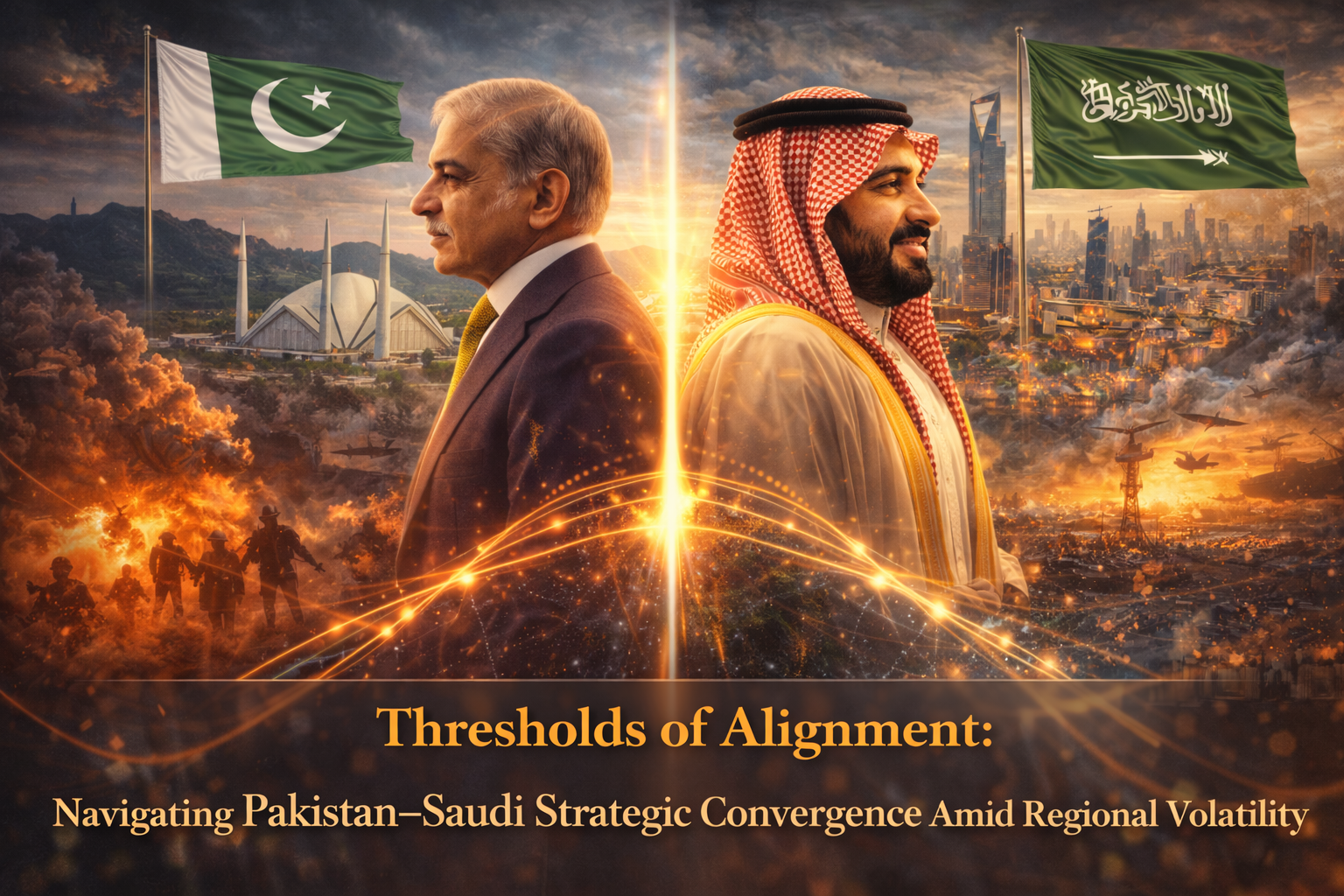
Constrained Neutrality


Pakistan’s aspiration to function as a credible intermediary in regional conflicts is increasingly shaped by a structural condition that can be described as constrained neutrality, a state in which diplomatic positioning is formally autonomous yet substantively conditioned by financial dependence, security entanglements, and labor market exposure. This condition is not an episodic diplomatic dilemma but an embedded structural feature of Pakistan’s external relations architecture, particularly in its engagement with Saudi Arabia, where economic stabilization mechanisms and strategic defense alignments converge to produce a narrow corridor of permissible diplomatic maneuvering.
Within classical international relations theory, neutrality presupposes a degree of material independence sufficient to sustain non alignment without external coercion. However, in the context of contemporary global political economy, neutrality is increasingly mediated by economic interdependence networks that shape policy incentives without requiring direct compulsion. Pakistan’s position illustrates this transformation with particular clarity, as its foreign policy autonomy is continuously negotiated within the constraints of external liquidity dependence and strategic security partnerships.
Saudi Arabia occupies a central position in this configuration due to its dual role as both financial stabilizer and strategic partner. Through recurring deposits, deferred oil arrangements, and emergency balance of payments support, Saudi Arabia contributes significantly to Pakistan’s macroeconomic continuity, particularly during periods of external debt pressure and foreign exchange volatility. These financial mechanisms are not merely transactional but constitutive of a broader stabilizing framework that integrates Pakistan into a Gulf centered liquidity system. This integration inevitably produces policy externalities, as fiscal dependence narrows the scope of independent diplomatic experimentation.
At the same time, Pakistan’s defense relationship with Saudi Arabia introduces an additional layer of structural constraint. Although not formalized as a mutual defense treaty in the classical sense, the strategic alignment between the two states generates expectations of reciprocal security support and political alignment in broader regional theaters. This produces what neo structuralist analysis would describe as a security embedded dependency, where defense cooperation becomes intertwined with economic stabilization, reinforcing a multidimensional alignment that extends beyond conventional alliance behavior.
From the perspective of complex interdependence theory, Pakistan and Saudi Arabia are bound by multiple channels of interaction including labor migration, remittance flows, energy transactions, financial deposits, and security cooperation. These channels operate simultaneously and create a dense network of mutual sensitivity. However, the distribution of sensitivity is not symmetrical. Pakistan’s macroeconomic structure is significantly more vulnerable to disruptions in Gulf financial flows and labor market conditions than Saudi Arabia is to fluctuations in Pakistani policy orientation. This asymmetry transforms interdependence into a hierarchically structured relationship, where influence is diffused but unevenly weighted.
The concept of constrained neutrality emerges precisely from this asymmetry. Pakistan’s diplomatic posture toward regional conflicts, particularly in the Middle East, must continuously account for the potential impact of its positions on financial inflows and labor market access. Even in the absence of explicit conditionality, anticipatory alignment behavior becomes rational within such a structure. Policymakers internalize the external constraints not as coercive impositions but as systemic parameters within which strategic choices are made.
This dynamic is further reinforced by Pakistan’s structural reliance on remittances from Gulf economies, particularly Saudi Arabia, which represent a critical pillar of external account stability. Labor migration functions as a safety valve for domestic employment pressures while simultaneously generating foreign exchange inflows that stabilize the balance of payments. However, this mechanism also deepens exposure to external labor market policies, creating a form of demographic dependence that intersects with financial vulnerability. Any disruption in Gulf labor demand therefore carries immediate macroeconomic implications, further narrowing the scope of independent foreign policy articulation.
Saudi Arabia’s internal transformation under long term economic diversification strategies introduces an additional layer of complexity to this relationship. As the kingdom gradually shifts toward a post oil economic structure emphasizing automation, domestic labor nationalization, and capital-intensive growth sectors, the demand for low skilled foreign labor may experience structural adjustment. This evolution introduces a latent uncertainty into Pakistan’s remittance dependent equilibrium, as the stability of inflows becomes increasingly sensitive to domestic policy recalibration within Saudi Arabia itself.
Within this context, Pakistan’s neutrality is not only constrained by present dependencies but also by anticipated future shifts in those dependencies. This introduces a temporal dimension to constrained neutrality, where policy calculations are shaped not only by current interdependence structures but also by projected transformations in those structures. Strategic foresight therefore becomes an essential component of diplomatic positioning, yet Pakistan’s limited economic diversification restricts its ability to fully internalize such forward looking adjustments.
Dependency theory provides a critical lens through which to interpret this condition. In its classical formulation, dependency theory emphasizes the structural subordination of peripheral economies to core economic centers through trade, finance, and technology flows. However, in the Pakistan Saudi context, dependency is not purely extractive but functionally reciprocal, albeit asymmetrically weighted. Pakistan depends on Saudi liquidity and labor markets for macroeconomic stability, while Saudi Arabia benefits from Pakistani labor supply and strategic security cooperation. This produces a hybrid dependency structure that cannot be reduced to simple domination but instead reflects a complex web of mutual yet uneven reliance.
Neo structuralist perspectives further refine this analysis by emphasizing the role of state capacity and institutional adaptation within dependent systems. From this viewpoint, Pakistan’s constrained neutrality is not merely imposed externally but is also reproduced internally through institutional reliance on external stabilization mechanisms. Fiscal planning, foreign exchange management, and even elements of domestic economic policy are increasingly oriented toward maintaining external confidence, particularly among Gulf financial partners. This creates an internalization of external constraints within domestic governance structures, reinforcing the durability of constrained neutrality.
The operational implications of this condition are particularly evident in Pakistan’s diplomatic behavior during regional crises. While Pakistan seeks to position itself as a potential mediator in conflicts involving Gulf states and other regional actors, its ability to maintain perceived neutrality is continuously filtered through the lens of its strategic and financial alignment with Saudi Arabia. Even subtle shifts in diplomatic language or voting behavior in international forums can carry perceived signaling value, influencing financial market perceptions and external credit assessments.
This introduces a feedback loop between diplomacy and economic stability. Diplomatic neutrality is evaluated not only in political terms but also in financial terms, where perceived misalignment can translate into increased risk premiums or reduced access to external liquidity. As a result, foreign policy decisions are increasingly embedded within macroeconomic risk management frameworks, blurring the distinction between diplomatic autonomy and financial necessity.
Saudi Arabia, for its part, benefits from this structure insofar as it allows the kingdom to extend its regional influence through financial rather than coercive instruments. By providing liquidity support and maintaining labor market access, Saudi Arabia indirectly shapes the strategic environment of partner states without resorting to formal political control mechanisms. This form of influence is more durable and less visible than traditional power projection, as it operates through systemic dependencies rather than explicit directives.
However, this arrangement also carries risks for Saudi Arabia. Over exposure to external fiscal stabilization commitments may generate contingent liabilities that become more pronounced during periods of global financial tightening or oil revenue volatility. Moreover, as Pakistan’s economic fragility persists, the marginal cost of stabilization support may increase over time, potentially altering the cost benefit calculus of sustained financial engagement.
The long-term sustainability of constrained neutrality therefore depends on structural adjustments within Pakistan’s domestic economy. Without significant diversification of export capacity, expansion of tax base efficiency, and reduction of external financing reliance, neutrality will remain conditional rather than substantive. Economic sovereignty, in this context, is not merely a function of policy choice but of structural capacity to absorb external shocks without immediate recourse to external stabilization mechanisms.
At a broader systemic level, the Pakistan Saudi relationship exemplifies the evolving nature of sovereignty in an interconnected global economy. Sovereignty is no longer defined solely by territorial control or formal independence but by the capacity to navigate dense networks of financial, labor, and security interdependence. In such a system, neutrality becomes less an absolute position and more a continuously negotiated equilibrium shaped by material constraints and strategic necessities.
Pakistan’s constrained neutrality thus reflects a broader transformation in the logic of international relations, where power is exercised not only through military or diplomatic means but through the architecture of economic dependence and financial integration. Within this architecture, states operate less as fully autonomous actors and more as nodes within interconnected systems of mutual vulnerability and selective influence.
Ultimately, the persistence of constrained neutrality underscores the limits of traditional foreign policy autonomy in a globalized political economy. For Pakistan, the challenge lies not in abandoning neutrality as an aspiration but in reconstructing the material foundations that would allow neutrality to function as a credible strategic option rather than a conditional posture. For Saudi Arabia, the challenge lies in managing the balance between strategic influence and systemic exposure, ensuring that financial stabilization tools do not evolve into overextended obligations.
In this sense, constrained neutrality is not merely a descriptive condition but a diagnostic lens through which the evolving structure of regional interdependence can be understood. It reveals a world in which diplomacy, economics, and security are no longer separable domains but interwoven dimensions of a single systemic reality, where sovereignty is continuously produced, negotiated, and constrained within networks of asymmetrical interdependence.
A Public Service Message