From Patronage to Partnership: Reengineering Pakistan–Saudi Economic Relations for Strategic Capitalization


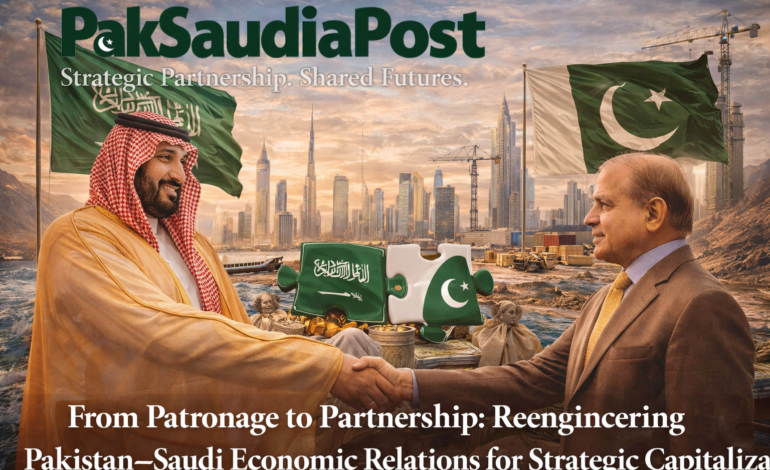
The historical trajectory of economic relations between Pakistan and Saudi Arabia has been defined less by structural interdependence and more by episodic interventions. For decades, the relationship has functioned within a paradigm of financial patronage, where Saudi Arabia has extended liquidity support to Pakistan in moments of fiscal distress. These interventions, often in the form of deferred oil payments, balance of payments assistance, and emergency deposits, have provided immediate relief but have simultaneously entrenched a pattern of dependency. In the contemporary geopolitical and geo economic environment, this model is undergoing a gradual yet decisive transformation. The shift from bailouts to buy ins represents not merely a change in financial instruments but a reconfiguration of the underlying logic of engagement.
This transition carries profound implications for Pakistan’s economic sovereignty, developmental trajectory, and strategic autonomy. The central question is whether Pakistan can convert Saudi financial inflows from short term stabilizers into long term drivers of industrial transformation. Achieving this requires a deliberate restructuring of how capital is absorbed, allocated, and governed. Without such restructuring, the shift from bailouts to investments risks becoming cosmetic rather than substantive, perpetuating dependency under a different guise.
The logic of bailouts is inherently reactive. It is triggered by crisis and designed to restore equilibrium in the short term. Such interventions rarely address structural weaknesses within the economy. They provide liquidity without productivity, stability without transformation. In contrast, the logic of investment is proactive. It seeks to generate returns, create assets, and build capacity. The transition to investment based engagement therefore introduces a new set of expectations, constraints, and opportunities.
Saudi Arabia’s evolving economic strategy, particularly under its broader diversification agenda, aligns with this shift. The kingdom is increasingly seeking to deploy capital in a manner that generates sustainable returns while expanding its global economic footprint. Pakistan, with its large market, strategic location, and resource endowment, presents a compelling destination for such investments. However, attractiveness alone is insufficient. Pakistan must actively shape the terms of engagement to ensure that incoming capital contributes to national development rather than merely extracting value.
The energy sector constitutes a primary domain of engagement. Historically, Pakistan’s energy relationship with Saudi Arabia has been characterized by dependence on imported oil. This dependence has contributed to persistent current account pressures and fiscal vulnerability. The introduction of Saudi investment into Pakistan’s energy infrastructure offers an opportunity to alter this dynamic. Investments in refining capacity, storage facilities, and downstream industries can reduce import dependency while enhancing value addition within the domestic economy.
To maximize the benefits of such investments, Pakistan must adopt a framework that prioritizes integration over isolation. Energy projects should not function as standalone entities but as components of a broader industrial ecosystem. Refining capacity, for instance, should be linked to petrochemical industries, manufacturing clusters, and export oriented production. This integrated approach ensures that the economic impact of investment extends beyond the immediate sector, generating spillover effects across the economy.
The mining sector represents another area of significant potential. Pakistan possesses substantial mineral resources, including copper, gold, and rare earth elements. These resources, if developed effectively, can serve as a foundation for industrial growth and export diversification. Saudi investment in mining offers the prospect of capital infusion, technological expertise, and market access. However, the governance of such investments is critical. Resource extraction must be accompanied by value addition within Pakistan, rather than the export of raw materials.
This requires the establishment of regulatory frameworks that incentivize local processing, technology transfer, and skill development. Joint ventures, rather than wholly foreign owned enterprises, can facilitate knowledge sharing and ensure that domestic stakeholders retain a meaningful stake in the sector. Transparent contracts, robust oversight mechanisms, and clear revenue sharing arrangements are essential to prevent the concentration of benefits in a narrow set of actors.
Logistics and infrastructure form the connective tissue of industrial transformation. Saudi investment in ports, transportation networks, and logistics hubs can enhance Pakistan’s connectivity and competitiveness. Gwadar, in particular, offers a strategic platform for such engagement. Its location near key maritime routes positions it as a potential gateway for regional trade. However, realizing this potential requires more than physical infrastructure. It demands efficient governance, security assurance, and integration with national and regional supply chains.
The structuring of investment inflows is central to avoiding dependency. Pakistan must move beyond a passive recipient model toward an active partnership framework. This involves negotiating terms that align with national priorities, ensuring that investments contribute to employment generation, technology transfer, and export capacity. Fiscal incentives, while necessary to attract investment, must be carefully calibrated to avoid eroding the long term revenue base.
Financial architecture plays a critical role in this process. Pakistan must develop mechanisms that channel foreign investment into productive sectors while minimizing volatility. Sovereign wealth partnerships, co investment platforms, and public private partnerships can provide structured avenues for capital deployment. These mechanisms enable risk sharing, enhance accountability, and align incentives between investors and the state.
The risk of dependency remains a persistent concern. Investment inflows, if not managed effectively, can create new forms of vulnerability. Excessive reliance on a single partner, concentration of investments in limited sectors, and weak regulatory oversight can undermine economic sovereignty. Pakistan must therefore pursue diversification, both in terms of investment sources and sectoral distribution. While Saudi Arabia represents a critical partner, engagement with other actors must continue to ensure balance and resilience.
Institutional capacity is a determining factor in the success of this transition. Effective management of large scale investments requires competent institutions, transparent processes, and consistent policy frameworks. Bureaucratic inefficiencies, regulatory uncertainty, and political instability can deter investment and undermine outcomes. Pakistan must therefore prioritize institutional reform as a core component of its economic strategy.
Human capital development is equally important. Investments in energy, mining, and logistics require a skilled workforce capable of operating advanced technologies and managing complex systems. Pakistan must invest in education, training, and capacity building to ensure that its workforce can fully participate in and benefit from these investments. Without such investment, the economic benefits of foreign capital may be limited and unevenly distributed.
The broader geopolitical context adds another layer of complexity. Pakistan’s economic engagement with Saudi Arabia cannot be viewed in isolation. It intersects with relationships with other regional and global actors, including China, the Gulf states, and Western economies. Managing these relationships requires strategic coherence and diplomatic agility. Pakistan must ensure that its economic policies are aligned with its broader foreign policy objectives, maintaining balance while maximizing opportunity.
Transparency and accountability are essential to sustaining public trust and ensuring the legitimacy of economic engagement. Large scale investments often generate public scrutiny, particularly in sectors such as mining and energy. Pakistan must ensure that contracts are transparent, environmental standards are upheld, and local communities are engaged. Inclusive development enhances the sustainability of investments and reduces the risk of social and political backlash.
The transition from bailouts to buy ins also necessitates a shift in mindset. Policymakers must move from a crisis management approach to a long term developmental perspective. This involves strategic planning, prioritization of sectors, and continuous evaluation of outcomes. Economic policy must be proactive, anticipating challenges and opportunities rather than reacting to them.
Fiscal discipline is a critical component of this transformation. While investment inflows provide resources, they do not eliminate the need for prudent fiscal management. Pakistan must ensure that public finances are managed responsibly, avoiding excessive borrowing and maintaining macroeconomic stability. A stable economic environment enhances investor confidence and supports sustainable growth.
Technology transfer represents a key avenue for maximizing the benefits of investment. Pakistan must negotiate agreements that facilitate the transfer of knowledge, skills, and innovation. This not only enhances productivity but also builds domestic capacity for future growth. Technology partnerships can accelerate industrial development and reduce dependence on external expertise.
Regional integration offers additional opportunities. By leveraging its strategic location, Pakistan can position itself as a hub for trade and investment linking South Asia, Central Asia, and the Middle East. Saudi investment can play a role in this integration, supporting infrastructure and connectivity projects that enhance regional linkages. Such integration amplifies the economic impact of investments and strengthens Pakistan’s geopolitical position.
Risk mitigation strategies are essential to managing uncertainties. Global economic fluctuations, political instability, and market volatility can affect investment outcomes. Pakistan must develop mechanisms to monitor and manage these risks, ensuring resilience and adaptability. Diversification, contingency planning, and strong regulatory frameworks contribute to risk mitigation.
The role of the private sector is critical in this transformation. While state to state agreements provide the foundation, private sector participation drives innovation, efficiency, and growth. Pakistan must create an enabling environment that encourages private investment, both domestic and foreign. This includes regulatory reforms, access to finance, and support for entrepreneurship.
The transformation of Pakistan Saudi economic relations represents a moment of opportunity. It offers the potential to move beyond a cycle of dependency toward a model of partnership that generates mutual benefit. However, this potential is not guaranteed. It requires deliberate strategy, effective governance, and sustained commitment.
The stakes are significant. Success can lead to industrial growth, economic stability, and enhanced strategic autonomy. Failure risks perpetuating dependency and missing a critical opportunity for transformation. Pakistan must therefore approach this transition with clarity, discipline, and a long term vision.
In redefining its economic engagement with Saudi Arabia, Pakistan has the opportunity to reshape its economic trajectory. By converting financial inflows into productive assets, integrating investments into broader development strategies, and maintaining strategic balance, Pakistan can transform a historically reactive relationship into a proactive partnership. This transformation is not merely an economic imperative. It is a strategic necessity in an increasingly competitive and interconnected world.
A Public Service Message