Saudi–Pakistan Strategic Futures Amid Regional Flux and Global Pressures

As the first half of 2026 unfolds, the Saudi–Pakistan partnership stands at a critical inflection point defined by converging geopolitical tensions, economic pressures, technological ambitions, and social dynamics. The regional security environment has become increasingly volatile due to escalating drone attacks in Yemen, ongoing strategic rivalry between Riyadh and Tehran, and disruptions in key energy corridors such as the Strait of Hormuz. Concurrently, Saudi Arabia’s domestic reforms under Vision 2030, including youth employment programs and large-scale infrastructure projects, have generated both economic opportunities and internal stresses that influence the bilateral relationship with Pakistan. For Islamabad, the challenge lies in translating historical ties, religious affinities, and strategic trust into proactive engagement across defense, labor, energy, technology, and finance, thereby positioning itself as a reliable partner capable of navigating regional complexity while safeguarding national interests.
The security and defense dimension remains central to the partnership. Saudi Arabia’s pivot away from détente with Iran reflects a broader strategic posture aimed at deterrence, regional influence, and the projection of sovereign strength. The escalation of proxy conflicts, particularly in Yemen, alongside growing Iranian assertiveness in the Gulf, has heightened Riyadh’s demand for credible operational support, intelligence sharing, and strategic collaboration. Pakistan, with its long-standing military cooperation with the Kingdom, occupies a pivotal role in this landscape. Beyond conventional training and advisory responsibilities, Islamabad’s engagement now encompasses intelligence analysis, strategic planning, maritime security, and crisis management coordination. This multidimensional involvement enables Saudi Arabia to reinforce deterrence credibility while allowing Pakistan to shape operational doctrines, anticipate emerging threats, and contribute technological and tactical expertise within a framework of mutual respect and discretion.
Economic dynamics are equally influential in shaping the future of Saudi–Pakistan relations. The Kingdom’s clampdown on unregulated cryptocurrency, fintech regulations, and controlled financial innovation reflects a broader emphasis on systemic stability and risk management. For Pakistan, this environment necessitates recalibration of remittance flows, investment engagement, and digital financial strategies. While immediate constraints may affect informal channels, the long-term opportunity lies in leveraging Pakistan’s emerging blockchain, fintech, and digital payment expertise to create secure, compliant, and technologically sophisticated corridors for remittances, trade settlements, and investment. These initiatives can transform financial dependency into strategic partnership, allowing both nations to co-develop platforms that meet global compliance standards while enhancing bilateral economic resilience.
Labor migration remains another critical pillar of cooperation. Saudi Arabia’s domestic reforms, aimed at increasing youth employment and reducing reliance on foreign workers, have resulted in sporadic unrest, particularly in large-scale projects like NEOM. Pakistan, whose diaspora contributes significantly to national remittances and economic stability, faces the dual challenge of advocating for its citizens’ rights while adjusting to evolving workforce regulations. Strategic engagement on workforce deployment, vocational training, certification programs, and regulatory alignment is essential to ensure that Pakistan’s labor presence in the Kingdom remains viable, protected, and mutually beneficial. Beyond remittances, this coordination signals Pakistan’s capacity to contribute to Saudi human capital development, positioning the country as a partner capable of bridging domestic employment priorities with international labor needs.
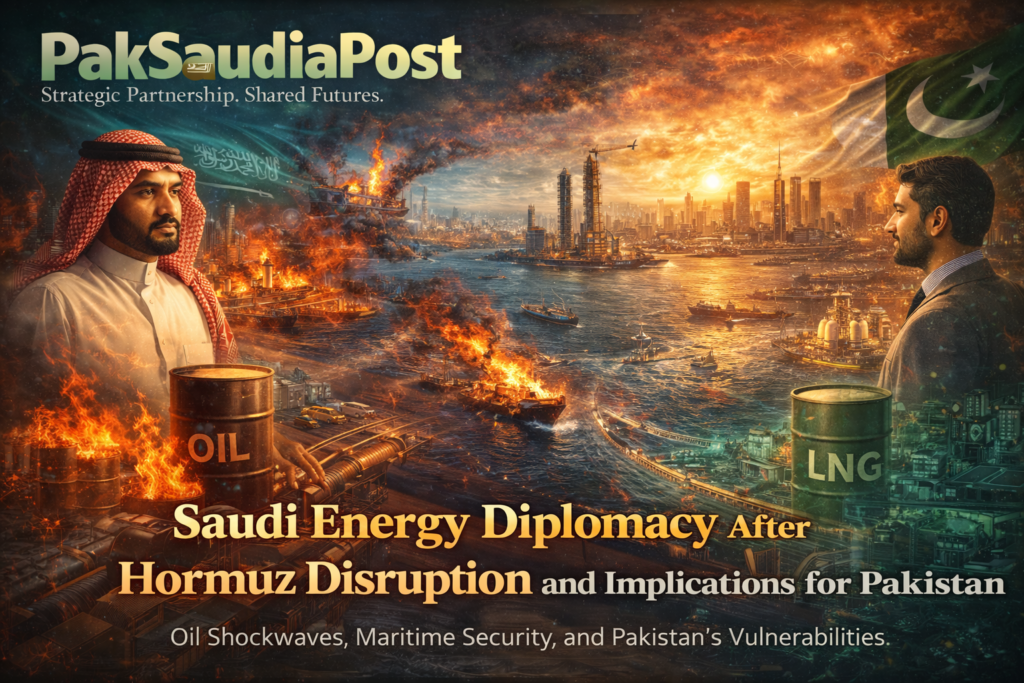
Energy security and cooperation form a central aspect of bilateral strategy. Saudi Arabia’s investments in alternative export routes, particularly through Red Sea ports such as Yanbu, alongside pipeline expansions and logistical redundancies, reflect a proactive response to vulnerabilities exposed by disruptions in the Strait of Hormuz. These measures are designed to safeguard global oil supply, stabilize markets, and maintain Saudi leverage in OPEC+ coordination. For Pakistan, which depends heavily on Saudi oil imports for electricity generation, industrial fuel, and transportation, understanding and integrating these developments into domestic energy planning is critical. Diversifying energy sourcing, engaging in bilateral agreements, and participating in infrastructural coordination enhances Pakistan’s resilience against potential supply shocks and reinforces the strategic dimension of the partnership.
Saudi Arabia’s nuclear ambitions and technological modernization further shape the bilateral landscape. Riyadh’s pursuit of civilian nuclear energy, investment in high-precision technologies, and interest in developing domestic scientific infrastructure creates an opportunity for Pakistan to provide strategic advisory and technological support. Islamabad’s decades of experience in nuclear engineering, reactor safety, and regulatory compliance allows for knowledge transfer that enhances Saudi operational capability while remaining within international non-proliferation frameworks. Beyond nuclear collaboration, Pakistan’s role in advanced technology, cybersecurity, energy management, and logistical systems offers avenues for deeper strategic integration that complement Saudi modernization priorities and reinforce regional influence.
Geopolitical intricacies define the contours of the partnership. Saudi Arabia’s hardening stance toward Iran, the Kingdom’s leadership role in Gulf security, and the interplay of regional proxy networks require Pakistan to engage with strategic foresight. Islamabad must carefully balance its relationships with Riyadh and Tehran, manage perceptions among regional and global stakeholders, and contribute to stability without appearing partisan in broader Gulf rivalries. This involves leveraging diplomatic channels, intelligence cooperation, and technological advisory capacities to ensure that Saudi actions enhance deterrence credibility without triggering unintended escalation. Pakistan’s role as a stabilizing actor, capable of bridging communication and operational gaps, amplifies its regional significance and reinforces trust with Gulf partners.
Financial collaboration and investment initiatives also remain central to long-term strategic stability. Saudi Arabia’s shift toward controlled digital finance, fintech innovation, and large-scale infrastructure projects provides Pakistan with opportunities for joint ventures, technology partnerships, and investment integration. Participation in halal-compliant financial systems, energy infrastructure projects, and strategic economic zones can diversify Pakistan’s economic footprint in the Kingdom while generating reciprocal benefits such as skill development, industrial cooperation, and secure investment flows. Beyond economic metrics, these collaborations serve as instruments of soft power, enhancing Pakistan’s strategic visibility and fostering long-term trust in a rapidly evolving regional environment.
Institutional mechanisms and procedural coordination are essential to sustaining multi-domain cooperation. High-level strategic dialogues, joint working groups, inter-ministerial coordination, and bilateral planning frameworks ensure that defense, energy, labor, technology, and financial initiatives are coherent and mutually reinforcing. Pakistan’s institutional capacity for rapid consultation, situational assessment, and operational planning positions it as a partner capable of contributing to agile, forward-looking bilateral decision-making. Such mechanisms reduce friction, enhance transparency, and allow both nations to respond effectively to crises, whether related to energy disruptions, proxy conflict escalation, or domestic socio-economic pressures.
The global context adds an additional layer of complexity. Pakistan faces fiscal constraints, IMF obligations, and foreign exchange pressures while navigating volatile regional energy markets and security threats. Saudi Arabia’s control over energy flows, technological capacity, and financial influence makes it a critical partner whose engagement must be strategically managed. Proactive participation in bilateral projects, technological collaboration, workforce planning, and energy supply coordination allows Pakistan to convert dependency into strategic partnership, ensuring resilience across economic, defense, and technological dimensions.
Cultural and normative alignment underpins trust and operational efficacy. Shared historical, religious, and strategic affinities provide a foundation for engagement, yet operational consistency, ethical adherence, and regulatory compliance are essential to sustain credibility. Pakistan’s ability to navigate complex normative environments, enforce regulatory discipline, and maintain professional standards strengthens its role as a dependable partner in areas ranging from labor management to technological advisory and energy cooperation.
Strategic foresight will define the trajectory of Saudi–Pakistan relations in the medium and long term. Contingency frameworks for energy supply, labor deployment, financial collaboration, and technological development must be formalized and institutionalized. Joint planning for security, maritime logistics, and crisis management ensures that bilateral engagement is proactive rather than reactive. Expanding technological partnerships in fintech, energy, and civilian nuclear projects reinforces resilience, operational efficiency, and strategic credibility. In the defense domain, integrating intelligence, training, and operational planning enhances deterrence capabilities while respecting Saudi sovereignty and regional sensitivities.
The interdependence of defense, energy, technology, labor, and financial policy underscores the systemic complexity of the relationship. Strategic coherence across domains ensures that operational stability, economic resilience, and geopolitical influence are mutually reinforcing. Energy security enables economic continuity, which in turn supports labor welfare and technological collaboration. Defense readiness underpins regional stability, while technological integration facilitates innovation, efficiency, and resilience. This holistic perspective is essential for navigating the multifaceted Saudi–Pakistan partnership and ensuring that bilateral engagement translates into tangible national and regional benefits.
In conclusion, the Saudi–Pakistan strategic partnership in 2026 is defined by complexity, interdependence, and opportunity. Defense collaboration, energy security, labor coordination, technological advisory, and financial integration converge to create a multi-dimensional relationship that is central to both nations’ regional influence and domestic stability. For Pakistan, the challenge lies in transforming historical dependency into proactive partnership, leveraging expertise, institutional capacity, and strategic foresight to reinforce credibility and resilience. For Saudi Arabia, Pakistan represents a trusted partner capable of enhancing operational effectiveness, technological advancement, and regional strategic equilibrium. The successful navigation of these domains will determine the durability, efficacy, and strategic value of the bilateral relationship, providing a model for adaptive, multi-sectoral cooperation in a region characterized by volatility, competition, and complex interdependence.
A Public Service Message.