
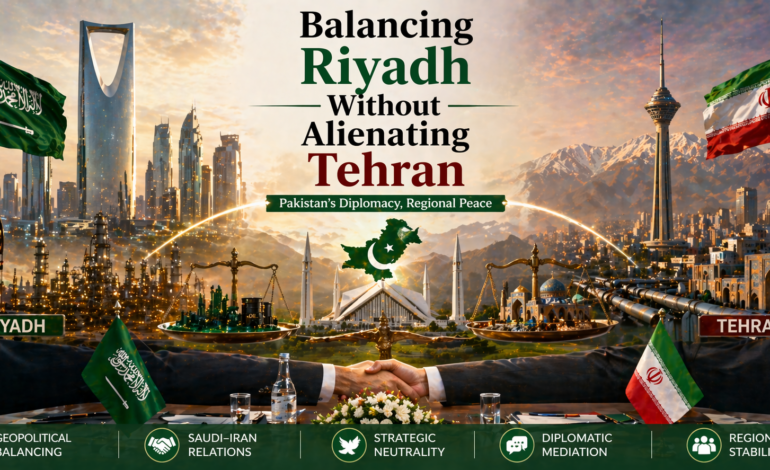
Balancing Riyadh Without Alienating Tehran

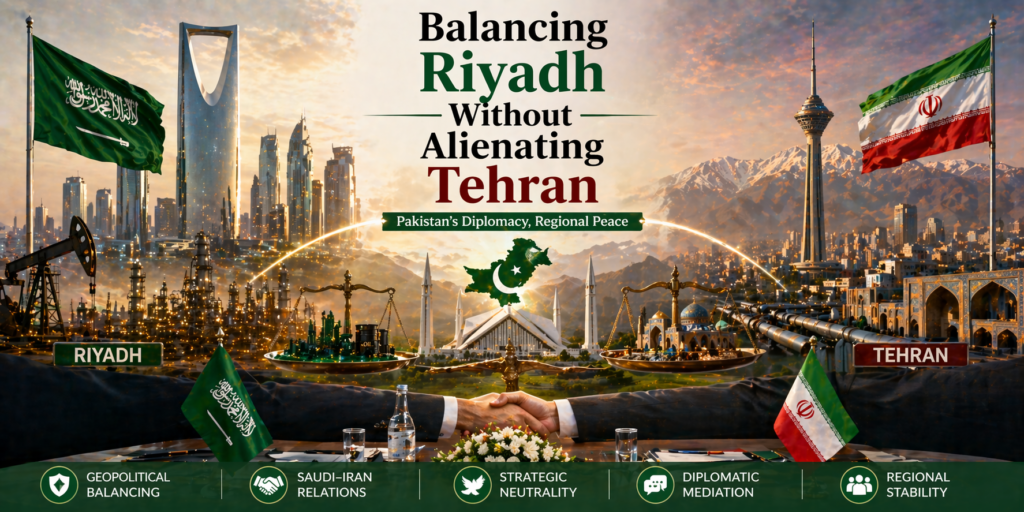
Pakistan’s foreign policy has long been described as a study in constrained motion, a state perpetually navigating between necessity and geography, ideology and economics, proximity and patronage. Nowhere is this more visible than in its attempt to balance its ties with Saudi Arabia while avoiding rupture with Iran. What appears at first glance as classical hedging is in reality something more fragile and more demanding: a continuous act of geopolitical calibration in a region where alignment is rarely cost free and neutrality is rarely believed.
The difficulty for Islamabad is not simply that Saudi Arabia and Iran are rivals. It is that their rivalry is no longer episodic but structural, embedded in competing regional visions, security doctrines, and economic corridors. In such an environment, Pakistan is not a distant observer but an adjoining stakeholder. It shares deep financial interdependence with Riyadh and a long, volatile border with Tehran. The result is a foreign policy condition in which distance cannot be chosen and consequences cannot be fully controlled.
For decades, Pakistan’s relationship with Saudi Arabia has been anchored in a combination of economic relief, labor migration, energy support, and security cooperation. The Kingdom has acted as a recurring financial stabilizer during Pakistan’s balance of payments crises, often providing deferred oil facilities, deposits to central banking reserves, and bilateral assistance packages during moments of fiscal distress. This has created a pattern of reliance that is not easily substituted by other partners. Even as Pakistan diversifies its external financing sources, Saudi Arabia remains a pivotal anchor in moments of macroeconomic vulnerability.
Yet this relationship is not merely economic. It carries symbolic and strategic dimensions that extend into defense cooperation and regional diplomacy. Pakistani military expertise has historically been valued in Gulf security frameworks, and the broader alignment between the two states has increasingly taken on institutional characteristics. This has generated perceptions, particularly in Tehran, that Pakistan’s strategic orientation is tilted toward Riyadh, regardless of Islamabad’s public insistence on neutrality.
Iran, however, occupies a fundamentally different category in Pakistan’s strategic imagination. It is not a distant partner but a contiguous neighbor sharing a long and complex border that stretches across volatile provinces. This geography imposes constraints that are more immediate than ideology. Cross border militancy, smuggling networks, energy potential, and Afghan spillovers create a dense web of interdependence that cannot be ignored or outsourced. Even during periods of political tension, both states have had to return to dialogue simply because geography leaves no alternative architecture for coexistence.
This dual dependency produces a diplomatic paradox. Pakistan requires Saudi Arabia for macroeconomic stability, yet it requires Iran for border stability. One relationship is financial and strategic, the other is territorial and security driven. Attempting to satisfy both simultaneously forces Islamabad into a mode of diplomacy that is reactive rather than directive, shaped more by crisis management than long term design.
In recent years, this balancing act has become more complicated as the Saudi Iran rivalry has intensified within a broader regional transformation. The Middle East is no longer defined solely by bilateral antagonisms but by overlapping theatres involving energy transitions, normalization agreements, proxy competition, and shifting alliances with external powers. Within this fluid environment, Pakistan has attempted to position itself as a mediator or at least a stabilizing interlocutor. Yet mediation itself is not neutral. It requires trust from both sides, and trust is precisely what is most difficult to sustain in polarized systems.
Saudi Arabia’s evolving regional strategy adds another layer of complexity. Under its broader economic transformation agenda, the Kingdom has sought to reposition itself as a central hub of diplomacy and security coordination. This involves deepening ties with selected regional partners who can contribute to its vision of a stable and investment friendly environment. Pakistan, with its military capabilities, demographic weight, and historical linkage, fits into this framework as a valuable partner.
At the same time, this partnership is increasingly embedded in a wider recalibration of Saudi foreign policy that seeks to reduce overdependence on any single external guarantor. This diversification has created space for more autonomous regional relationships, but it has also introduced new expectations. Cooperation is no longer purely transactional. It is increasingly tied to broader strategic convergence, including regional security coordination and diplomatic alignment on key issues.
For Pakistan, this evolution is both an opportunity and a constraint. It provides access to financial and strategic support at a time of domestic economic fragility, yet it also increases the visibility of its alignment choices. Every deepening of cooperation with Riyadh is closely observed in Tehran, where historical sensitivities and regional competition shape interpretation. The perception of imbalance can be as consequential as imbalance itself.
Iran’s perspective on Pakistan is shaped by a combination of historical expectation and strategic disappointment. Despite shared religious and cultural linkages, bilateral relations have been periodically disrupted by mutual suspicion, border insecurity, and divergent regional alignments. Tehran’s strategic environment, particularly its competition with Gulf states, means that Pakistan’s relationship with Saudi Arabia is rarely viewed in isolation. Instead, it is interpreted through the prism of regional contestation.
This creates a situation in which Pakistan’s diplomatic signals are constantly overdetermined. A defense agreement with Saudi Arabia is read not only as bilateral cooperation but as regional positioning. A security dialogue with Iran is interpreted not only as neighborly engagement but as strategic recalibration. The space for purely functional diplomacy is therefore narrow.
The challenge for Islamabad is compounded by its domestic constraints. Economic fragility limits foreign policy autonomy. States with strong financial buffers can afford ambiguity; those dependent on external financing often cannot. When fiscal stability is tied to external partners, strategic flexibility becomes conditional. This is particularly relevant in Pakistan’s case, where periodic balance of payments pressures require engagement with institutions and states that also have geopolitical preferences.
Within this context, Pakistan’s policy of maintaining equilibrium between Riyadh and Tehran is less a strategic doctrine and more a survival mechanism. It is an attempt to prevent external alignments from hardening into irreconcilable contradictions. Yet survival strategies are inherently reactive, and over time they risk being interpreted as inconsistency rather than balance.
The deeper question is whether such balance can be sustained in a regional order that is itself becoming less balanced. The Middle East and its adjoining regions are witnessing a gradual shift from fluid alignments to more structured blocs, even if informal. Energy cooperation, defense partnerships, and infrastructure corridors are increasingly being embedded within competing strategic architectures. In such an environment, states that occupy intermediary positions face growing pressure to clarify their orientation.
Pakistan’s response has been to emphasize diplomacy, mediation, and regional connectivity. It has sought to present itself as a bridge rather than a pivot, a connector rather than a camp follower. This narrative is strategically useful, but its durability depends on whether both Saudi Arabia and Iran are willing to tolerate ambiguity in Pakistan’s positioning. So far, tolerance has been uneven.
Saudi Arabia’s strategic patience with Pakistan is closely linked to its broader regional calculations. As long as Pakistan contributes to stability, security cooperation, and diplomatic support, Riyadh has an incentive to maintain the relationship despite occasional misalignments. Iran’s patience, however, is more constrained by immediate security concerns and regional rivalries. This asymmetry in tolerance levels further complicates Pakistan’s balancing strategy.
There is also the question of external powers. The presence of global actors in the region introduces additional layers of influence. Great power competition shapes regional alignments in ways that indirectly affect Pakistan’s options. Energy security concerns, maritime routes, and connectivity projects all intersect with broader geopolitical rivalries, limiting the scope for purely regional solutions.
Against this backdrop, Pakistan’s attempt to avoid alienating Tehran while deepening ties with Riyadh resembles a continuous negotiation rather than a settled policy. It is a process of constant adjustment, where diplomatic language, timing, and signaling become as important as substantive agreements. The objective is not to resolve contradictions but to prevent them from escalating into crises.
Yet the limits of such an approach are increasingly visible. As regional tensions rise, the margin for ambiguity narrows. At some point, every balancing act risks being interpreted as preference. And in geopolitics, perceived preference often becomes reality regardless of intent.
Pakistan therefore faces a structural dilemma. To secure economic stability, it must maintain strong ties with Saudi Arabia. To ensure territorial security and regional continuity, it must preserve workable relations with Iran. These two imperatives are not mutually exclusive, but they are increasingly difficult to harmonize in a polarized environment.
The future of this balancing act will depend less on Pakistan’s diplomatic skill alone and more on the trajectory of Saudi Iran relations themselves. If regional tensions ease, Pakistan’s intermediary role becomes easier to sustain. If rivalry intensifies, Islamabad may find itself pulled into choices it has long sought to avoid.
For now, Pakistan remains suspended between necessity and geography, attempting to maintain equilibrium in a system that is steadily losing its own balance. The choreography continues, but the stage beneath it is becoming less stable.
A Public Service Message


