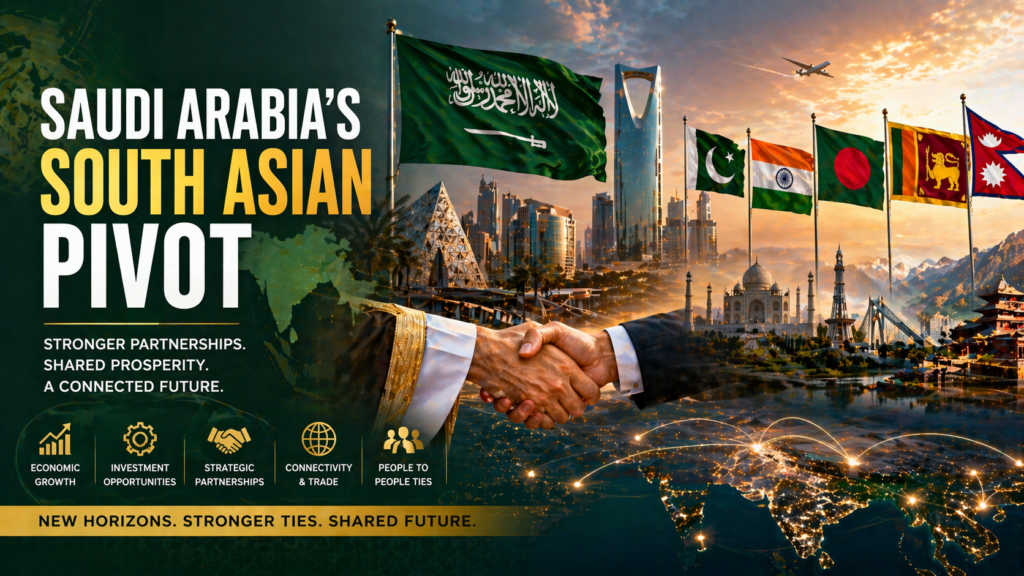
Saudi Arabia’s South Asian Pivot

Saudi Arabia’s expanding engagement with South Asia, and particularly its deepening strategic attention toward Pakistan, reflects a quiet but consequential transformation in the Kingdom’s foreign policy architecture. What was once a relationship largely defined by labor migration, energy trade, and episodic financial support is now increasingly embedded in a broader strategic recalibration. This shift is not cosmetic. It is structural, driven by Riyadh’s attempt to reposition itself within a rapidly evolving global order where influence is no longer derived solely from hydrocarbons, but from connectivity, security partnerships, and diplomatic centrality.
At the heart of this pivot lies Saudi Arabia’s broader ambition to diversify its geopolitical dependencies and expand its strategic bandwidth beyond its traditional Western security umbrella. For decades, Riyadh’s external security architecture was heavily anchored in its alignment with the United States. That alignment remains important, but it is no longer sufficient in a world marked by fragmented power centers, regional volatility, and the gradual diffusion of global authority. As a result, Saudi foreign policy has entered a phase of pragmatic diversification, where partnerships are being evaluated not merely on ideological alignment but on functional utility.
South Asia, long treated as a peripheral theater in Saudi strategic thinking, has now acquired renewed importance. This is not because the region has suddenly become stable, but precisely because it has become strategically consequential. The convergence of nuclearized deterrence structures, rising economic corridors, maritime chokepoints, and great power competition has elevated South Asia from a secondary arena to a primary node in global geopolitics. Within this space, Pakistan occupies a distinctive position.
Pakistan’s value to Saudi Arabia is not reducible to a single dimension. It is a composite of military capacity, demographic weight, geopolitical location, and historical affinity. The Pakistani military establishment has long maintained institutional familiarity with Gulf security environments, contributing personnel, training frameworks, and advisory support in various phases of regional instability. This legacy has created a foundation of trust that continues to shape contemporary cooperation, even as the strategic context has evolved.
More importantly, Pakistan’s geographical positioning places it at the intersection of multiple strategic corridors. It borders Iran, connects to Afghanistan, faces the Arabian Sea, and sits adjacent to the emerging China centered connectivity landscape. For Saudi Arabia, which is seeking to expand its global partnerships beyond traditional Western corridors, Pakistan offers a bridge into multiple overlapping regions. This makes Islamabad not just a bilateral partner but a multidimensional strategic node.
The Saudi pivot toward Pakistan must also be understood within the context of Riyadh’s domestic transformation agenda. Vision oriented reforms aimed at restructuring the Saudi economy require a stable regional environment, diversified investment partnerships, and reduced exposure to singular geopolitical shocks. In this framework, foreign policy becomes an extension of economic policy. Security partnerships are evaluated not only in terms of military utility but also in terms of their contribution to regional predictability and investment confidence.
Pakistan, despite its economic vulnerabilities, offers Saudi Arabia a form of strategic reliability that is rooted in long standing institutional familiarity. This reliability is particularly valuable in volatile regional conditions where alliances are increasingly fluid and transactional. The Saudi approach therefore reflects a blend of continuity and innovation, preserving old relationships while repurposing them for new strategic objectives.
One of the most visible expressions of this evolving relationship is the gradual shift from episodic financial assistance to more structured economic engagement. In earlier decades, Saudi support to Pakistan often took the form of short term deposits, oil payment deferrals, or crisis driven liquidity injections. While these mechanisms remain relevant, they are now increasingly supplemented by longer horizon engagements that reflect a more strategic understanding of interdependence.
This evolution signals a departure from purely patronage based diplomacy toward what can be described as conditional partnership logic. In this model, financial and economic cooperation is intertwined with broader expectations of strategic alignment, policy coordination, and regional stability contributions. The relationship thus becomes less about assistance and more about co management of regional uncertainties.
At the same time, Saudi Arabia’s engagement with Pakistan cannot be understood in isolation from its complex regional environment. The Kingdom’s rivalry with Iran continues to shape its external alignments, even as both states occasionally explore de escalation pathways. Within this context, Pakistan becomes both an opportunity and a constraint. It is an opportunity because of its proximity to Iran and its potential role as a diplomatic intermediary. It is a constraint because excessive alignment risks complicating Pakistan’s ability to maintain balanced relations with Tehran.
This duality reflects a broader feature of Saudi foreign policy in the current era. Riyadh seeks to expand its partnerships without locking itself into rigid blocs. It prefers flexible alignments that can adapt to shifting regional dynamics. Pakistan fits this preference structurally, but only as long as it retains its diplomatic flexibility. If Pakistan is perceived as too closely aligned with any single regional camp, its utility as a bridge diminishes.
The Saudi pivot toward South Asia is also influenced by the changing nature of global economic geography. The rise of Asia as the center of global economic gravity has pushed Gulf states to diversify their external linkages. Energy flows, investment patterns, and labor markets are increasingly oriented toward Asia rather than the West. In this context, South Asia is not merely a labor exporting region but a potential partner in infrastructure, logistics, and connectivity networks.
Pakistan’s inclusion in this emerging framework reflects both opportunity and limitation. On one hand, it offers access to a large consumer base, transit routes, and strategic depth. On the other hand, persistent structural economic weaknesses constrain the extent to which Pakistan can fully capitalize on these opportunities. This asymmetry creates a dynamic in which strategic potential and economic reality do not always align.
The military dimension of Saudi Pakistan relations remains a central pillar of this evolving partnership. However, it is increasingly embedded within a broader strategic logic rather than existing as an isolated domain. Security cooperation is now intertwined with regional stabilization objectives, counterterrorism frameworks, and crisis management mechanisms. This reflects a shift from reactive security collaboration to more anticipatory forms of strategic coordination.
Yet, despite this deepening engagement, the relationship remains fundamentally asymmetrical. Saudi Arabia’s economic weight far exceeds that of Pakistan, giving Riyadh significant leverage in shaping the terms of engagement. Pakistan, in contrast, contributes primarily through strategic utility rather than economic equivalence. This asymmetry is not necessarily destabilizing, but it does require careful management to prevent dependency from hardening into structural imbalance.
The question of whether Saudi Arabia’s South Asian pivot represents a long term strategic reorientation or a tactical diversification remains open. There are arguments for both interpretations. On one hand, the institutionalization of defense agreements, economic frameworks, and diplomatic coordination suggests a durable shift in strategic orientation. On the other hand, the persistence of regional volatility means that many of these arrangements may remain contingent on external shocks and crisis cycles.
What is clear, however, is that Pakistan is no longer a peripheral partner in Saudi strategic thinking. It has moved closer to the center of a broader regional calculus that includes energy security, maritime stability, and geopolitical balancing. This elevation carries both opportunity and responsibility. It enhances Pakistan’s strategic relevance, but it also increases the complexity of its diplomatic environment.
As Saudi Arabia continues to reposition itself in a multipolar world, its engagement with South Asia will likely deepen further. However, the sustainability of this pivot will depend on its ability to balance ambition with restraint, and partnership with flexibility. Pakistan, for its part, will need to navigate this evolving relationship with careful attention to its own regional constraints, particularly its delicate equilibrium with Iran and its internal economic fragilities.
Ultimately, Saudi Arabia’s South Asian pivot is not a sudden turn but a gradual unfolding. It reflects a broader transformation in how regional powers perceive influence, security, and partnership in an age where traditional hierarchies are dissolving and new forms of strategic interdependence are emerging. In this evolving landscape, Pakistan occupies a position of both opportunity and tension, simultaneously central to Saudi calculations and constrained by its own geopolitical realities.
A Public Service Message