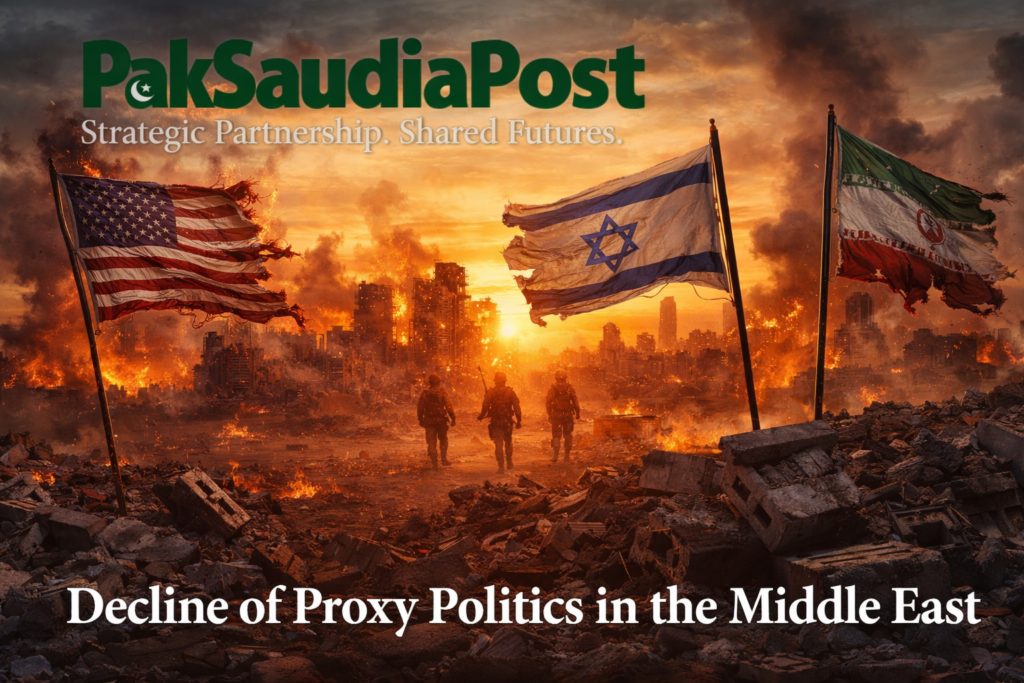
Decline of Proxy Politics in the Middle East

The Middle East has long been characterized by a complex web of proxy conflicts that have shaped the strategic, political, and economic contours of the region. For decades, states have leveraged non-state actors, ideological movements, and indirect interventions to project influence without engaging in direct confrontation. India, Israel, the United Arab Emirates, and other regional powers have historically utilized proxies to advance strategic objectives, secure territorial and ideological advantages, and influence outcomes in neighboring states. These arrangements, while often subtle, have produced enduring instability, recurring cycles of conflict, and pervasive mistrust among regional actors. However, emerging patterns of cooperation between Pakistan and Iran present a transformative potential to alter the trajectory of proxy politics, recalibrate regional power balances, and stabilize a region long accustomed to strategic competition.
Pakistan’s strategic engagement with Iran reflects a historical continuum grounded in geography, culture, and security imperatives. Both countries share extensive borders, overlapping cultural linkages, and mutual interests in regional stability. Historically, Pakistan has maintained a delicate balance between its relations with Gulf states, the United States, and Iran, positioning itself as a credible interlocutor capable of navigating competing interests. In the contemporary context, Pakistan’s rapprochement with Iran represents not merely a bilateral engagement but a strategic recalibration with implications for the broader Middle East. By cultivating trust, facilitating dialogue, and coordinating policy initiatives, Pakistan has the capacity to serve as a stabilizing agent capable of neutralizing proxy conflicts that have long defined regional rivalries.
The decline of proxy politics in the Middle East is contingent upon multiple intersecting factors. First, the operational viability of proxies has increasingly come under scrutiny. Non-state actors often lack the capacity to sustain influence independently, rely on external sponsorship, and face the growing effectiveness of regional security apparatuses. Second, regional actors have begun to recognize the limitations of indirect confrontation in achieving strategic objectives. The human, economic, and reputational costs of proxy engagement have become increasingly apparent, compelling states to seek alternative mechanisms of influence that are less destructive and more sustainable. Third, the emergence of multilateral frameworks and confidence-building initiatives provides avenues for de-escalation and conflict resolution. Pakistan, through its historical credibility and regional positioning, can play a central role in facilitating these frameworks, offering a neutral platform for dialogue and negotiation.
The role of Pakistan–Iran cooperation in this emerging dynamic is particularly significant. By aligning strategic objectives, enhancing communication channels, and coordinating policies related to security and diplomacy, both states can create conditions in which proxies are rendered ineffective or are reintegrated into formal political processes. This approach requires a nuanced understanding of regional fault lines, including sectarian dynamics, ideological affiliations, and the operational networks of proxy actors. Pakistan’s historical experience in managing internal security challenges, cross-border dynamics, and complex alliances provides it with a unique skill set that can be leveraged to mediate conflicts and neutralize destabilizing influences. Iran, for its part, benefits from Pakistan’s credibility among Gulf states and other regional actors, allowing it to engage in dialogue without triggering undue suspicion or confrontation.
The implications for regional stability are profound. If proxy conflicts are successfully diminished, states in West Asia can redirect resources from conflict management to development, governance, and institutional strengthening. Civilian populations, long affected by the indirect consequences of proxy wars, would experience improved security, economic opportunity, and social cohesion. For Gulf states such as the UAE and Saudi Arabia, the mitigation of proxy conflicts reduces the strategic pressure to invest disproportionately in military interventions or intelligence operations. It also enables more effective diplomatic engagement with neighboring powers, including Iran, Iraq, and Pakistan, facilitating coordinated approaches to regional security and development.
The concept of a symbolic “Treaty of Islamabad” exemplifies the potential of Pakistan to act as a strategic mediator in this context. Such a framework represents more than a bilateral agreement; it embodies a paradigm shift in which regional stability is achieved through cooperative engagement rather than unilateral dominance or coercive influence. The treaty would institutionalize mechanisms for conflict resolution, confidence building, and coordination among regional actors, offering a blueprint for managing disputes without reliance on proxies. By leveraging its historical neutrality, operational credibility, and diplomatic networks, Pakistan can anchor this framework, positioning itself as an indispensable facilitator in the emerging regional order.
Track-two diplomacy is a critical mechanism in reducing proxy conflicts. Informal networks, including think tanks, academic institutions, and private diplomatic initiatives, allow for dialogue between actors that may be constrained in official settings. Pakistan’s engagement in track-two channels can facilitate communication, mediate misunderstandings, and identify pathways for cooperation that are politically acceptable to all parties. These initiatives complement formal diplomatic engagement, creating a multilayered approach to conflict mitigation. By combining formal agreements with informal dialogue, Pakistan and Iran can reduce the operational space for proxies, encourage reintegration into political frameworks, and promote sustainable stability.
The decline of proxy politics also has implications for external actors engaged in West Asia. India, Israel, and other states that have historically relied on indirect methods of influence must recalibrate strategies in a context where proxies are less effective. This transition necessitates more direct engagement, investment in formal diplomacy, and participation in multilateral frameworks designed to manage regional disputes. Pakistan’s role in facilitating this transition is central, providing credible channels for negotiation, mediation, and coordination while ensuring that national interests are respected and regional stability is prioritized.
Economic, social, and political dimensions are intertwined in the effort to neutralize proxy conflicts. Proxy actors often thrive in environments characterized by weak governance, economic deprivation, and social fragmentation. By supporting initiatives that strengthen governance, enhance economic opportunity, and foster social cohesion, Pakistan and Iran can address the root causes that enable proxies to operate. This multidimensional approach requires sustained investment, strategic foresight, and coordination among regional and international partners. It also underscores the interdependence of security and development, demonstrating that the mitigation of proxy conflicts is inseparable from broader efforts to promote stability, prosperity, and cooperation in West Asia.
Policy makers in Pakistan, Iran, and Gulf states face a set of complex but manageable challenges in this endeavor. First, there is a need to institutionalize mechanisms for coordination and consultation that are resilient to political shifts. This includes formal agreements, joint committees, and regularized channels of communication. Second, track-two networks must be expanded and integrated into broader strategic planning to ensure that informal dialogue complements formal diplomacy effectively. Third, confidence-building measures must be prioritized to reduce mistrust, manage perceptions, and create an environment conducive to cooperation. Fourth, mechanisms for monitoring and evaluating progress are essential to ensure accountability, transparency, and adaptive management of initiatives aimed at reducing proxy conflicts.
The potential benefits of this approach extend beyond immediate security concerns. A reduction in proxy conflicts can enhance regional economic integration, facilitate trade and investment, and attract international support for development initiatives. Civil society, academic institutions, and the private sector stand to benefit from a more stable environment, creating conditions for long-term growth and social development. Furthermore, the credibility and influence of Pakistan as a regional mediator are reinforced, positioning it to play a central role in shaping West Asian security architectures and diplomatic networks. This strategic advantage translates into both immediate operational benefits and long-term geopolitical leverage.
The decline of proxy politics also reinforces the principle that sustainable regional stability requires cooperative engagement rather than coercion or unilateral action. States that invest in dialogue, trust-building, and multilateral mechanisms are better positioned to manage complex security challenges, navigate competition, and achieve strategic objectives without destabilizing the broader system. Pakistan’s engagement with Iran, combined with its historical relationships with Gulf states and other regional actors, exemplifies this principle. By acting as a credible intermediary, Pakistan demonstrates that influence is derived not solely from military power or economic wealth but from the capacity to facilitate constructive engagement, mediate disputes, and build resilient institutional frameworks.
In conclusion, the decline of proxy politics in the Middle East represents a transformative opportunity for regional stability, security, and prosperity. Emerging Pakistan–Iran cooperation provides a credible pathway for reducing the influence of proxies, managing conflict, and promoting multilateral engagement. By leveraging historical experience, operational capacity, and diplomatic networks, Pakistan can act as a stabilizing force, facilitating dialogue among Gulf states, regional powers, and external actors. The symbolic Treaty of Islamabad illustrates the potential for institutionalized frameworks that promote cooperation, trust, and sustainable peace. Strategic foresight, track-two diplomacy, and integrated policy initiatives are central to this effort. If successful, the neutralization of proxy conflicts will allow states to redirect resources toward development, strengthen governance, and enhance the security and well-being of civilian populations. Pakistan’s role as a mediator, facilitator, and trusted interlocutor underscores the evolving nature of influence in West Asia, demonstrating that sustainable power is rooted in cooperation, credibility, and the capacity to manage complexity rather than reliance on indirect confrontation.
The decline of proxy politics is not merely an operational shift but a conceptual transformation in the way regional power is exercised. It requires a recalibration of strategy, a commitment to dialogue, and an investment in multilateral frameworks that prioritize long-term stability over short-term advantage. Pakistan’s emerging role exemplifies how historical experience, strategic depth, and diplomatic credibility can be harnessed to address persistent challenges, offering a blueprint for a new era in West Asian security. By neutralizing proxies, facilitating cooperation, and promoting institutionalized engagement, Pakistan and Iran contribute not only to regional stability but also to a broader international environment in which West Asia can transition from cycles of conflict to a paradigm of constructive diplomacy, mutual interest, and sustainable peace.
A Public Service Message