Corridor From Bailouts To Industrial Partnership

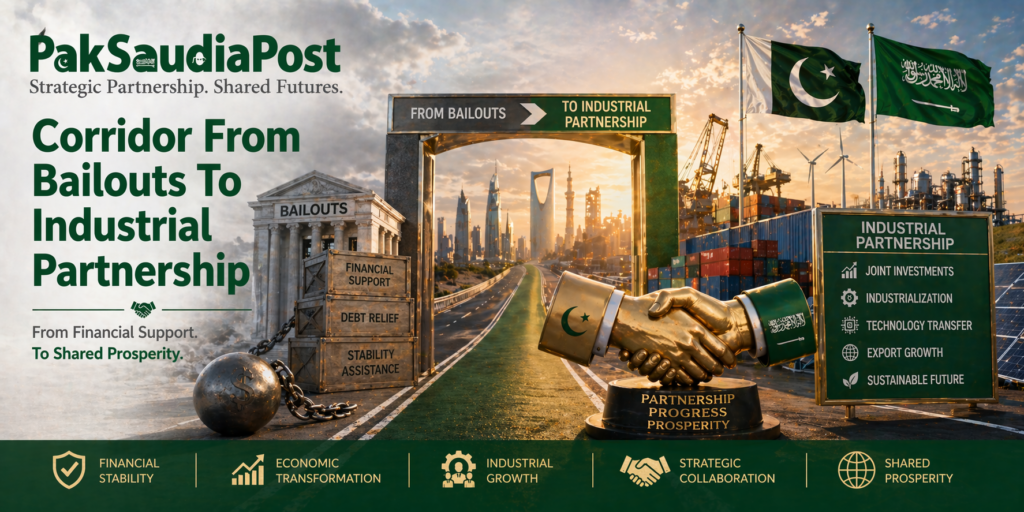
For much of the post Cold War period, Pakistan Saudi economic relations have operated through a familiar rhythm of episodic liquidity and political reassurance. When Pakistan’s external accounts deteriorate, Saudi Arabia has repeatedly stepped in with deposits, deferred oil payments, or short term financial support. These interventions have prevented crises from escalating into defaults and have stabilized market sentiment at critical moments. Yet they have also reinforced a structural pattern in which economic engagement is reactive rather than transformative.
The idea of a Riyadh Islamabad investment corridor emerges from a recognition that this cycle, while stabilizing, is insufficient for long term development. Bailouts address liquidity stress. They do not generate productive capacity. Deposits strengthen reserves. They do not build export industries. Oil financing smooths imports. It does not alter the underlying structure of dependence. A corridor model, if implemented seriously, would attempt to move the relationship from crisis management to co production of economic value.
This shift is not merely semantic. It requires institutional redesign. A corridor implies predictable flows of capital into defined sectors, governed by transparent rules, long term contracts, and measurable outcomes. It implies that investment is not episodic but programmed. It also implies that political relationships are translated into economic architecture rather than remaining at the level of diplomatic goodwill.
Saudi Arabia’s own transformation provides the strategic context for this possibility. Under its diversification agenda, the kingdom is seeking to deploy capital into sectors that will define post oil economic strength. These include mining, logistics, renewable energy, advanced manufacturing, tourism infrastructure, digital ecosystems, and food security. Sovereign capital is being increasingly managed through performance oriented frameworks, where returns, strategic positioning, and industrial capabilities matter more than symbolic presence.
Pakistan, on the other hand, offers a very different economic profile. It is a large population economy with significant labor supply, strategic geography, underutilized mineral resources, and an agricultural base that remains under modernized. It also has a growing services sector, particularly in information technology and remote digital work. However, its macroeconomic stability remains fragile, export base narrow, and institutional predictability uneven.
The corridor concept sits at the intersection of these two realities. It seeks to connect Saudi capital with Pakistani production potential in a structured way that reduces transactional uncertainty and increases developmental impact. But such alignment does not occur automatically. It must be designed.
Mining is often identified as the most immediate anchor for this transformation. Pakistan possesses significant deposits of copper, gold, and other industrial minerals, particularly in regions such as Balochistan. These resources require large scale capital investment, long gestation periods, and advanced extraction technology. Saudi sovereign investors have already shown interest in global mining assets as part of their diversification strategy. The logic is clear. Minerals are critical inputs into electrification, defense systems, and industrial manufacturing.
A corridor approach would require more than ownership stakes. It would require integrated value chains. This includes exploration partnerships, processing facilities within Pakistan, rail and port connectivity for export, and environmental governance frameworks that ensure sustainability. Without downstream development, mining risks becoming extractive rather than developmental.
Agriculture offers a second pillar. Pakistan’s agricultural sector remains dominated by low productivity methods, inefficient water usage, and weak supply chain integration. Yet the country has the potential to become a significant exporter of processed food, dairy products, halal certified goods, and high value horticulture. Saudi Arabia’s food security concerns make agricultural investment strategically attractive.
A corridor model in agriculture would focus on cold chain logistics, seed technology, precision irrigation, storage infrastructure, and export branding. It would move Pakistan away from commodity based farming toward value added agro industry. Saudi capital, if directed through structured investment vehicles, could accelerate this transition while securing stable food supply linkages.
Energy remains a third critical domain. Pakistan’s energy sector is characterized by high import dependence, circular debt, transmission inefficiencies, and rising demand. Saudi Arabia, while traditionally an oil exporter, is simultaneously investing in solar, hydrogen, and petrochemical upgrading. Joint ventures in renewable energy generation, grid modernization, and fuel efficiency could serve both countries.
The corridor logic here is not simply about replacing imports but about restructuring the energy mix. Distributed solar systems, industrial efficiency upgrades, and localized manufacturing of energy components could reduce external vulnerability. Saudi participation would bring capital and technical expertise. Pakistan would provide scale and demand.
Logistics and infrastructure represent a fourth dimension. Pakistan’s geographic position places it near major maritime routes and at the crossroads of South and Central Asia. However, its internal logistics remain constrained by bottlenecks in rail freight, port efficiency, customs clearance, and road connectivity. Saudi Arabia’s expanding interest in global logistics networks creates potential alignment.
A corridor in this domain would require modernization of ports, development of special economic zones, integration of digital customs systems, and improvement in inland freight corridors. The objective would be to reduce friction in moving goods from production sites to global markets. Infrastructure investment would therefore become a catalyst for trade expansion rather than an isolated construction activity.
Digital economy cooperation may appear less traditional but could prove equally significant. Saudi Arabia’s push into artificial intelligence, cloud infrastructure, fintech, and smart governance systems aligns with Pakistan’s large pool of young digital labor. A structured corridor could include joint venture technology parks, outsourcing hubs, data infrastructure investment, and startup funding mechanisms.
This would require regulatory harmonization, intellectual property protection, and stable digital payment systems. If implemented effectively, it could position Pakistan as a regional digital services hub linked to Gulf capital and global clients.
Despite these opportunities, the corridor concept faces substantial constraints. The first is institutional fragmentation within Pakistan. Investment decisions are often dispersed across multiple agencies with overlapping authority. Regulatory unpredictability discourages long term capital commitments. Without institutional coherence, even well designed projects face execution delays.
The second constraint is policy discontinuity. Frequent shifts in economic direction, taxation structures, and incentive regimes create uncertainty for investors. Long term corridors require long term policy stability, which remains challenging in politically volatile environments.
The third constraint is risk perception. Pakistan is often viewed through the lens of macroeconomic instability, security concerns, and currency volatility. While such perceptions do not fully reflect economic potential, they influence capital allocation decisions in global markets. Overcoming this requires sustained demonstration of reliability rather than rhetorical reassurance.
The fourth constraint is absorptive capacity. Large inflows of capital require corresponding administrative and technical capacity to implement projects effectively. Without skilled project management, infrastructure delivery systems, and local supplier integration, investment can underperform.
Saudi Arabia also faces its own considerations. As a sovereign investor, it must ensure that capital deployed abroad aligns with domestic priorities and delivers adequate returns. It must also manage geopolitical exposure and reputational risk. Therefore, even friendly partnerships must meet professional investment standards.
The corridor idea is therefore not a political slogan. It is an economic engineering challenge. It requires translating diplomatic goodwill into financial instruments, project pipelines, governance frameworks, and institutional coordination mechanisms.
If successful, the benefits could be significant. Pakistan would gain access to stable long term capital, technology transfer, export diversification, and employment generation. Saudi Arabia would gain strategic economic footholds, diversified asset exposure, and strengthened regional connectivity. The relationship would move from consumption of support to production of value.
If unsuccessful, the status quo will persist. Pakistan will continue to rely on episodic financial support during crises. Saudi Arabia will continue to provide selective assistance without deep structural engagement. The relationship will remain stable but underutilized.
The global context adds urgency. Capital is becoming more selective, competition for sovereign investment is intensifying, and geopolitical fragmentation is reshaping trade and finance. Countries that fail to build structured investment corridors risk marginalization. Those that succeed will secure long term developmental partnerships.
The choice before Pakistan is therefore not whether Saudi capital will arrive. It already does, in various forms. The choice is whether that capital will remain episodic or become structural. Whether it will stabilize crises or transform economies.
A corridor from Riyadh to Islamabad is not yet a reality. It is a possibility. Converting possibility into infrastructure, contracts, and production will determine whether the next chapter of this relationship is written in bailouts or in industries.
A Public Service Message