

Positioning Pakistan and Saudi Arabia in Multipolar Equilibrium Dynamics

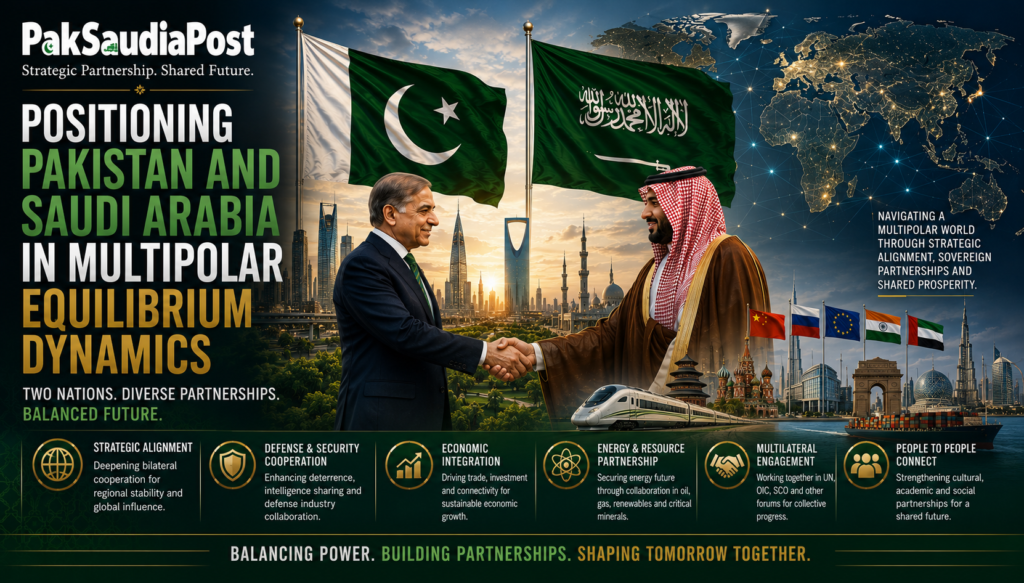
The international system is undergoing a structural reordering in which no single pole can impose durable hierarchy across economic, technological, and security domains. Instead, overlapping spheres of influence are emerging, shaped by transactional alignments, sector specific partnerships, and rapidly shifting diplomatic calibrations. For states such as Pakistan and Saudi Arabia, this environment does not offer the stability of rigid blocs nor the predictability of Cold War style binaries. It demands a more granular diplomacy in which strategic value is derived from flexibility, redundancy, and the ability to operate across competing networks without entrapment.
For both Islamabad and Riyadh, the central question is no longer alignment with a dominant patron but the construction of diplomatic portfolios that can absorb shocks generated by intensifying competition among the United States, China, and a widening set of regional actors with expanding operational reach. The practical reality is that neither Pakistan nor Saudi Arabia can afford exclusivity in external partnerships. The cost of over commitment to any single axis is rising, not only in financial terms but in terms of autonomy over domestic reform agendas and external policy discretion.
In this context, calibrated multi alignment emerges less as a theoretical construct and more as an administrative necessity. It refers not to ideological neutrality but to structured engagement with multiple power centers, each serving distinct functional domains. Security cooperation, trade financing, digital infrastructure, energy transition, and industrial investment are increasingly decoupled fields. A doctrine of segmented engagement allows states to diversify dependencies while avoiding strategic overexposure in any single relationship.
For Saudi Arabia, the recalibration is particularly visible in its simultaneous deepening of ties with China through infrastructure and energy cooperation, while maintaining long standing defence and financial linkages with the United States. The diversification strategy embedded in Vision 2030 reflects an implicit recognition that economic transformation requires multiple external anchors rather than reliance on a single guarantor of security or liquidity. Yet this diversification also introduces friction, as competing technological standards, data governance regimes, and financial compliance systems increasingly overlap within the same national space.
Pakistan’s position is structurally more constrained but analytically parallel. Its economic stabilization efforts remain linked to multilateral financial institutions and bilateral partners with divergent conditionalities. At the same time, its strategic partnership with China through the China Pakistan Economic Corridor introduces a long-term infrastructural dependency that must be balanced against the imperatives of macroeconomic reform and engagement with Western financial systems. The challenge for Pakistan is not merely diversification but synchronization of competing external economic logics within a fragile domestic fiscal architecture.
A shared Pakistan Saudi strategic horizon emerges in the domain of energy security and labor mobility. Saudi Arabia’s transition away from hydrocarbon dependency creates demand for investment outlets and workforce partnerships that can be partially met by Pakistani human capital and industrial aspirations. However, converting this complementarity into structural advantage requires institutional depth rather than episodic agreements. Without such institutionalization, cooperation risks remaining cyclical, vulnerable to external shocks and domestic political fluctuations.
The broader multipolar environment complicates this equation further. The United States remains a central security provider in parts of the Gulf system while simultaneously recalibrating its global commitments. China expands its economic footprint through infrastructure financing, digital ecosystems, and industrial relocation strategies, yet remains cautious in assuming overt security responsibilities. Middle powers such as India, Türkiye, and Iran pursue their own layered strategies, creating a dense field of overlapping alignments that reduce predictability in regional calculations.
Within this setting, Pakistan and Saudi Arabia face a shared constraint: the erosion of policy insulation. Economic decisions are increasingly inseparable from geopolitical implications, while security partnerships carry direct economic consequences. The distinction between strategic and economic policy is collapsing, requiring integrated state capacity that can interpret external signals across multiple domains simultaneously.
A calibrated multi alignment doctrine, if operationalized effectively, would require three institutional shifts. First, the creation of cross ministerial coordination mechanisms capable of aligning foreign policy, trade policy, and security cooperation under a unified analytical framework. Fragmentation of decision-making increases vulnerability to external pressure, particularly in environments where partners operate through issue specific leverage rather than comprehensive alliances.
Second, both states would need to invest in predictive diplomatic analytics. This involves the systematic mapping of partner incentives, policy trajectories, and regulatory shifts across multiple capitals. The objective is not prediction in a deterministic sense but the reduction of surprise in policy environments characterized by rapid reconfiguration. For Pakistan, this is particularly relevant in managing simultaneous engagements with Beijing, Washington, Gulf capitals, and multilateral institutions. For Saudi Arabia, it is critical in balancing investment flows, defence procurement, and technology transfer regimes across competing jurisdictions.
Third, multi alignment requires the cultivation of issue-based coalitions beyond traditional geographic groupings. Energy transition financing, food security logistics, climate adaptation infrastructure, and digital governance standards are emerging as domains where alignment is determined less by ideology and more by functional convergence. Pakistan and Saudi Arabia can jointly position themselves within such coalitions, particularly within frameworks linked to the Gulf Cooperation Council and broader Islamic financial architecture, while also engaging selectively with platforms such as BRICS where economic pragmatism aligns with development needs.
However, multi alignment is not without structural risk. The most significant challenge is coherence. As states expand the number of external partnerships, the internal capacity to manage policy consistency becomes strained. Divergent regulatory expectations from different partners can generate institutional contradictions, particularly in areas such as data governance, financial transparency, and defence procurement standards. Without harmonization mechanisms, diversification can evolve into fragmentation at the policy execution level.
There is also the risk of perception asymmetry. External partners may interpret multi alignment as strategic ambiguity, leading to reduced trust in long term commitments. This is particularly relevant in defence and intelligence cooperation, where predictability is often valued over flexibility. Pakistan and Saudi Arabia must therefore calibrate communication strategies that distinguish diversification from disengagement, and flexibility from unreliability.
At the same time, the current environment offers a rare opening. The erosion of unipolar certainty has created demand for intermediary states capable of bridging divergent systems. Pakistan and Saudi Arabia, by virtue of their geographic positioning, economic complementarities, and historical relationships across multiple blocs, are structurally positioned to perform such intermediary functions. This requires a shift from reactive diplomacy to agenda shaping participation in global economic and governance discussions.
In practical terms, this means moving beyond bilateral transnationalism toward coauthored frameworks in energy investment, infrastructure financing, and labor market integration. It also implies joint participation in setting standards for emerging sectors such as artificial intelligence governance, climate finance architecture, and digital trade regulation. The objective is not to replace existing institutions but to incrementally influence their operational logic through coordinated participation.
Ultimately, calibrated multi alignment is less a doctrine than an operating system for states navigating a dense and competitive international environment. For Pakistan and Saudi Arabia, its success will depend on institutional discipline, analytical sophistication, and the ability to sustain policy coherence across multiple external engagements without dilution of strategic autonomy. The alternative is not alignment failure but incremental marginalization within systems where rules are increasingly written by those who combine scale with coordination.
If implemented with precision, this approach could reposition both states not as passive respondents to global shifts but as structured participants in shaping the conditions under which those shifts unfold.
A Public Service Message


