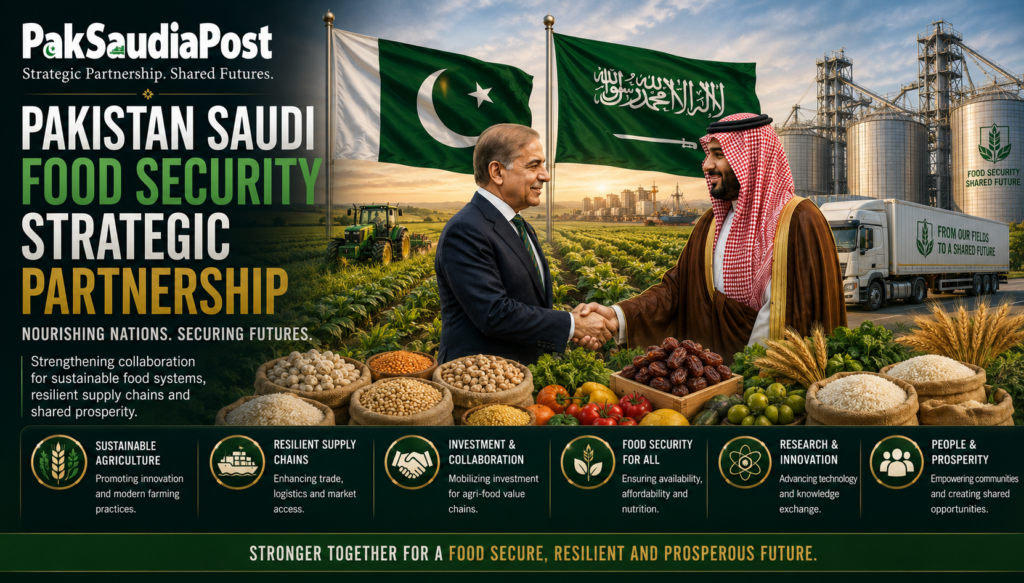
Pakistan Saudi Food Security Strategic Partnership

The question of food security is gradually moving from a technical agricultural concern into a core strategic variable shaping bilateral relations between Pakistan and Saudi Arabia. What was once treated as a trade linkage in wheat, rice, meat, and livestock products is now being reframed within a broader calculus of supply chain resilience, climate stress adaptation, and long horizon demographic planning. In this emerging configuration, food is no longer simply a commodity. It is a strategic asset embedded in national security planning and macroeconomic stability frameworks.
Saudi Arabia’s food import dependency is structurally entrenched due to arid geography, limited arable land, and water scarcity constraints. Despite advances in controlled environment agriculture and overseas farmland investments, domestic production cannot fully offset import reliance. Pakistan, by contrast, possesses significant agricultural endowment, including fertile land, diverse agro climatic zones, and a large rural labor base. Yet its agricultural system is constrained by low productivity, inefficient water usage, weak storage infrastructure, and fragmented value chains. This structural asymmetry creates a natural but underdeveloped complementarity between the two economies.
The central question is whether food security can evolve into the defining pillar of bilateral engagement over the next decade, surpassing traditional labor remittance flows and episodic commodity trade. The answer depends not only on trade volumes but on whether both states are willing to redesign the architecture of agricultural production, logistics, and procurement into an integrated system of shared resilience.
Climate volatility is accelerating this strategic recalibration. Erratic monsoons, rising temperatures, water table depletion, and soil degradation are increasingly affecting agricultural output in South Asia. At the same time, global supply chains have become more vulnerable to geopolitical disruptions, shipping route instability, and export restrictions by major producing states. These pressures elevate the importance of secure, predictable, and politically stable food sourcing arrangements. In this environment, long term bilateral agricultural partnerships become more valuable than spot market procurement.
For Saudi Arabia, securing diversified and reliable food supply corridors is now part of broader national planning under its economic transformation agenda. For Pakistan, integrating into a stable demand framework offers an opportunity to modernize its agricultural base, stabilize rural incomes, and attract technology transfer in precision agriculture, irrigation efficiency, and post-harvest processing. The convergence is therefore not only commercial but structural.
However, the transformation from trade to strategic food partnership requires moving beyond conventional import export arrangements. It necessitates the creation of integrated agro industrial ecosystems. This would involve Saudi investment in large scale cold chain infrastructure, grain storage facilities, logistics corridors, and food processing zones within Pakistan. In return, Pakistan would align production systems with quality standards, traceability mechanisms, and contractual supply commitments that ensure predictability for Saudi markets.
A critical area of intervention lies in water efficiency and irrigation modernization. Pakistan’s agriculture consumes a disproportionate share of freshwater resources through traditional flood irrigation methods. Transitioning toward drip irrigation, sensor-based soil monitoring, and satellite guided crop planning could significantly enhance yield per unit of water. Saudi Arabia’s experience in water scarce agriculture, hydroponic systems, and controlled environment farming can provide technical inputs, though adaptation to Pakistani agro ecological conditions would require localized innovation rather than direct replication.
Livestock and dairy systems represent another underutilized pillar of cooperation. Pakistan possesses one of the largest livestock populations in the region, yet productivity remains low due to weak breeding programs, inadequate veterinary infrastructure, and poor feed quality. Saudi investment in feedlot systems, genetic improvement programs, and meat processing facilities could transform this sector into a high value export channel. This would also allow Saudi Arabia to diversify protein supply sources while ensuring halal compliance and traceability standards aligned with its regulatory framework.
Food processing and value addition are perhaps the most critical missing links in Pakistan’s agricultural economy. A significant proportion of agricultural output is lost post-harvest due to inadequate storage, transportation inefficiencies, and lack of processing capacity. Joint ventures in agro processing zones could reduce these losses while simultaneously creating export-oriented food industries. Saudi Arabia’s retail and hospitality sectors could serve as anchor demand centers for such processed products, ensuring stable offtake agreements.
Institutionally, the success of a food security partnership depends on the creation of long-term procurement frameworks rather than ad hoc trade agreements. Structured purchasing contracts, strategic grain reserves coordination, and emergency food supply protocols could be established between the two states. These mechanisms would reduce exposure to global price volatility while ensuring continuity of supply during crisis periods.
Digital transformation of agriculture is another emerging frontier. Data driven farming systems, blockchain based supply chain tracking, and predictive yield analytics can significantly improve efficiency and transparency. Pakistan’s growing information technology sector could be integrated into agricultural modernization programs, creating hybrid agro digital ecosystems. Saudi investment in agri tech platforms could accelerate this transition while ensuring interoperability with global standards.
Yet, structural constraints remain significant. Pakistan’s agricultural sector is heavily influenced by fragmented land ownership patterns, water governance challenges, and inconsistent policy enforcement at provincial levels. Without institutional reform, external investment alone cannot generate systemic transformation. Similarly, Saudi Arabia’s procurement strategies must account for variability in production quality and logistical reliability, requiring robust monitoring and risk mitigation frameworks.
This is where governance design becomes central. A bilateral Food Security and Agricultural Transformation Authority could be established to coordinate long term strategy, oversee joint investments, and monitor implementation. Such an institution would need technical autonomy, insulation from short term political cycles, and direct reporting mechanisms to high level economic councils in both countries.
Another dimension involves human capital development. Agricultural modernization requires skilled labor in agronomy, food engineering, logistics management, and data analytics. Joint training programs, agricultural research exchanges, and university level collaboration could build a new generation of professionals capable of operating within integrated food systems. This would ensure that cooperation is not limited to capital flows but extends into knowledge production.
Risk diversification is also essential. Overdependence on a single supply corridor exposes both sides to systemic shocks. Therefore, the partnership should be structured as part of a broader multi sourcing strategy rather than exclusive dependency. This would ensure resilience while still deepening bilateral integration.
The evolution of food security into a strategic bilateral pillar reflects broader changes in global economic thinking. Food is increasingly understood as part of critical infrastructure, alongside energy, data, and logistics. In this context, the relationship between Pakistan and Saudi Arabia has the potential to shift from conventional trade dependency to a more sophisticated model of co-managed food systems.
Whether this potential is realized will depend on institutional imagination, execution discipline, and long-term policy consistency. If successful, the partnership could redefine regional agricultural economics and establish a durable model of food resilience cooperation. If not, it will remain confined to periodic commodity exchanges vulnerable to external shocks and internal inefficiencies.
The next decade will determine whether food security becomes a transactional footnote or a foundational pillar of bilateral strategic architecture.
A Public Service Message