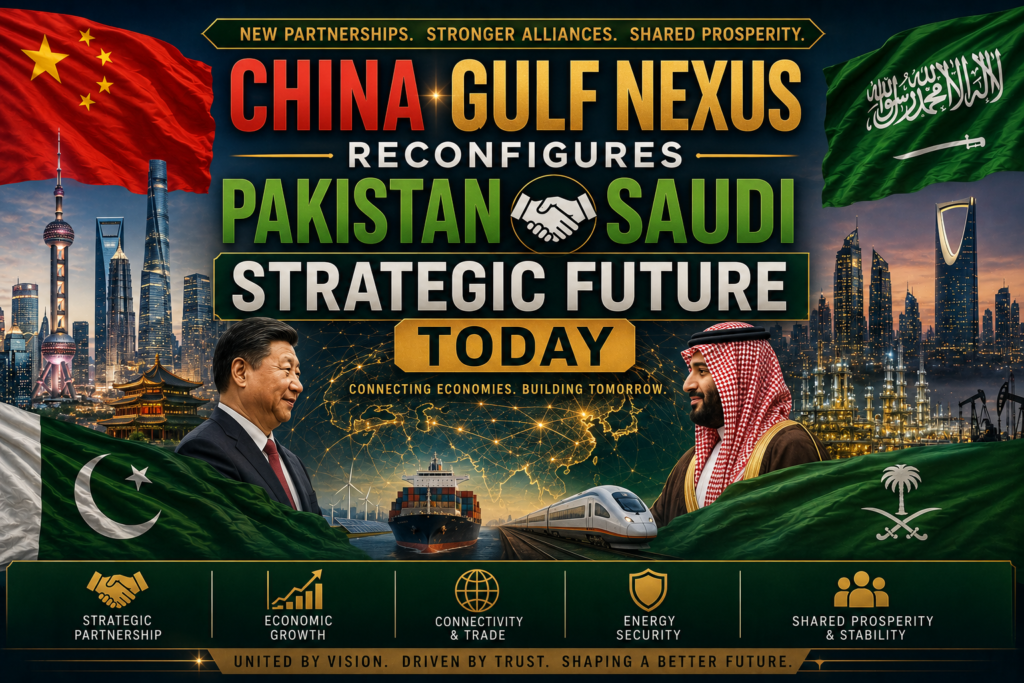
China Gulf Nexus Reconfigures Pakistan Saudi Strategic Future Today

BY SHAFQAT ALI QURESHI
The expanding role of China in the evolving strategic matrix between Pakistan and Saudi Arabia represents one of the most consequential yet structurally understated transformations in contemporary global geopolitics. Unlike traditional great power interventions that operate through overt military alliances or ideological projections, China’s presence is embedded in a more subtle architecture of economic interdependence, infrastructural integration, and transactional diplomacy. It is precisely this low visibility yet high impact modality that renders Beijing’s role both stabilising and systemically transformative.
Within Pakistan Saudi Arabia relations, China is no longer an external observer or peripheral investor, but an increasingly central node in the connective tissue of bilateral and regional interaction. The China Pakistan Economic Corridor has already repositioned Pakistan within a broader Eurasian connectivity framework, linking it structurally to Chinese industrial supply chains, energy investments, and logistical ambitions. Saudi Arabia, meanwhile, has deepened its engagement with Chinese capital markets, energy partnerships, and industrial diversification strategies under its long term economic transformation agenda. The convergence of these parallel trajectories has created an implicit triangular configuration in which China functions as a silent integrator.
This triangularity does not operate as a formal alliance structure. Instead, it functions through overlapping economic dependencies that reduce volatility and increase predictability across otherwise fragmented geopolitical relationships. In this sense, China’s influence is not exercised through command but through calibration. The more deeply Pakistan and Saudi Arabia become embedded in Chinese linked economic ecosystems, the more their bilateral and regional interactions are indirectly stabilised by shared external dependencies.
In Pakistan’s case, Chinese involvement has become foundational to infrastructural development, energy security, and industrial upgrading. From transport corridors to power generation projects, Chinese capital and technical expertise have redefined the parameters of Pakistan’s developmental state. This has had a dual effect. On one hand, it has strengthened Pakistan’s long term connectivity potential within the broader Eurasian space. On the other hand, it has increased structural dependence on a single external partner, thereby narrowing the margin of strategic autonomy in certain policy domains.
Saudi Arabia’s engagement with China operates on a different but complementary logic. As the Kingdom seeks to diversify its economic base away from hydrocarbon dependence, China offers both a vast investment destination and a critical energy market. The deepening energy relationship between Riyadh and Beijing is not merely commercial but increasingly strategic in nature, shaping global oil pricing dynamics, investment flows, and industrial cooperation frameworks. This evolving interdependence has introduced a new layer of complexity into Saudi Arabia’s global positioning, allowing it to diversify away from exclusive reliance on traditional Western partnerships.
Within this emerging structure, China does not act as a mediator between Pakistan and Saudi Arabia in a formal diplomatic sense. Rather, it operates as a structural enabler of convergence by embedding both states within shared economic and infrastructural ecosystems. This shared embedding reduces the probability of extreme divergence between Islamabad and Riyadh, not through political alignment, but through economic synchronisation.
The concept of China as a silent strategic stabiliser emerges from this dynamic. Unlike traditional guarantor states that enforce stability through security commitments or alliance frameworks, China’s stabilising influence is derived from the cost of disruption. When multiple regional actors are simultaneously integrated into Chinese financed infrastructure, energy systems, and industrial supply chains, instability becomes economically self-limiting. Disruption in one node generates systemic inefficiencies across interconnected networks, thereby incentivising restraint.
However, this form of stability is inherently conditional and non-normative. It does not eliminate conflict potential, nor does it resolve underlying political divergences. Instead, it raises the economic threshold for escalation. Stability becomes a byproduct of interdependence rather than a consequence of political reconciliation. This distinction is critical for understanding the limits of China’s role in the Pakistan Saudi strategic environment.
The Belt and Road architecture further amplifies this dynamic by embedding Pakistan within overland connectivity routes linking China to the Arabian Sea, while simultaneously extending maritime and industrial cooperation with Gulf economies. Saudi Arabia’s growing participation in Chinese industrial parks, renewable energy projects, and technological partnerships further extends this network into the Arabian Peninsula. The result is a multi-layered connectivity grid that links South Asia, the Gulf, and East Asia within a shared but uneven economic space.
This configuration has significant implications for traditional external actors, particularly Western powers whose historical influence in both Pakistan and Saudi Arabia has been mediated through security guarantees, financial systems, and institutional partnerships. China’s rise does not fully displace these structures, but it introduces parallel systems of economic engagement that reduce exclusivity and increase strategic optionality for regional states. The resulting environment is neither bipolar nor unipolar, but increasingly polycentric.
For Pakistan, this polycentricity presents both opportunity and constraint. On one hand, alignment with Chinese infrastructure and investment flows enhances its connectivity potential and provides alternatives to traditional Western financial dependence. On the other hand, over concentration within a single external ecosystem risk reducing strategic flexibility, particularly in moments of global financial or geopolitical stress. The challenge lies in converting connectivity into diversification rather than substitution.
Saudi Arabia faces a different but related challenge. Its deepening engagement with China must be balanced against its longstanding security relationships and financial integrations with Western economies. The Kingdom’s strategic objective is not replacement but recalibration, ensuring that Chinese partnership enhances rather than constrains its global positioning. This balancing act requires sophisticated diplomatic management, particularly as global economic fragmentation increases.
Within the Pakistan Saudi bilateral context, China’s role introduces a form of indirect triangulation that reduces friction while increasing structural complexity. Projects involving energy cooperation, infrastructure development, and industrial collaboration increasingly operate within frameworks that include Chinese participation either directly or indirectly. This triangulation creates shared reference points that can facilitate coordination but also introduces new layers of dependency.
The question of whether China is becoming a guarantor of regional stability must therefore be answered with precision rather than abstraction. Beijing does not provide security guarantees in the traditional sense, nor does it intervene militarily to enforce order. Instead, it constructs what can be described as infrastructural deterrence, where the density of economic interdependence itself functions as a stabilising force. Stability emerges from the rational calculation that disruption carries disproportionate economic cost across multiple interconnected systems.
Yet this model has inherent limitations. It is vulnerable to geopolitical shocks, financial recalibrations, and domestic political shifts within participating states. Moreover, it does not address ideological, sectarian, or strategic divergences that exist independently of economic interdependence. In this sense, China’s stabilising role is necessary but not sufficient for comprehensive regional order.
The long term trajectory of Pakistan Saudi China relations will likely be shaped by the interplay between connectivity and sovereignty. As infrastructure deepens and economic integration expands, questions of policy autonomy, strategic flexibility, and external dependence will become increasingly salient. States will need to navigate the tension between the benefits of integration and the risks of over exposure to external systems.
Policy implications for Pakistan are particularly significant. It must pursue a calibrated strategy of engagement that maximises infrastructural and economic gains from Chinese partnership while simultaneously preserving diplomatic diversification across multiple global actors. This requires strengthening domestic institutional capacity, enhancing financial resilience, and developing a coherent long term economic strategy that is not solely externally driven.
For Saudi Arabia, the imperative is to integrate Chinese engagement within a broader diversification framework that maintains balance across multiple global partnerships. This includes ensuring that economic cooperation with China complements rather than displaces existing strategic relationships. It also involves leveraging Chinese participation to accelerate domestic transformation without compromising external strategic autonomy.
In the broader regional context, China’s role is best understood not as a replacement for traditional powers, but as an additional layer in an increasingly complex geopolitical architecture. It adds density to economic networks, increases interdependence among regional actors, and introduces new forms of stability through structural entanglement. However, it does not resolve underlying political fragmentation, nor does it create a unified regional order.
Ultimately, the China Gulf Pakistan nexus represents a transition from alliance-based geopolitics to network-based interdependence. Power is no longer exercised primarily through hierarchical command structures, but through embedded connectivity systems that shape incentives and constrain behaviour. Within this system, Pakistan and Saudi Arabia are not passive recipients of external influence, but active participants in a rapidly evolving architecture where strategic outcomes are increasingly determined by the management of interdependence rather than its avoidance.
A Public Service Message